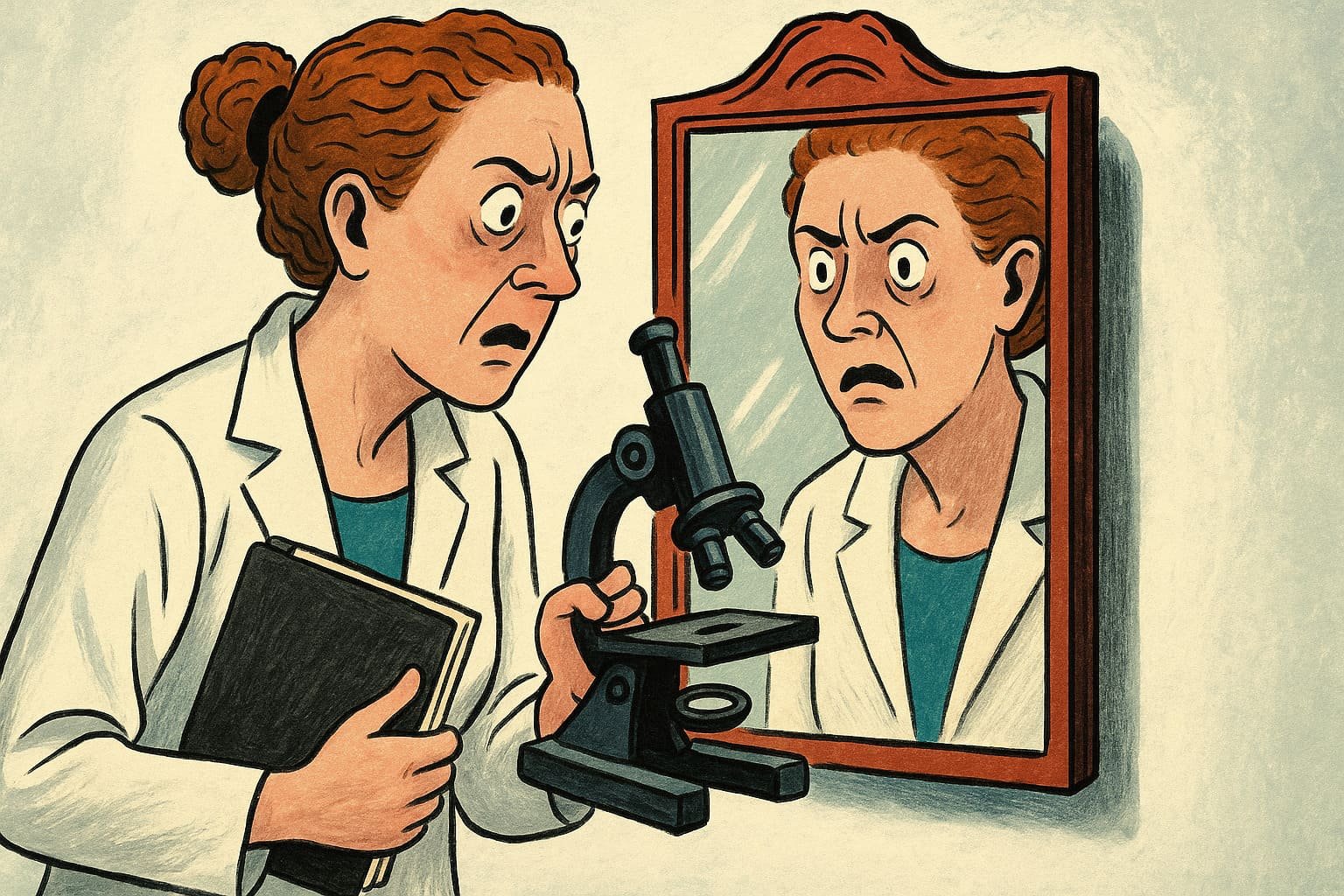
The lights flicker overhead in a spotless research lab, silent except for the hum of machines tracking a hundred hidden variables. Here, the world’s brightest minds gather, each one convinced they chase truth, armed with formulas and peer review. Yet beneath the cool confidence, every data point glimmers with a secret shadow: the silent curve of human bias. A mirror stands at the center of the room—unpolished, raw, impossible to avoid. Suddenly, the air thickens, the screens blur, and every researcher finds themselves trapped in a hall of reflections. Not a single soul is immune, not even the legend in the corner, who built a reputation on “objectivity.” The room swirls with anxiety and awe as discovery morphs into self-reckoning. Here, science collides with the uncomfortable, hilarious, sometimes humiliating fact that the human brain is wired to distort the very truth it longs to uncover. In this surreal theater of ambition and intellect, each person faces the most unforgiving test: seeing their own hands on the scale.
Peering closer, the mirrors fracture into a kaleidoscope of stories. The finance PhD whose favorite model can’t predict her own spending. The marketing executive who tests “unbiased” ads and realizes the click-through rates echo his personal taste in sneakers. The political scientist who weaves complicated surveys only to discover that the questions betray her own leanings. The realization strikes with the force of a punchline in a cosmic joke: research is as much a performance of self as it is a pursuit of certainty. Industry titans parade their latest findings at TEDx, only to get roasted by a twelve-year-old on TikTok with sharper questions. At the exact moment the curtain rises on yet another “breakthrough,” a janitor sweeping the hallway wonders aloud why no one ever asks who picks the questions in the first place. The entire scene feels like an episode of “Black Mirror” rewritten by Charlie Chaplin.
Meanwhile, outside the sanitized walls, ordinary people crave answers: “Does that study on happiness really mean anything to me?” The answer comes not from another abstract equation, but from the confession of a sleep-deprived scientist in a coffee-stained lab coat. She admits that every so-called “neutral” experiment carries the fingerprint of its creator—desire, history, blind spot, pride. The bravest scholars acknowledge their fallibility and keep going anyway, seeking wisdom in the very flaws that make research real. With every honest admission, the mirror cracks just enough to let in a shaft of light.
Curiosity pulls at every corner of the human experience. People want to know why AI makes mistakes, why polls miss the mark, why “evidence” keeps shifting. The answer lies in the ghostly fingerprints smudged across every dataset, every algorithm, every narrative told in boardrooms and blogs. This is not the story you’ll hear at keynote speeches or in faculty lounges. It is messier, more thrilling, and infinitely more human—a story about the shock, shame, and secret liberation that comes when research reveals not just the world, but the researcher’s own soul.
In the next five acts, prepare to walk through shattered glass, stolen ideas, and boardroom betrayals. You will meet characters who lost millions to their own assumptions and those who built movements by exposing the elegant lie at the heart of certainty. Each page is a challenge to your comfort zone, a riddle, and maybe—just maybe—a cracked-open window to what it means to finally see yourself.
Quick Notes
- Everyone’s Got Skin in the Game: Even Nobel Prize winners can’t dodge their own perspective. The biggest breakthroughs often start with a confession of personal bias, not a boast of objectivity.
- The Data’s Always Sweating: Every chart, graph, and dashboard comes drenched in human fingerprints. If you think your research is immune, check again—especially when it “proves” what you wanted to see.
- Algorithms Lie with a Straight Face: The hottest AI startups pitch “unbiased” technology, but every line of code holds the secret sauce of the developer’s history, hang-ups, and hope for a bonus.
- Confession Fuels Innovation: Movements that change the world often start with someone admitting, “I was wrong.” The greatest leaders aren’t the ones who claim purity—they’re the ones who clean up their own mess.
- You’re Starring in the Show: Every time you share an “amazing study,” retweet a chart, or argue in a meeting, your own worldview is on display. The fastest way to level up? Stop pretending you don’t have a bias. Start learning from it.
Smoke and Mirrors—The Comedy of Certainty
Bold declarations echo across the conference floor, each expert certain their findings hold the key to human behavior. Crowds hang on every word, eager for the next secret shortcut to happiness, productivity, or profit. Beneath the applause, doubts flicker in private: who decided which questions were worth asking, and who got left out? Professor Anita Ray, a behavioral economist, tells the story of her “fail-proof” savings app that tanked in the real world. After months of research, her team realized their own preferences shaped every design choice, right down to the app’s cheerful blue—a color they later learned evoked sadness for half their users.
Industry worships at the altar of objectivity, but the gods are often tricksters. Silicon Valley’s favorite founders declare their AI can spot fraud “without bias,” only for the press to uncover that the tool confuses rural addresses for criminal intent. The old joke lands hard: “Data never lies, but people with data do.” Countless studies on leadership, wellness, or innovation end up mirroring the beliefs of the company CEO, a phenomenon seen everywhere from Wall Street to wellness retreats. A viral TikTok by analyst Kai Woods pokes fun at research lingo by showing how you can “prove” any point if you tweak the filters just enough.
Historical examples underscore the pattern. For years, medical trials assumed the “average” patient was a 70-kilogram white male, leaving generations of women, minorities, and elders outside the official definition of “normal.” Each attempt to fix the bias opens new blind spots, a lesson both humbling and hilarious. Even corporate giants like PepsiCo and Procter & Gamble have faced public backlash after internal studies missed entire segments of their market due to groupthink. At the end of every report, the question lingers: was it the data, or the mirror that needed cleaning?
Contrarians seize these moments, flipping the script for fun and profit. Maverick researcher Dr. Samuel Gold writes bestselling books mocking the obsession with “evidence-based everything,” pointing out that most so-called breakthroughs are just old ideas with new logos. He recounts the story of a pharmaceutical CEO who was shocked to discover that his most loyal customers were buying the company’s flagship pill for off-label reasons no one at headquarters had considered. It turns out the real insights live in the stories we never think to ask.
The comedy of certainty is not a flaw—it’s the starting point for wisdom. When teams admit their own limitations, the entire culture shifts from ego to inquiry. Failure becomes fuel, and mistakes open doors. Research turns from a rigid script into a living conversation, messy but magnetic, full of moments that make you laugh, cringe, and maybe even change your mind.
Behind the Algorithm—Ghosts in the Machine
The hottest trend in research and business right now is artificial intelligence: smart, efficient, and—supposedly—neutral. Boardrooms fill with excitement as executives watch demos of software that predicts sales, prevents fraud, or even writes job descriptions. Yet the curtain always falls the same way: at some point, someone notices the pattern of mistakes. The facial recognition system that fails to identify dark-skinned faces, the hiring algorithm that quietly prefers people named “Greg.” Suddenly, the fantasy of objectivity unravels.
A quiet engineer at a major tech firm once revealed that her machine learning model started flagging resumes from a certain neighborhood as “unreliable.” No one understood why, until a former HR intern confessed that during the training period, recruiters had marked dozens of qualified candidates from that zip code as “not a fit”—not because of talent, but because the subway line was always late. Years of innovation, and the system had inherited a bias from someone’s frustration with morning commutes.
Famous names fill the headlines: when Apple’s credit card algorithm gave women lower limits than men, outrage erupted, and the company had to apologize. Google faced lawsuits when its image search labeled people of color as animals. These moments reveal the uneasy truth: code is just human judgment written in a language that hides its accent. The tech world loves to promise “fairness by design,” but as ethicist Joy Buolamwini has shown, every line of code starts with a choice.
Satirical takes on this phenomenon light up social media. One viral meme shows a robot in a lab coat whispering, “I learned it from watching you!” after making a bizarre, biased prediction. The most successful AI teams now employ “red teams” whose sole job is to break their own products, exposing assumptions before customers do. Jessica Lin, founder of a software startup, now insists every product review begins with the question, “Who does this leave out?” The answer is never as simple as it seems.
Peeking behind the algorithm’s curtain, companies discover that perfection is not the goal—progress is. Each time someone calls out bias, the system gets smarter, not weaker. The ghosts in the machine aren’t enemies, but guides, pointing toward a better question and a deeper kind of truth.
Confessions of a Recovering Guru—When Experts Get It Wrong
Every field has its rock stars, those larger-than-life voices who claim to have cracked the code. Their books sit on airport shelves, their TED Talks rack up millions of views, and their frameworks get copied into PowerPoint decks around the world. Yet hidden behind the stage lights, the greatest teachers are often those who admit how often they’ve been wrong.
Take the story of consultant Michael Grant, once hailed as a leadership whisperer for his “five steps to effective management.” Years into his career, he noticed that the teams who thrived most often ignored his rules, inventing their own methods on the fly. At a conference in London, Grant finally stood up and admitted, “Half of what I taught was just me repeating what worked for my own personality.” The confession went viral, sparking a movement called #GuruConfessions, where thousands shared the moments their favorite theories blew up in the real world.
Even the hallowed halls of academia are full of these moments. Psychologist Daniel Kahneman, Nobel laureate and best-selling author, famously admitted that some of his own research findings didn’t replicate in new studies. The shock wasn’t in the error—it was in his willingness to admit it, and then work to find the deeper cause. By confessing, Kahneman made his own field stronger and gave others permission to question sacred cows.
A fictional story brings this home. Meet Tania, a consultant in Singapore whose “Guaranteed Innovation Method” sold out workshops across Asia. When a client called her out for ignoring cultural norms that clashed with her system, Tania realized she’d built a toolkit for herself, not for everyone else. Her business nearly collapsed, until she started listening more and speaking less. She now opens every seminar by asking attendees to write down what doesn’t fit their experience—and builds the agenda from there.
It turns out the most valuable experts are not the ones who claim to have all the answers, but those who turn their mistakes into roadmaps. The greatest innovation comes from humility, not bravado. By making vulnerability a feature, not a bug, the best leaders invite everyone to participate in the search for better solutions.
The Blame Game—How Organizations Dodge Responsibility
Inside every corporate boardroom, there is a quiet contest to avoid blame when things go wrong. Sales dip, scandals erupt, and someone digs up the last “data-driven” strategy. A roomful of executives debate whether the problem was the research, the market, or the messenger. Rarely does anyone ask if the real issue was the bias no one wanted to name.
At a global consulting firm, the launch of a new performance tool backfired when it ranked minority employees lower on average. The official explanation blamed “insufficient data diversity,” but the real story emerged in whispers: most of the project team came from the same school, same city, same narrow set of career tracks. The project’s leader, Malik, privately admitted to a friend, “We built a mirror and called it a map.”
In pop culture, the plotlines of shows like “Succession” and “The Office” lampoon the endless cycle of passing the buck. Real-world scandals erupt when whistleblowers reveal that company research teams have ignored inconvenient truths to protect leadership. When Volkswagen’s emissions cheating scandal broke, investigators found that managers dismissed early warnings from engineers who questioned the data. The cost in reputation and billions could have been avoided if someone had just admitted the bias up front.
A micro-case from retail: an upstart grocer, MarketTrue, rose to fame with its “people-first” analytics promising better scheduling for employees. But after a year, workers complained of burnout. The company’s CEO confessed on a podcast that their algorithm quietly prioritized efficiency over empathy—reflecting the values of the company’s finance team, not the actual needs of frontline staff.
True accountability in organizations begins with honest reflection. It means moving beyond scapegoats and slogans, facing the uncomfortable possibility that the group’s biggest mistakes are also the best opportunities for growth. When teams name their biases, they don’t just protect the brand; they build cultures that actually learn and adapt.
Rewriting the Script—Learning to Love the Mirror
After all the disasters, viral callouts, and confessions, what happens next? The answer is surprisingly hopeful. The most innovative organizations and thinkers don’t run from the mirror—they learn to love it. Each flaw becomes a feature, every mistake a clue to what matters most. Research, stripped of its armor, finally becomes what it was meant to be: a tool for understanding, not just persuading.
Across industries, the most successful teams now start every project with a ritual. They ask, “What do we want to see—and what are we afraid to find?” By naming their hopes and fears, they weaken the grip of unconscious bias before it takes root. In a high-stakes hospital in Toronto, a research director named Priya hosts regular “bias roundtables,” where every team member gets to share one assumption they’re questioning that week. The result is fewer surprises, less groupthink, and more creative breakthroughs.
Media companies are catching on, too. Netflix rewrote its content algorithm after learning that its old formula kept recommending similar stories, trapping viewers in a bubble. By designing new “wild card” recommendations that deliberately expose users to different perspectives, Netflix found engagement actually increased. Audiences, it turned out, loved a challenge—as long as it felt authentic, not forced.
A fictional story from a startup: three founders, burned by early failures, institute “mirror moments” at every all-hands meeting. Each person shares one way their own background or beliefs might have shaped a key decision. What began as awkward confessions quickly became a badge of honor. Investors started requesting transcripts, hoping to spot the next big lesson before the rest of the market did.
In the end, the shock of seeing your own bias is less about shame and more about freedom. When you accept that the mirror never lies, you stop trying to look perfect—and start learning to see what’s really there. That, in the final accounting, is where transformation happens.
The Mirror Never Blinks
The old lab sits in near darkness now, save for a single lamp reflecting off the scratched glass. The experiments are done, the papers stacked high, the arguments cooled to a silent hum. Across the hallway, a janitor pauses, mop in hand, and catches his own reflection in the unguarded mirror. For one rare moment, the usual defenses drop, and the truth stares back: every breakthrough is haunted by the person who chased it.
In the world’s grand theaters of ambition, researchers, leaders, and dreamers step out onto the stage, script in hand, only to forget the lines they wrote in the haze of certainty. Shadows stretch across the polished floor as someone, somewhere, admits, “I saw what I wanted, not what was there.” The illusion shatters, not in shame, but in the sudden possibility of seeing with new eyes.
There are stories hiding inside every dataset and confession waiting in the silence between presentations. The mirror never blinks, never flatters, never relents. It asks the same question of everyone, regardless of title, fame, or fortune. Are you brave enough to face the story you tell yourself, or will you spend a lifetime ducking your own gaze?
The only way forward is through that shock: the cold glass against your skin, the certainty crumbling, the sense that everything you thought you knew is just the first draft. The mirror holds its ground, offering no comfort, no lies. It dares you to try again, this time with honesty, humility, and a little more hope.
So, what will you see when the glass finally clears and you look back at the person who shaped your own world?
Why scroll… When you can rocket into Adventure?
Ready to ditch the boring side of Life? Blast off with ESYRITE, a Premier Management Journal & Professional Services Haus—where every click is an adventure and every experience is enchanting. The ESYRITE Journal fuels your curiosity to another dimension. Need life upgrades? ESYRITE Services are basically superpowers in disguise. Crave epic sagas? ESYRITE Stories are so wild, your grandkids will meme them. Want star power? ESYRITE Promoted turns your brand cosmic among the stars. Tired of surface-level noise? ESYRITE Insights delivers mind-bending ideas, and galactic-level clarity straight to your inbox. Cruise the galaxy with the ESYRITE Store —a treasure chest for interstellar dreamers. Join now and let curiosity guide your course.
