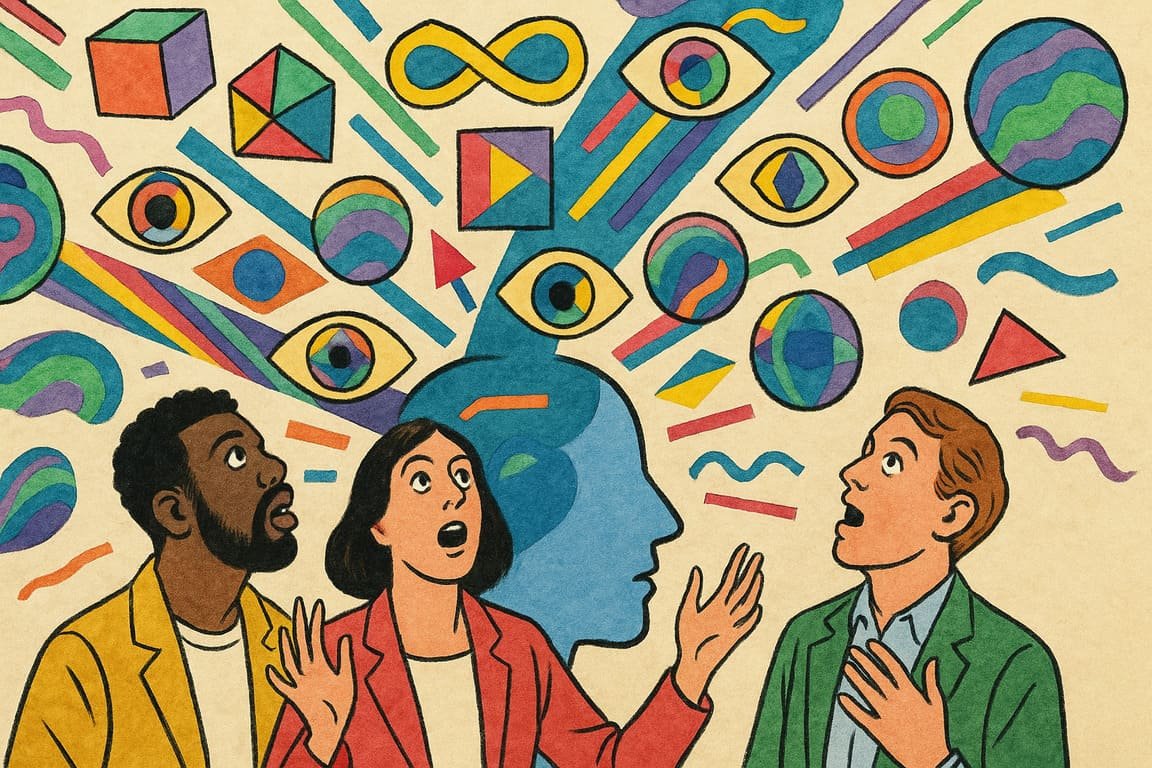
At the edge of an endless city, streetlights cast strange shadows over a mural-in-progress, each splash of color foretelling tomorrow’s taste. Here, under scaffolding and neon glow, a group of artists and digital wizards gather in silent conspiracy. Their tools flicker between spray cans and styluses, between reality and code. In this alley, the past dissolves and new visual worlds crash through the surface. Every night, the boundary blurs further. Trends don’t merely ripple through design—they roar, reshaping the landscape so profoundly that reality itself seems to flex and buckle in response.
Trends are not decoration. They are revolutions that begin as whispers and finish as cannon blasts. Think of gradients—the kind once mocked as relics of dial-up days—now revived as Instagram’s oxygen. Or the rise of immersive, motion-first layouts, where static screens shatter into living canvases. Each year, the digital ecosystem mutates: retro typography, acid green palettes, abstract blobs, AR overlays. What felt like a gimmick yesterday becomes the new gospel overnight.
You’re swept along whether you like it or not. Open your favorite app, visit a news site, or scroll through TikTok—some new visual twist is waiting, hungry for your reaction. This evolution is not random. Every trend answers a hunger: for clarity, for emotion, for belonging, for rebellion. Soft pastels bloom after anxious news cycles. Maximalism explodes after years of spare, “safe” design. The audience—impatient, omnivorous, and restless—demands constant surprise.
The sharpest creators do not just follow trends; they remix them. Take Tasha Okoye, a young motion designer whose viral campaign for a streetwear brand paired Memphis-style graphics with brutalist layouts and a dash of Y2K chaos. Her team won not because they played it safe, but because they sampled, clashed, and invented with confidence. Originality is no longer about inventing from scratch—it’s about knowing what to steal and how to make it new.
Motion has become the universal language. What was once a luxury for big-budget sites now pulses at the center of every experience: micro-animations, scrolling text, background videos, layered parallax. Even the most minimalist apps now pulse with subtle life, guiding the eye, rewarding curiosity, and giving each click a sense of consequence. Netflix’s dynamic thumbnails, Google’s playful search animations, Spotify’s kinetic album art—these are not extras. They are the new standard.
Mixed reality is quietly becoming the next great graphic frontier. Designers now paint with photons and polygons as much as with ink or pixels. AR and VR were once for gamers and futurists; today, brands blend them into product launches, art shows, and even classroom lessons. In Seoul, an independent studio projected a sneaker drop into the night sky, turning sidewalks into digital runways. Reality itself becomes a canvas, malleable and communal.
Accessibility surges alongside novelty. What use is a trend that excludes? High-contrast modes, dynamic scaling, and color-blind friendly palettes are not afterthoughts—they are requirements. Netflix’s accessible controls, Apple’s adaptive icons, and Google’s screen reader features lead the way, showing that the most viral visuals are also the most welcoming.
Branding is now a living organism. Logos mutate for social campaigns, mascots gain backstories, colorways switch with the news cycle. If you still think a brand style guide is a fixed document, you’re missing the party. Nike’s recent drop—pairing brutalist web design with nostalgic 3D animation—reminded the industry that adaptation is not a risk, but the only guarantee of relevance.
Community-driven aesthetics shape trends at lightning speed. TikTok’s “photo dump” trend, Discord’s vaporwave nostalgia, and Instagram’s lo-fi edits all began as grassroots rebellion against slickness. Audiences want to see the seams, the fingerprints, the messy humanity beneath the polish. Successful brands now hand over their visual identity, letting fans remix and remake in a thousand directions.
You cannot future-proof your visuals, but you can future-proof your mindset. The bravest teams hold trends lightly, experimenting with pop culture, tech, and audience feedback. They ask: what’s next, and how can we break it? Every trend is an opportunity to invent a new normal. It’s about knowing when to ride the wave and when to build the next one.
The old rulebooks have burned. You can’t cling to what worked last quarter and expect tomorrow to notice. Graphic design now answers to algorithms, to memes, to movements you can’t predict. The only certainty is that the visual future will surprise those who don’t pay attention.
As morning climbs over the skyline, the mural in the alley is almost done. Strangers stop, phones out, marveling at shapes they’ve never seen, their eyes wide with possibility. In the hush, you sense that reality itself is stretching, asking for new stories, new heroes, new colors.
Trends do not ask permission. They roar through the world, reshaping every surface, every mind. Will you wait for the world to decide what is beautiful, or will you be the one who paints the first stroke?
