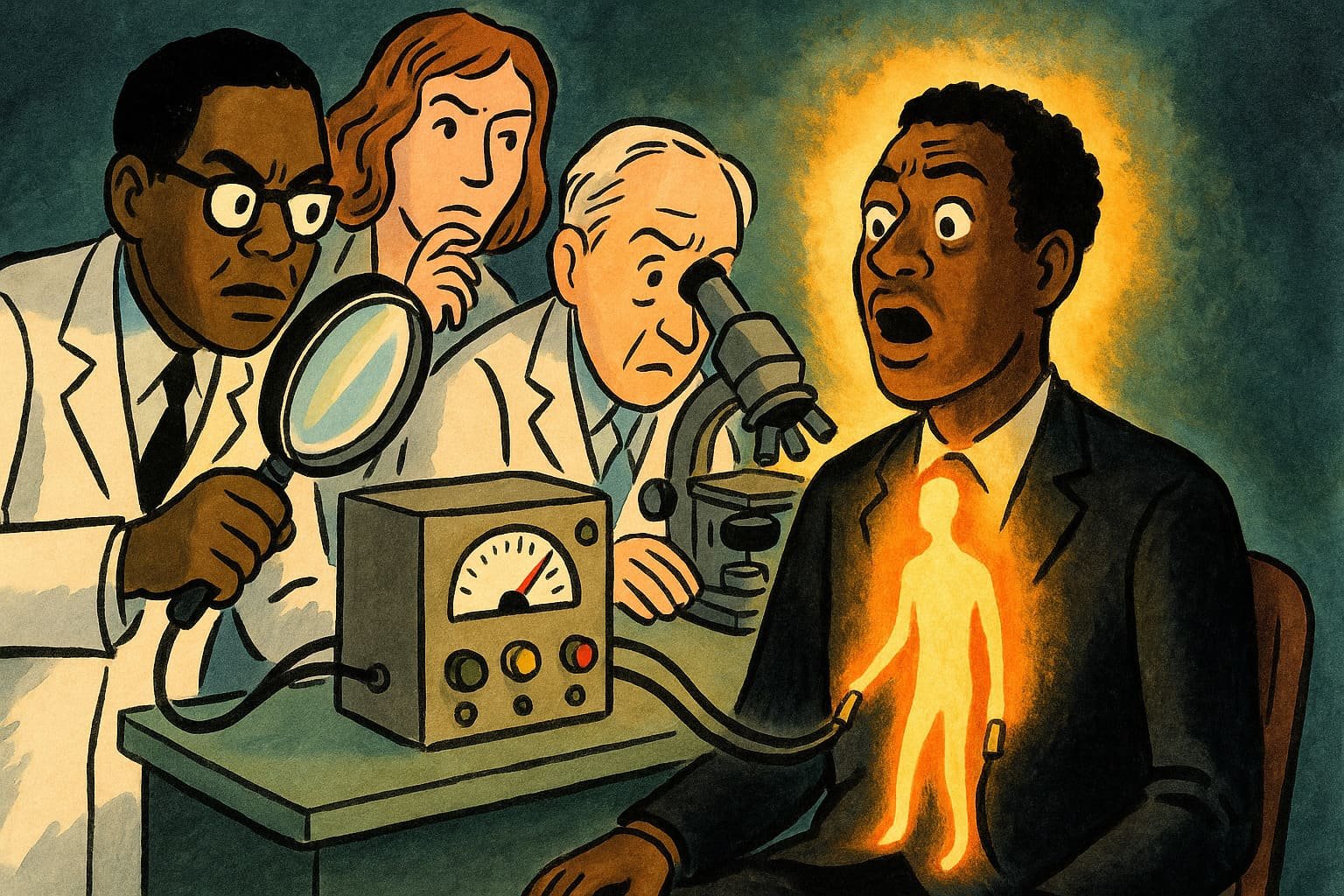
A single light bulb flickers in the back room of a university’s research hospital. The air smells faintly of bleach and late-night coffee. Monitors hum, wires snake across tables, and on one metal tray rests a sealed envelope, labeled with nothing more than a number. Through the glass, a woman sits alone in a chair, staring at her own hands, her breath shallow as technicians attach sensors to her temples and wrists. Across the hallway, a professor scrolls through data on his tablet, searching for a blip—a deviation, a signal, a ghost in the numbers.
Outside, news vans idle with their engines running. Someone live-tweets the event, hashtags spinning into the void. The headline promises a miracle: “Science Finally Measures the Soul.” Crowds gather in digital spaces, shouting in threads, memes, and prayers. What weighs more: faith, or the absence of it? The question, ancient as fire, now sounds like a clickbait dare.
Inside the lab, the soul is not a metaphor. It’s a variable. Oxygen, heartbeat, electricity, tears, all logged in spreadsheets. Can a spreadsheet feel hope? The woman in the chair doesn’t care. She just wants to know if what she’s carried all her life has weight, shape, or a frequency that someone can hear. No one mentions the philosopher’s warning: to measure is to change, to seek is to wound.
A university spokesperson, crisp suit and smooth accent, gives interviews by the vending machines. “We’re making history,” he says, as if history ever needed permission. His words sound more like an ad campaign for a blockbuster film than the start of a scientific revolution. “This is the dawn of a new era.” Behind him, a janitor quietly replaces a spent trash bag, glancing over his shoulder at the commotion, then shaking his head. The trash, the research, the soul—all destined for measurement, all weighed against expectation.
Suddenly, the machines in the lab beep in synchrony. The numbers change. The lead scientist leans forward, heart pounding in her ears. She’s not thinking about funding or headlines. She’s thinking about her grandmother’s hands, folded in prayer, trembling at midnight. The soul, she realizes, is not a number, but a question that refuses to die.
Quick Notes
- Faith Is Data’s New Frontier: Science is no longer content with just the mind or body; now it’s poking at the very idea of a soul, asking if human essence can be found on a monitor or in a chemical spike.
- Measurement Madness: Every new study claims a breakthrough, but every chart leaves a trail of unanswered questions. Faith and skepticism now arm-wrestle for control over meaning itself.
- Real People, Real Stakes: For some, it’s a lab project; for others, it’s about hope, healing, or the memory of a loved one. Micro-stories and test subjects reveal the true stakes of the soul experiment.
- The Business of Belief: Wellness companies, spiritual startups, and tech giants race to monetize the unmeasurable, promising apps, wearables, and biohacks that touch the edges of the human spirit.
- Shock and Awe: Every answer births another controversy, flipping certainty on its head. The story doesn’t end with a number, but with a dare: What are you willing to believe when the data runs out?
The Great Soul Hunt—Can Science Find What Religion Promised?
Skepticism crackles in the air as teams of neuroscientists, theologians, and biohackers chase after the unseeable. Not long ago, most researchers sidestepped anything labeled “soul,” dismissing it as superstition’s last stand. Now, universities and think tanks compete to design experiments that claim to quantify consciousness, measure near-death experiences, and log subtle changes at the moment of passing. The game is no longer about ignoring belief—it’s about trying to catch it in the act.
Dr. Eliza Greer, a neurologist in Boston, once scoffed at the soul debate. That changed after her hospital hosted a study tracking electrical shifts in terminally ill patients’ brains. She recalls a midnight when monitors recorded a ripple, a sudden change no one could explain. “You want to believe it’s just noise,” she said, “but something in the room felt different, like silence with teeth.” Her account, published in medical journals, started a small avalanche of follow-up projects around the world.
Religious leaders watch the spectacle with a mix of dread and curiosity. Some accuse science of violating sacred ground, while others see a chance to “prove” what faith claims. At St. Julian’s Church, Father Matteo wonders aloud if miracles can survive lab protocols. “If you try to weigh the soul, don’t be surprised if it slips through your fingers,” he warns his congregation. His words echo far beyond the chapel’s stained glass, turning up in forums, podcasts, and late-night talk shows.
Tech founders sniff opportunity in the chaos. Bianca Teal, founder of MindMesh, dreams of an algorithm that detects “spiritual presence” through biometrics. Her pitch decks are full of heart rate graphs and glowing testimonials, but investors want proof the software isn’t just digital incense. Meanwhile, skeptics like comedian Samir Ghosh lampoon the entire trend, joking on stage that “next up, Silicon Valley will launch an app to tell you if your grandma’s ghost is buffering.”
In a world desperate for certainty, every new study is devoured and dissected online. “Soul weighs 21 grams!” reads one viral headline, a nod to Dr. Duncan MacDougall’s infamous early 20th-century experiment. Decades later, the number lives on as a meme, a punchline, and a talisman. The quest for a measurable soul reveals a deeper truth: even in an age ruled by data, humans still hunger for stories bigger than facts.
The Battle for Meaning—Skepticism vs. Spirituality in the Age of Big Data
If data is the new gold, then faith is the last unmined mountain. Everywhere, researchers hustle to publish findings that might prove—or disprove—what cultures have whispered for millennia. You, sitting at your desk, scrolling through endless feeds, sense the tension. It’s not just about science versus religion. It’s about whether meaning is something you build, or something you’re born with.
Scroll past the headlines, and you’ll find debates that sound like courtroom dramas. One scientist posts brain scans showing that spiritual experiences can be induced with a helmet full of magnets. In the comments, a retired nurse describes holding her mother’s hand during her last breath, swearing she felt a warmth that no instrument could measure. The debate, messy and personal, spills across social media, spilling over into coffee shops, classrooms, and awkward family dinners.
Real-life stories break the spell of abstraction. Take Adam, a paramedic in Chicago. He tells friends about a call where a man survived cardiac arrest, then described seeing a light and “feeling like he was everywhere at once.” Adam saw nothing unusual on the monitors, but he couldn’t shake the sense that something unspeakable had happened. It wasn’t proof, but it changed the way he listened to survivors.
Meanwhile, Silicon Valley’s wellness gurus hawk mindfulness sensors and “digital aura” cameras, promising scientific validation for your chakras. There’s a bizarre comfort in numbers, a reassurance that every shiver, sigh, or flash of inspiration has a biochemical explanation. Yet, the more researchers try to pin down meaning, the more it wriggles away, like a trickster spirit in an ancient myth.
The tug-of-war is personal. Your neighbor believes a soul can’t be scanned. Your coworker, after years of loss, needs to believe it can. At the end of the day, science may measure patterns, but you measure life in moments, glances, and the memories that make you ache. The soul, it seems, plays hide-and-seek with anyone bold enough to chase it.
Human Stories—When Experiments Become Confessions
Walk through any research wing on the night of a major experiment, and the atmosphere feels like a cross between a vigil and a talent show. You see researchers, tired and hopeful, whispering to each other about outlier cases, strange dreams, and moments when equipment acted “possessed.” You meet test subjects who signed up for the stipend but left the lab believing in something they can’t explain. Every soul study produces as many stories as spreadsheets.
Marina Solis, a volunteer for a mind-body experiment, arrived thinking she’d spend the day hooked to electrodes, watching cartoons. Midway through, she reported a surge of emotions so intense she wept. “It was like reliving my entire childhood in five minutes,” she recalled, sitting on the curb outside, breath visible in the cold air. The researchers, reviewing their notes, quietly agreed the data could not explain her experience. Still, they logged every spike, every tear.
These moments spread through the scientific community like secret handshakes. One technician told of a patient whose heart monitor flatlined, only to resume seconds later. He remembered the room’s sudden chill, and the way the patient later described meeting her late husband. The technician, raised atheist, wondered if he’d witnessed a glitch or a glimpse beyond the known. He doesn’t share the story often, but when he does, he always says, “You had to be there.”
At conferences, stories like these come out over drinks. Some researchers laugh, others bristle, worried about reputation and tenure. A few quietly admit their own brushes with the inexplicable, the dreams or hunches that guide them more than any protocol. It’s as if science, in its quest to demystify, can’t help but stumble into the mystical.
The human stories that swirl around these experiments give them weight. Every confession, every hushed anecdote, becomes part of a new mythology. In the end, what’s measured may matter less than what’s remembered.
The Business of Spirit—How the Soul Became a Market
Capitalism, never one to miss a trend, has found its newest gold rush. Companies now sell products that promise to “map your spiritual DNA,” “quantify your intuition,” or even “capture the moment your energy changes.” Wearable tech companies offer wristbands that claim to detect spiritual awakening through heart rate variability and skin conductance. Suddenly, the soul is not just the subject of debate—it’s a business model.
Entrepreneurs, sensing an opening, build apps for guided meditations that supposedly increase “spiritual resonance.” Some pitch digital “soul journals” that analyze your dreams and moods, then spit out personalized insights. The most ambitious go further, promising you a data-driven path to enlightenment. The language is pure Silicon Valley: optimize, maximize, disrupt your path to the ineffable.
Not everyone’s buying. Lucien, a skeptical venture capitalist, invested in a startup that promised to use brainwave data to predict when employees would need “spiritual refreshment breaks.” The launch bombed. Users called it intrusive, absurd, and—ironically—soulless. Lucien jokes about it now at industry mixers, but admits the idea still haunts him. “You can’t automate a sense of meaning,” he tells anyone who will listen. “But it’s so tempting to try.”
For every flop, there’s a runaway hit. Mindfulness platforms rake in millions, and spiritual influencers turn Instagram accounts into mini-media empires. Pop culture turns soul measurement into the next frontier of wellness, with celebrities posting their aura scans alongside smoothie recipes. The public, always hunting for a shortcut to happiness, laps it up.
Meanwhile, critics warn of spiritual snake oil. Some psychologists argue that true transformation can’t be quantified, that the soul resists algorithms. Still, the marketplace barrels forward, fueled by our desire to turn every feeling, every hope, into something that fits in your pocket. In the end, the soul, once the domain of philosophers and poets, now has a price tag and a pitch deck.
Shockwaves—How Faith, Science, and Doubt Rewrite the Future
Every breakthrough sparks backlash. Each viral headline about measuring the soul unleashes a storm of reactions, arguments, and memes. Faith groups denounce the research as arrogant. Atheist collectives call it pointless. In between, a swelling chorus of ordinary people just want to know if meaning can survive the test tube.
You read stories about patients who, after a near-death experience, turn to science for answers and find only more questions. You see researchers, exhausted from years in the lab, privately wondering if their search has changed them in ways they can’t explain. The experiment becomes the experimenter.
Popular culture jumps in, spinning the debate into movies, books, and late-night comedy sketches. A best-selling novelist writes about a future where souls can be measured, ranked, and traded. The dystopian vision is chilling, but the underlying question is evergreen: can you ever really measure what matters most?
Sometimes the shock is personal. A young doctor, raised in a family that dismissed religion, breaks down in the hospital stairwell after witnessing a patient’s final words. “I felt something leave,” she whispers to a colleague. The experience, she admits, will never appear in her research papers. But it lives in her memory, shaping the way she approaches every new case.
The soul debate refuses to die. Every new discovery, every failed experiment, every miracle claimed or debunked, keeps the conversation alive. The shockwaves spread, challenging each of us to choose what to believe and how to measure a life well lived.
The Weightless Secret
A cathedral of glass and steel stands silent at sunrise. Shadows move across the marble, lengthening and shrinking as the light shifts. In a quiet corner, a child watches dust float in the rays, each particle turning golden for a split second before vanishing. Nearby, an old scientist sits with hands folded, not in calculation, but in wonder. Machines rest idle, screens gone dark, numbers waiting for meaning.
No one in the room speaks. The search for the soul has paused, replaced by a hush as sacred as prayer. A nurse glances at her wrist, where a fitness tracker still glows faintly. She smiles, not at the data, but at a memory that floods her senses—the taste of birthday cake, the sound of laughter, the weight of a hand in hers. No research can quantify this. No graph can hold it.
Across the world, millions check their phones for news of the latest breakthrough. The headlines offer certainty, but the real miracle lingers in the questions left unanswered. The soul escapes every measurement, defies every hypothesis, hiding in plain sight, weightless as a promise.
You stand at the edge of certainty, heart pounding, daring to wonder: What if the most important thing about you can never be measured at all?
Why scroll… When you can rocket into Adventure?
Ready to ditch the boring side of Life? Blast off with ESYRITE, a Premier Management Journal & Professional Services Haus—where every click is an adventure and every experience is enchanting. The ESYRITE Journal fuels your curiosity to another dimension. Need life upgrades? ESYRITE Services are basically superpowers in disguise. Crave epic sagas? ESYRITE Stories are so wild, your grandkids will meme them. Want star power? ESYRITE Promoted turns your brand cosmic among the stars. Tired of surface-level noise? ESYRITE Insights delivers mind-bending ideas, and galactic-level clarity straight to your inbox. Cruise the galaxy with the ESYRITE Store —a treasure chest for interstellar dreamers. Join now and let curiosity guide your course.
