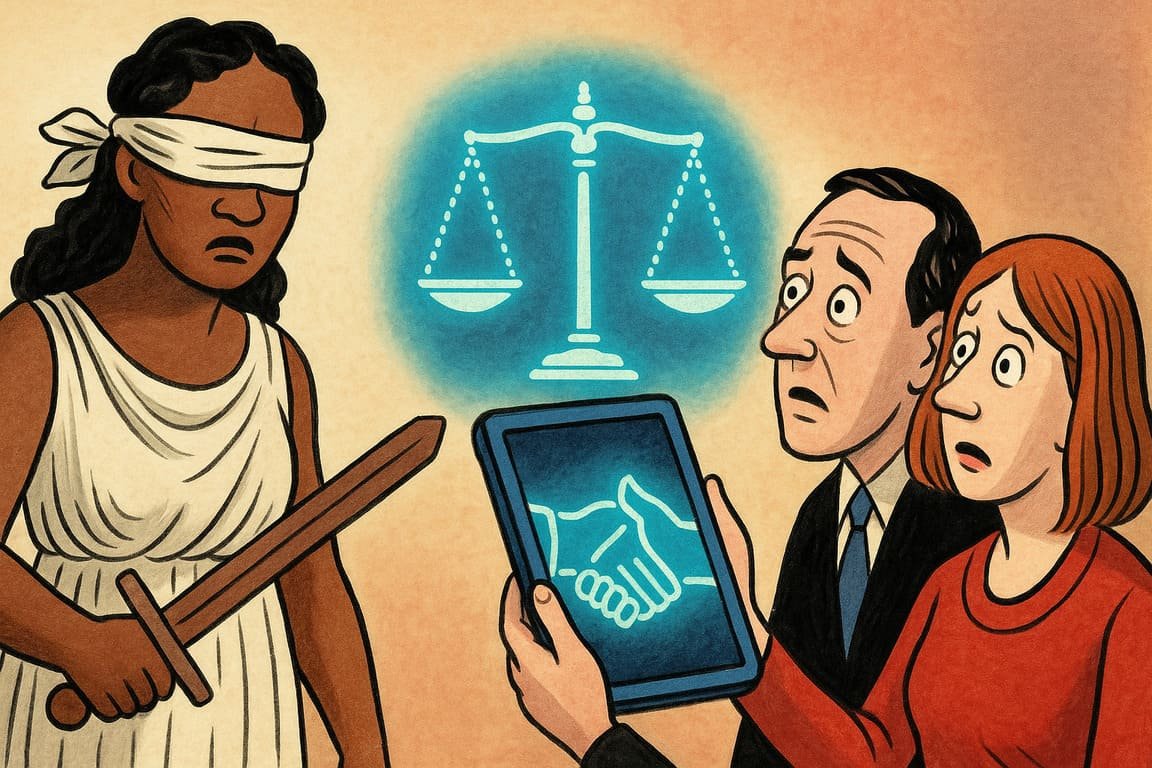
A digital gavel slams in a courtroom without walls. Faces appear as avatars—pixelated, muted, and waiting for their verdict. The judge is an algorithm, unseen but absolute, sorting pleas into winners and losers at the speed of light. Outside, real people stare at their screens, wondering how fairness could feel so arbitrary, so cold. Their fates are decided in milliseconds, with no room for stories, only scores.
In a bustling Nairobi fintech hub, Njeri watches her microloan application whir through automated checks, her hopes rising and falling with each status update. She knows everything rides on the algorithm’s decision—credit score, neighborhood, a handful of words entered by mistake years ago. She trusts the process, because there’s nobody left to ask.
A gig driver in Mexico City, Santiago, wakes to find his account suspended. No warning, no appeal, just a form email: “policy violation detected.” He pounds the steering wheel, desperate to explain, but there’s no one on the other end. Justice, he learns, is now a mirage—a fleeting hope flickering on the surface of the cloud.
Digital fairness promised equality, but everywhere, people are discovering it’s just another word for surrender.
Quick Notes
- Algorithmic Judgment: Automation decides who wins, who loses, and who never gets a chance, reducing justice to code and calculation.
- The Mirage of Impartiality: Systems claim to be fair, but inherit human bias—sometimes amplifying it—while hiding behind a veneer of objectivity.
- Powerless Appeal: When digital decisions go wrong, there’s rarely a path to challenge or even understand the outcome.
- Society on Trial: Pop culture, viral scandals, and real-life injustice expose the hollow promise of digital justice, revealing who it truly serves.
- The Call for Real Equity: A new wave of activists, technologists, and leaders demand algorithms be transparent, accountable, and human-centered, sparking a global reckoning.
Algorithmic Judgment: When Justice Is Reduced to Code
In the digital marketplace, algorithms serve as judge and jury. Njeri, the Kenyan entrepreneur, never meets the loan officer who decides her fate. The approval or denial is rendered by a string of code, tuned by data scientists continents away. She gets the result, but never the reason.
Employment portals quietly filter out “undesirable” resumes. Some applicants never receive a rejection, just a lifetime in the digital void. “You feel erased before you’ve even started,” says Arun, a skilled engineer in Mumbai whose credentials were lost in the black box.
These systems promise efficiency but lack memory for context or second chances. Last year, a New York tenant was denied an apartment after a glitch marked him as a credit risk. No human checked the file; the system’s word was final. Justice becomes a probability curve, not a conversation.
Insurance premiums, college admissions, even health care eligibility—each now decided by models that claim impartiality but offer no empathy. At a Paris hospital, a patient’s critical request was delayed by an AI flagging “low priority.” The attending nurse called it “justice by spreadsheet.”
The old idea that justice means a day in court, a hearing, a second look—has vanished for millions. Today, your future often lies in the hands of machines you’ll never meet.
The Mirage of Impartiality: Bias, Cloaked in Code
Algorithms market themselves as neutral, but inherit the prejudices of their creators. Studies show facial recognition fails more often on darker skin tones. Lending algorithms often penalize applicants from marginalized neighborhoods, regardless of individual merit.
Santiago’s suspension as a rideshare driver highlights this injustice. His route, flagged as “unusual” by a risk model, was actually an emergency detour. The system couldn’t know his mother was ill. “To them, I was a pattern,” he says. “To me, it was my life.”
Tech firms tout “fairness audits,” but these reviews rarely catch deep-seated bias. In a famous scandal, an AI hiring tool at a Fortune 500 company systematically down-ranked female applicants. The code was blind, but the outcome was not.
Popular media runs with the theme. In “Minority Report,” predictions become preemptive punishments. In real life, “predictive policing” directs law enforcement to over-surveil already vulnerable communities. A self-fulfilling prophecy, played out on screens and streets.
Objectivity is the cloak; injustice is the reality. Every automated decision is a ghost of the humans who designed it.
Powerless Appeal: No Second Chance in the Digital Court
When digital justice fails, the appeal process is a dead end. Santiago’s emails go unanswered. Njeri’s online chats loop her back to FAQs. A teacher in Seoul, accused of plagiarism by an AI grading tool, loses her job before she can present evidence. The computer’s verdict stands.
A South African university student, Musa, watched his scholarship vanish after a facial recognition system flagged “inconsistent attendance.” The camera had been obscured by poor lighting, but no one believed him. “I never got to speak to a person,” Musa remembers. “It was like shouting into the void.”
Even tech support agents are powerless, reading scripted apologies while escalation teams hide behind process. The justice system once prided itself on “a hearing.” In the digital age, silence is the answer.
Stories of false positives and mistaken identities make headlines. But the majority—ordinary people denied loans, jobs, or parole—just vanish. There’s no headline for a life quietly erased by code.
If justice means accountability, digital fairness fails the test. Systems rarely explain their logic, let alone allow for mercy.
Society on Trial: Truth, Scandal, and the Pop Culture Reckoning
Tech failures don’t stay hidden for long. Viral scandals erupt on Twitter, Reddit, and TV news. The “robodebt” scandal in Australia saw thousands wrongly accused of welfare fraud by an automated system—many lost homes, some lost hope, and a few lost their lives.
Pop culture magnifies the crisis. “Black Mirror” episodes like “Nosedive” skewer a world obsessed with digital scoring. “Coded Bias,” a hit documentary, exposes how justice can be subverted by math.
Celebrities fall too. An AI deepfake led to a famous actor being “canceled” for a crime he never committed, the viral clip amplified by millions of shares before the truth caught up.
Even art gets tangled. A painter in Lagos found her work rejected by an AI as “copyright infringement” based on a misread pattern. She protested, but the platform’s bot moderators could not reverse the verdict.
Society is on trial, judged by systems it cannot see or question. The promise of fairness becomes another performance, a digital pantomime.
The Call for Real Equity: Reclaiming Justice from the Machine
Awareness breeds action. Technologists like Joy Buolamwini campaign for ethical algorithms and demand audits, transparency, and real consequences for injustice. New laws require companies to explain, not just execute, decisions that affect lives.
A Berlin startup developed an “algorithmic advocate”—an AI tool that audits other AIs and flags unjust outcomes for human review. Early results show fewer wrongful denials, more second chances.
Activists push platforms to include appeal processes, real support teams, and meaningful review by human beings. Some governments now mandate algorithmic transparency, turning black boxes into glass walls.
Forward-thinking leaders in business and government host open forums—inviting the public to challenge and improve digital justice systems. The result is slow but real progress: more equity, more humility, more listening.
The future belongs to those who put people at the center, not as data points but as stories worthy of dignity.
Echoes in the Cloud: The Reckoning of Justice
Somewhere in a quiet apartment, Njeri stares at her reflection on the laptop screen. She sees not a data point, but a living story. Her hand hovers over the power button, heart pounding with hope for an answer, a reason, a human voice. Across continents, others wait for justice to notice them, to recognize their humanity behind the code.
Fairness is not a feature. It’s a promise—one that must be defended, reclaimed, and rebuilt each day. You deserve more than a verdict from a faceless machine. Demand the justice that listens, questions, and sees you.
