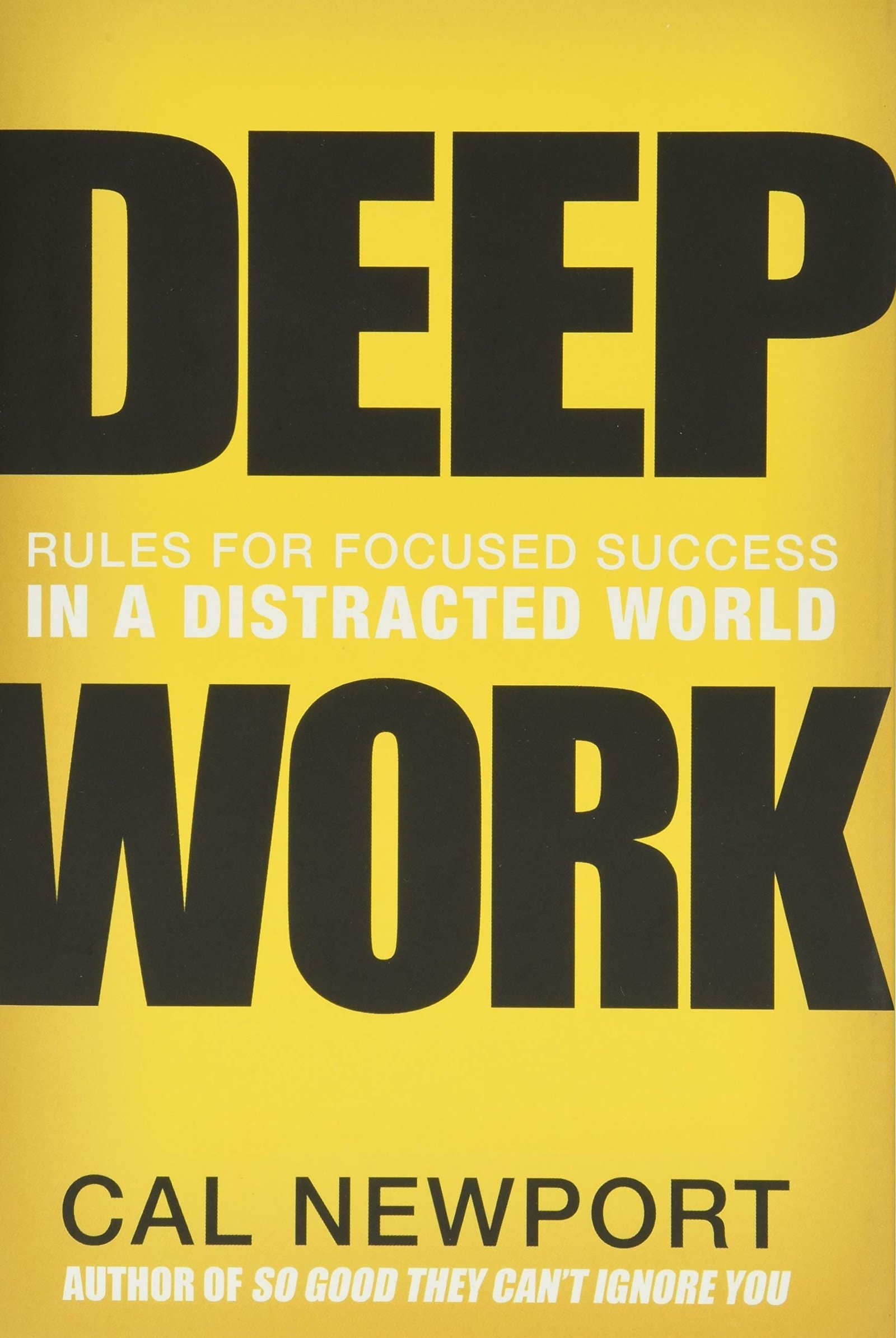
There’s a quiet epidemic in today’s world, and it’s not something you can medicate away. It’s the constant buzzing of notifications, the multitasking madness of modern work, and the deep, unrelenting erosion of our ability to focus. If you’ve ever found yourself scrolling Instagram while half-listening to a Zoom call and mentally drafting a to-do list, Cal Newport’s Deep Work: Rules for Focused Success in a Distracted World will feel like a slap and a lifeline.
Published in 2016, Newport’s book doesn’t just expose the rot in how we think, work, and live today; it offers a no-nonsense cure. Deep Work doesn’t promise productivity hacks or gimmicky routines. It dares to question the very structure of our work culture and rewires how we approach ambition, excellence, and attention. Think of it not as a time management manual, but as a survival guide for the knowledge economy.
But here’s the kicker: Newport isn’t your average self-help guru spewing motivational quotes. He’s a computer science professor at Georgetown who surgically dissects distraction with the precision of a coder debugging broken logic. His argument? That the ability to focus without distraction on cognitively demanding tasks is becoming one of the most valuable skills in our economy and almost no one is doing it.
Deep Work hits differently because it doesn’t just tell you to focus; it explains why we’ve forgotten how and how to get that superpower back. This isn’t a book about balance; it’s a call to go all in on what matters. It doesn’t coddle. It commands. And that’s precisely why it resonates so deeply in an age of surface-level everything.
This review will dive into the heart of Newport’s thesis, unpack its bold rules, challenge some of its harder claims, and surface the actionable gems you can use right now; even if you’re still battling your email tab. Let’s cut the noise and dig into why Deep Work is the hard reset our distracted minds desperately need.
Quick Notes: 5 Golden Nuggets from Deep Work
- Deep Work Is a Superpower: Newport argues that the ability to perform focused, undistracted work is becoming rare yet more valuable than ever in today’s economy.
- Shallow Work Is Slowly Destroying Productivity: Most of what we do: emails, meetings, social media is “shallow work” that creates the illusion of progress but delivers minimal value.
- Rituals Create Focus: To consistently perform deep work, you must develop strict routines and rituals that eliminate distraction and train your mind for sustained concentration.
- Work Less, Achieve More: Counterintuitively, Newport reveals that fewer hours of deep focus produce better results than long days of fragmented attention.
- Digital Minimalism Is Crucial: Not all tech is evil, but Newport urges deliberate use. Quit mindless scrolling and start using digital tools with intent, not impulse.
The Deep Work Playbook: A Summary of the Book
Cal Newport divides Deep Work into two core parts: “The Idea” and “The Rules.” In the first part, he lays down the intellectual and philosophical groundwork. He makes the bold claim that deep work is the key to thriving in an information economy. The world now rewards those who can learn complex things quickly and produce at an elite level and both require deep focus. Newport reinforces this with case studies, from Carl Jung’s forest hideaway to Bill Gates’ “Think Weeks.”
He doesn’t stop at theory. Newport also exposes the myth of multitasking and skewers the culture of busyness. He explains why distraction-heavy environments not only ruin productivity but also kill innovation. In his view, deep work isn’t just a habit; it’s a competitive advantage. If you can master it, you’ll outpace the distracted masses.
The second part of the book is where the rubber meets the road. Newport outlines four specific rules: Work Deeply, Embrace Boredom, Quit Social Media, and Drain the Shallows. These aren’t gentle nudges; they’re a manifesto. Each rule is loaded with strategies that are both philosophical and practical. From scheduling deep work blocks to weaning off Twitter, he teaches how to restructure your day and your brain.
One of the most refreshing elements of the book is its realism. Newport isn’t preaching monasticism or telling you to throw your phone in a lake. He acknowledges the pull of shallow work and offers grounded ways to battle it. Even if you work in a corporate environment, you can find hacks in his system.
In essence, Deep Work is not just a set of productivity tips. It’s a lifestyle shift; a deliberate decision to reclaim your cognitive power and use it to build, think, and create at a much higher level.
Laser Focus or Bust: Key Lessons That Will Shift How You Work
Cal Newport doesn’t mince words: if you’re not embracing deep work, you’re wasting your potential. One core lesson that hits hard is this; your ability to focus is like a muscle, and you’ve likely let it atrophy. With every notification buzz and every tab switch, you weaken your attention span. Newport emphasizes that rebuilding this cognitive muscle requires deliberate practice. No shortcuts. Just like an athlete in training, the more you push your limits with focused, distraction-free sessions, the stronger your concentration becomes.
Another powerful insight is the idea that busyness is not productivity. Newport ruthlessly critiques how modern workers confuse activity with value. Just because you answered 78 emails and sat in six meetings doesn’t mean you accomplished anything meaningful. He urges professionals to ask a haunting but necessary question: “Would anyone notice if I stopped doing this task?” If the answer is no, it’s probably shallow work; ditch it, delegate it, or automate it.
A third lesson is the deep value of embracing boredom. In a world that conditions us to reach for our phones the second we feel the slightest tinge of restlessness, Newport argues for the opposite. He says boredom is a signal, a space for ideas to emerge. By learning to sit with stillness, you retrain your mind to reach deeper levels of insight and creative thought. You can’t do breakthrough thinking while being bombarded with dopamine hits from TikTok.
Equally critical is Newport’s call to quit social media (or at least ruthlessly audit it). He advocates for what he calls the “craftsman approach to tools”: Only use platforms that deliver substantial, measurable value to your goals. Facebook, Instagram, even LinkedIn; if they aren’t significantly contributing to your work or life, drop them. Not because they’re inherently bad, but because they demand far more attention than they return in value.
Newport’s advice to drain the shallows teaches readers to stop celebrating “full calendars.” Time blocking, time batching, and ending the workday with intention are not just techniques; they’re acts of rebellion against a culture that worships the grind. He wants readers to pursue depth, not hours worked. The result? More impact in less time, with less burnout.
Close the Tabs, Open Your Life: Why Deep Work Is a Revolution, Not a Routine
Deep Work isn’t just another productivity book; it’s a battle cry for reclaiming your brain. Newport doesn’t offer superficial fixes or trendy hacks. What he proposes is radical, especially in today’s culture of hyper-responsiveness: choose depth over distraction, quality over quantity, meaning over motion. This is not a gentle lifestyle tweak; it’s a complete reorientation of how you engage with your work and your mind.
One of the most empowering takeaways from Deep Work is its insistence on agency. You are not a victim of digital distraction. You are not bound to your notifications or the demands of shallow urgency. Newport gives readers a blueprint for how to take back control. It starts with intent, is driven by discipline, and ends with tangible transformation; more meaningful output, clearer thinking, and greater satisfaction.
What’s striking is how this philosophy applies beyond just work. Want to be a better writer, coder, strategist, or entrepreneur? Deep work helps. But also want to be a more present parent, a thoughtful partner, a lifelong learner? Same principle applies. Focused attention enhances not just your productivity, but your humanity. It sharpens your capacity to listen, to create, to care.
There’s a quiet rebellion embedded in Newport’s thesis. In a world built to splinter your attention, choosing depth is a form of resistance. And resistance, in this case, breeds clarity. The discipline to disconnect, to focus, to build something meaningful; this is the stuff that careers are built on. Not tweets. Not Slack messages. Not likes.
If you’re tired of the noise, the stress, the constant tug-of-war with your own mind, Deep Work is your call to arms. Not a whisper, but a roar. Newport invites you to stop skimming life and start living it with deliberate depth.
About the Author
Cal Newport is not your typical productivity guru churning out recycled motivational fluff. He’s a tenured computer science professor at Georgetown University and the author of several bestsellers that explore the intersection of technology, work, and focus. With a background rooted in academia and a career built on intellectual rigor, Newport brings rare credibility to the conversation about attention and performance. He doesn’t just preach deep work; he lives it.
What makes Newport’s insights so compelling is that he straddles two worlds: the hyper-demanding world of technical academia and the chaotic, noisy realm of modern knowledge work. His academic work involves complexity and depth, and his books are extensions of that ethos, grounded in logic, evidence, and real-world application. Unlike self-styled influencers who chase likes, Newport famously avoids social media altogether; living proof of the discipline he teaches.
Newport’s voice is thoughtful, sharp, and unapologetically contrarian. He challenges conventional thinking not with loud opinions, but with calm reasoning and empirical examples. His arguments are not reactive; they are architected like code; clean, efficient, and brutally effective. And through all this, he’s built a following of professionals, students, and creatives who are hungry for a more meaningful, focused life.
His work; including books like So Good They Can’t Ignore You and Digital Minimalism; forms a cohesive philosophy: that success, satisfaction, and sanity are not found in endless connectivity, but in clarity of focus and intention. That’s what gives Deep Work its edge; it’s not a lone cry in the void but part of a broader intellectual rebellion against mediocrity and mindless busyness.
Whether you’re a burned-out entrepreneur, a distracted student, or a manager drowning in meetings, Cal Newport’s work speaks directly to your pain and gives you the tools to fight your way back to clarity.
Disclaimer
Note that the ideas and content in the book are solely from the Author of the book and not the ESYRITE Editorial Team. All opinions expressed in this book review are entirely from the ESYRITE Editorial Team. This review may contains affiliate links, meaning ESYRITE may earn a small commission if you make a purchase through these links, at no additional cost to you.
