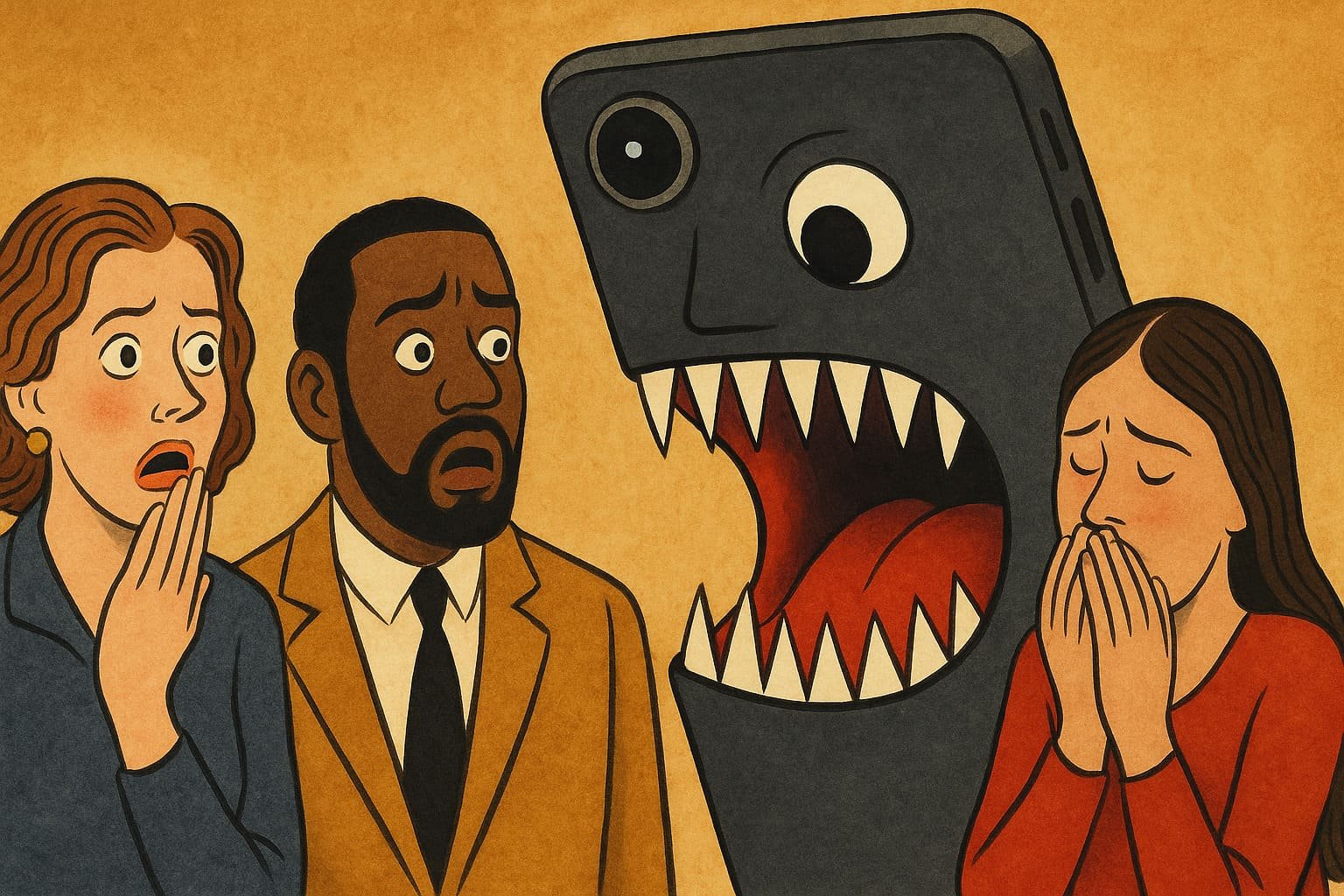
Night falls over a city of restless lights, each window flickering with lives being watched. In a cramped kitchen, a smart fridge hums softly, cataloging every item inside while a digital assistant listens from the countertop. A weary accountant prepares dinner, glancing at her phone as it vibrates with suggestions for new recipes, appliance upgrades, and “health insights” she never asked for. Across the street, a delivery drone captures faces in passing, mapping movements for future routes. Unseen, the city’s hungry devices collect secrets, turning the rhythms of home and heart into data points for someone else’s profit.
In a penthouse above, an executive reviews dashboards glowing with live feeds: temperature, motion, voice, consumption. Each spike is money, each anomaly a story. On the subway, commuters stare into their screens, swiping, scrolling, sharing thoughts that will soon become recommendations, ads, and tailored warnings. A child laughs at a smart toy’s joke, unaware that every giggle is logged, tagged, and sold.
At the center of this feast is a hunger that never ends. Devices promise help, but demand your privacy. Every click, whisper, and footstep becomes sustenance for machines that never sleep. The meal never stops. The world’s secrets are the main course.
Quick Notes
- Devices Feed on Secrets: Everyday gadgets are engineered to harvest, store, and monetize personal data, often without clear consent.
- Invisible Appetite: The hunger for information is relentless, with each convenience hiding deeper layers of surveillance and exploitation.
- True Stories, Real Costs: From smart toys to fitness bands, lives are transformed by breaches of trust and data-driven manipulation.
- Pushback and Protection: Communities, companies, and individuals explore ways to guard privacy, fight back, and regain control.
- Whose Story Gets Told?: The battle for privacy is a battle for autonomy—who decides what becomes public, and what stays sacred?
Appetite Unleashed – How Devices Became Predators
Everyday objects once stood silent, unnoticed. Now, each glows with sensors and ambition. In homes from Berlin to Buenos Aires, smart thermostats adjust the heat, doorbells record comings and goings, and televisions log every show, every pause, every fast-forward. A graphic designer in Cape Town returns from vacation to find her smart vacuum mapped her apartment and sent updates to a cloud she’s never seen. She feels invaded, but can’t quite pinpoint where the trespass began.
Grocery chains offer discounts in exchange for loyalty cards, tracking every purchase and predicting what customers will crave next. A student in Boston discovers his caffeine habit is public record when ads for energy drinks appear after a late-night run. “I never told anyone,” he says, laughing nervously, “but my phone did.” Even sleep is commodified. Fitness trackers count every toss and turn, their insights sold to health insurers and marketers alike.
Behind every convenience lies a calculation. Voice assistants, supposedly dormant until summoned, sometimes record fragments of conversation, shipping snippets off to servers for “quality improvement.” A family in Tokyo reads a news article about private discussions sent to strangers by accident. They unplug the device, unsure if the silence is freedom or just another illusion.
Automakers now offer insurance discounts to drivers willing to let their cars report every brake and swerve. One trucker in Dallas tried it, only to have his premium rise after a harsh winter storm. “They said I drove too hard,” he says, “but it was just ice.” His story travels through online forums, a warning for anyone tempted by the trade-off.
No one reads the fine print, but everyone lives by its rules. Each device arrives hungry, ready to eat secrets, and few realize just how much they’re feeding it.
Hidden Costs – The Price of Convenience
People trade privacy for comfort, rarely stopping to weigh the exchange. Smart home systems dim the lights, play music, even lock the doors—all in response to voice commands. A novelist in Montreal loves the freedom but grows uneasy when an ad for migraine medication appears after she confides her symptoms to a speaker. She wonders who else was listening. Her partner laughs, but the unease lingers.
Children’s toys grow smarter, learning names, preferences, even moods. A mother in Madrid discovers her daughter’s new doll records conversations for “improved interaction.” When hackers breach the company’s database, recordings surface online. The family’s private moments become fodder for strangers. Lawsuits follow, but the damage is done.
Grocery delivery apps promise convenience but quietly build profiles—what people buy, when, and with whom. A retiree in Melbourne is surprised by a visit from a marketing rep, armed with detailed knowledge of her habits. She feels seen, but not in a way she wanted. The trade-off is never neutral; convenience is just another name for surveillance.
Employers embrace wearable devices to “optimize productivity.” One tech startup offers free fitness bands, tracking not only steps but heart rate, sleep, and stress. The boss praises the program, but an employee named Ravi resigns after receiving warnings about his “work-life balance.” He felt exposed, judged, and finally out of place in a company that claimed to care.
Healthcare promises miracles through data, but at a price. Patients submit genetic samples to apps promising custom diets, only to discover their information is sold to pharmaceutical firms. A nurse in Lagos calls it “digital cannibalism”—feeding personal truth to machines that profit from the feast.
Breaches, Betrayals, and the Fallout
Every secret fed to a device can be weaponized. When a celebrity’s fitness tracker reveals her running route, fans swarm her favorite park. The company apologizes and updates settings, but the privacy breach has real-world consequences. The line between digital and physical safety dissolves.
A bank’s AI-powered assistant misinterprets a customer’s query, transferring money without permission. The user spends weeks battling customer service, the trust in automation permanently shaken. In forums, similar stories pile up—lost funds, ruined reputations, anxiety that persists long after the issue is resolved.
Data leaks spill across the news, but the headlines fade quickly. An apartment complex in New York installs “smart locks” for convenience. Months later, hackers break in, using default passwords to raid mailboxes and storage units. Residents protest, but the company insists the system is secure. Trust evaporates.
Insurance companies analyze data from connected cars, denying claims based on driving “patterns.” One family in Johannesburg is denied coverage after their vehicle reports “reckless behavior” during a carjacking. The data, they argue, is incomplete—a machine’s view, not a human’s story. Their case becomes a cause célèbre, sparking debate about who controls the narrative.
Schools embrace “adaptive learning” apps, tracking student progress down to the minute. Parents in Seattle file complaints after learning their children’s mistakes are stored indefinitely. The company promises to purge data, but suspicions linger. Childhood becomes just another dataset, vulnerable to misuse.
Drawing the Line – Stories of Pushback and Renewal
Not everyone accepts the data feast as inevitable. A co-op in Amsterdam launches a privacy-first phone, rejecting all tracking and data mining. The launch is quiet, but demand grows by word of mouth. Users praise the phone for its simplicity, but mostly for the peace of mind it brings.
A startup in Nairobi invents a “data shield”—a small device that blocks trackers in smart TVs and speakers. It sells out within weeks, driven by social media stories of surveillance fatigue. A customer named Esther posts a photo of her “offline home,” celebrating a space where secrets stay secret.
Legislators in California pass a sweeping privacy law, forcing companies to disclose what data they collect and how it’s used. Tech giants resist, but eventually comply, fearing a backlash. Citizens feel empowered, reading reports about what was once hidden.
Communities form around digital literacy. A church group in Manchester holds workshops teaching neighbors to audit privacy settings, read app permissions, and demand transparency. An elderly member, David, shares how he recovered control of his photos, inspiring others to follow suit.
Pop culture begins to shift. Films, books, and viral campaigns celebrate heroes who guard their secrets, question every device, and fight for autonomy. The hunger of machines is relentless, but so is the human need for sanctuary.
Autonomy and Agency – Choosing What You Feed
The final choice is always personal. Some people unplug, living in deliberate analog isolation. A musician in Vienna records on tape, mails letters, and swears off all smart devices. His friends think him eccentric, but his music thrives—raw, unfiltered, deeply personal.
Others negotiate boundaries. A journalist in Istanbul shares nothing she wouldn’t put on a billboard, keeping private life offline. She uses encryption, refuses loyalty cards, and treats every new gadget as a potential adversary. Her paranoia is strategic, not panicked. “I want to decide what becomes public,” she explains.
Companies respond, experimenting with user-owned data and “zero knowledge” systems that collect only what’s necessary. A fintech firm in Lisbon lets customers choose which data to share for discounts, building trust through transparency. The model attracts loyal fans, eager for a sense of control.
Parents teach children to question devices, ask what’s recorded, and practice digital hygiene. Schools introduce lessons in privacy alongside math and reading. The hope is that the next generation grows up knowing the value of secrets—not just as currency, but as part of their story.
The hunger of machines is insatiable. Yet, the power to feed—or starve—them rests with each person. Every secret is a choice, every setting a stand.
The Table Cleared: Choosing What You Serve
The kitchen falls quiet, devices dimmed, the only sound a kettle boiling for evening tea. Shadows lengthen, slipping across countertops and screens that once glowed with questions. Outside, the city’s appetite rumbles on, but within these walls, something shifts. The meal of secrets is paused, if only for a night.
A child asks for a story, not a screen. The accountant smiles, settling in to share memories untouched by data collectors. The hunger outside grows restless, but finds no entry here—no easy feast, no careless crumbs. The world can always ask for more, but tonight, you decide what’s served, and what remains yours alone.
