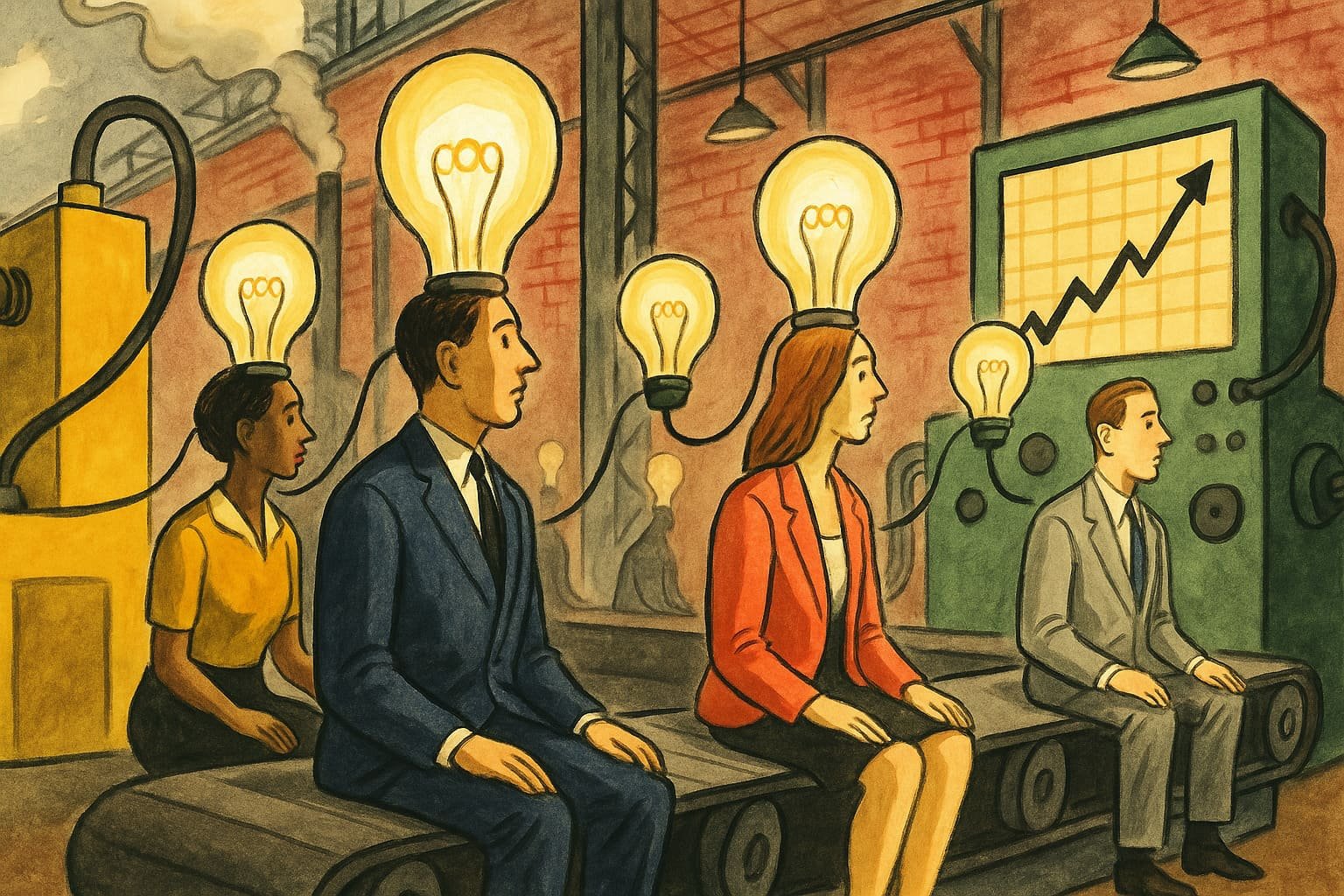
Beneath the electric buzz of monitors and the soft click of keyboards, a quiet competition unfolds. Inside an office that could be any headquarters, a storm of tiny interruptions blurs the line between daydream and duty. A digital stock ticker, somewhere in the room, never stops crawling; each flash a reminder that every second is for sale. Eyes dart between screens, wrists flick for dopamine hits, and somewhere behind glass, a manager paces with the grim look of someone betting the company on attention that no longer belongs to them.
Here, every workplace becomes a kind of auction house. Not for paintings or rare coins, but for human focus; bought, sold, stolen, or squandered with each ping. What used to be simple meetings now sprawl across time zones and tabs, with every participant half-present, half-elsewhere. Corporate emails and Slack messages blur into a cacophony of red dots, each demanding tribute. Even silence feels restless, as if a phone will vibrate any second, cracking open concentration like a glass dropped on marble.
In the next cubicle, Marla, a rising analyst, flicks through project files while texting her daughter about soccer practice. Her boss, Ajay, scrolls LinkedIn mid-call, hunting the next hire before the coffee grows cold. Above their heads, posters trumpet words like “synergy” and “innovation” in cheerful fonts, but the air tastes faintly metallic, sharp with tension and unspoken fatigue. If money was once the loudest currency in the room, attention now hums beneath, silent but ruthless.
A world leader tweets. A new app launches. A YouTube notification flashes. A product manager in San Francisco feels the jolt at midnight in Berlin. Like a trader on the floor, every worker knows: blink too long and the world moves past. Focus is no longer free. It is the prize, the resource, the hidden gold. Whoever owns it writes the rules.
At the end of the corridor, a small conference room glows with blue light. The CEO’s voice floats above the drone of devices. She tells a story about Toyota’s assembly line, about the Japanese practice of stopping everything for a quality fix, not for profit but for pride. Her words hover: “We used to chase efficiency. Now, we must protect attention.” Some laugh, unsure if it’s a joke or a warning. Most nod, already thinking of the next ping. In the auction house of distraction, the highest bid is always for the soul that never looks away.
Quick Notes
- Auction House Rules: Your focus is now traded like currency; every digital ping is a silent bid for your mind.
- Myth of Multitasking: Believing you can do it all only makes you poorer; the best fortunes are built on undivided attention.
- Guardians of Flow: The few who master deep work rule the factory floor; their secret is ruthless boundaries, not magic tricks.
- Pop-Culture Punchline: Attention is the new Marvel superpower; lose it and you’re just another extra in someone else’s movie.
- Ultimate Payoff: The real winners aren’t faster; they’re more present. In a world selling distraction, attention is the only thing that appreciates.
Bidding Wars—Why Focus Is Priceless in the Modern Workplace
Step onto any floor of a Fortune 500 office and the noise tells a story. Endless notifications and digital alerts slice up the day until only fragments of true thought survive. There’s a manager named Liz who keeps a handwritten log just to salvage a sliver of focus from a world intent on shredding it. Her team teases her about the analog habit, yet by Friday, her project list is always complete while the others chase their tails through digital dust storms.
Organizations are starting to see attention as a strategic asset. Silicon Valley startups now hire “attention coaches” who teach teams to weaponize their calendars against the onslaught. One tech founder, Marcus Lin, famously canceled half his meetings and banned Slack after 2 p.m. Productivity soared. The world called him mad until the company hit a billion-dollar valuation on the back of deep, sustained concentration. Sometimes the contrarians aren’t rebels; they’re prophets.
Most modern workplaces still cling to the myth that multitasking is a superpower. It’s a comforting story, but neuroscience tells a harsher tale. Switching between tasks drains more energy than running up stairs, leaving teams exhausted but oddly unproductive. HR consultants now pitch “focus audits” to measure the true cost of fractured days. Leaders who ignore this trend find their brightest minds burning out or quietly quitting for less noisy pastures.
The great irony is that every company wants innovation, but few realize creativity dies in chaos. Deep work is the birthplace of breakthroughs, yet it can’t coexist with constant interruption. When Pixar animators built “The Incredibles,” they locked their doors for days, shutting out the studio’s cheerful chaos. That space to think made all the difference, and the world remembers the result. Focus is the gatekeeper to creative gold.
If you believe attention is soft, try running a meeting where every participant scrolls Twitter. Outcomes crumble, ideas wilt, and morale seeps out like air from a tire. In contrast, teams who practice “single-task sprints” everyone unplugged for 90 minutes often double their output. In a world that rewards velocity, it’s the slow, deliberate thinkers who cash the biggest checks.
Multitasking Myths—The Silent Killers of Productivity
Picture a sales team grinding through targets while juggling email, CRM dashboards, and endless check-ins. The best performer, Ravi, never touches his phone during client calls. He sets it on airplane mode and gives clients the sense that nothing in the world matters more. His conversion rate climbs, his stress plummets, and his story spreads quietly through the office as legend.
Multitasking isn’t heroic; it’s a subtle thief. The average employee thinks they can outsmart the system, but every toggle between screens comes at a cost. Cognitive scientists have found that each switch resets attention, like a mental toll booth you must pay in lost clarity. Some leaders, like the late Steve Jobs, designed their days around ruthless prioritization, saying no to a thousand distractions so they could say yes to one thing that mattered. The lesson is simple: less really is more, but only when you dare to fight for it.
In the age of remote work, the home office adds another layer of noise. Kids wander in, laundry beeps in the background, and Slack explodes with urgent-not-urgent requests. Those who thrive aren’t superhuman; they’re architects of boundaries. A rising star at a creative agency, Pilar Gomez, wears noise-canceling headphones and signals “deep work” hours with a Batman figurine on her desk. Her team respects the signal, and her campaign wins more awards than any “always-on” competitor.
There’s a quiet rebellion growing among knowledge workers. The real elite aren’t chasing inbox zero; they’re building “focus fortresses” with no-phone zones, pre-meeting rituals, and even office naps. When Bill Gates retreats for his legendary “Think Weeks,” he leaves tech behind and brings only books, paper, and silence. The returns on those weeks can be measured in new patents and billion-dollar ideas. The most valuable real estate in business is not office space; it’s mental space.
Flip through the history of breakthrough companies and you’ll find stories of teams that carved out sanctuaries for thinking. When Nike’s design group wants inspiration, they take sketchpads to the woods and let the phones die. It sounds quaint, but the world wears their ideas on its feet. In the war for talent, those who defend focus will build the next empires.
Guardians of Flow—Cultivating Attention in a Noisy World
Attention isn’t just a resource; it’s an ecosystem. Leaders who get this become stewards, not just managers. There’s a story from a consulting firm where the HR director, Josephine, redesigned the whole office to mimic a library: quiet corners, signaled “do not disturb” times, even ambient soundscapes to help teams drop into flow. At first, people resisted the hush, but soon productivity climbed and sick days dropped. Sometimes, the best innovation is subtraction.
Guardians of flow do more than protect their own focus; they create environments where attention flourishes for everyone. In some law firms, associates are shielded from all non-essential communication before noon. Senior partners credit this “sacred window” for winning complex cases. The lesson is simple but easily lost in an age obsessed with speed. Presence beats haste.
Every company has its saboteurs: the serial meeting schedulers, the Slack addicts, the notification junkies. To fight back, bold organizations draft “attention charters” explicit agreements that meetings will be rare, concise, and optional. A software company in Amsterdam famously replaced meetings with five-minute “huddles,” then tracked output. Within months, deadlines vanished and teams set new records for shipping products. When everyone guards the gate, distractions starve.
Pop culture frames focus as superhuman, but the real trick is making it normal. NBA athletes use breathing drills to enter “flow state” before big games. Coders at startups build playlists to block out digital noise, creating a rhythm for problem solving. There’s even a word in Japan “ikigai” for that total absorption in a task that makes time vanish. You don’t have to be a monk or a genius. You just have to treat your attention like treasure, not loose change.
Deep work isn’t about becoming a robot. It’s about rediscovering the pleasure of doing one thing well. Teams who protect flow aren’t just more productive; they’re happier. They laugh more, trust more, and stick around longer. When focus becomes a shared value, companies stop chasing talent and start keeping it.
Superpowers of Focus—Turning Attention into Fortune
The ability to focus is the new currency of success. In a world where everyone is distracted, the one who pays attention becomes rare and valuable. There’s a story about an unknown developer named Farid who quietly built a productivity app after locking himself in a café for a month. He ignored the noise, rejected every networking event, and emerged with a product so simple and effective that Apple featured it on launch day. Focus wasn’t just his secret weapon; it was the fortune itself.
Companies that build cultures around attention see returns that go beyond profit. Patagonia, famous for its environmental activism, runs on clear minds and uncluttered calendars. Employees are encouraged to surf when the waves are good, then return to work refreshed. The paradox is that giving people space to recharge multiplies their focus when they return. That energy ripples through customer service, product design, and even corporate activism. Focus, like water, finds its own level.
Digital giants now design for “stickiness,” chasing engagement at all costs. Netflix and TikTok have built billion-dollar fortunes by hijacking attention with endless scrolls and auto-play. Yet the biggest fortunes now come from those who protect their own attention and teach others to do the same. Cal Newport, a professor and author, says “the ability to perform deep work is becoming increasingly rare at exactly the same time it is becoming increasingly valuable.” It’s the age-old rule: scarcity breeds value.
If you want to change your organization, stop rewarding busyness. Celebrate the engineers who disappear for a day and come back with a breakthrough. Applaud the marketers who say no to another campaign and instead deepen one message that sticks. There’s more money in one unforgettable idea than a thousand shallow slogans. The economy of the future will reward depth, not noise.
In a society that worships hustle, focus is the last rebellion. It’s not about working more; it’s about working with your whole mind. Those who master it won’t just make more money; they’ll enjoy the rarest luxury of all: the feeling of being fully alive, every day.
Reinventing the Factory—The Future of Work in the Attention Age
Factories once ran on steel and sweat. Today, the raw material is human attention, and the machines are smartphones, tablets, and apps. Leaders who see this shift are rewriting every rule. At a startup accelerator in Berlin, founders experiment with “focus pods” tiny soundproof spaces where only one task is allowed. Investors don’t care if you work 16 hours. They care if you build the next unicorn in three.
The biggest transformation comes when attention becomes not just personal but collective. Some companies are now ditching open offices for “focus zones” that look more like meditation studios than boardrooms. There’s an insurance firm in Toronto where teams light candles before major brainstorms. They laugh about it, but secretly, everyone loves the quiet power it brings. When an office feels sacred, even mundane work feels like art.
Work will never be distraction-free. The genius is in designing rituals and rhythms that defend focus against the onslaught. Smart teams have “no-meeting Wednesdays.” Executives keep “focus logs,” tracking not hours, but moments of true immersion. HR now measures “flow hours” alongside traditional KPIs. The best organizations don’t chase productivity; they cultivate presence.
Even the language of work is changing. Words like “attention capital” and “flow equity” are replacing old slogans about hustle. Conferences invite neuroscientists to speak alongside CEOs. The old assembly line is gone, replaced by a tapestry of micro-moments where one spark of focus can ignite a movement. The true revolution isn’t about working harder. It’s about reclaiming the right to think.
This is the new attention factory, humming not with noise, but with purpose. The companies who master this will shape the future. The rest will scroll into obscurity, remembered only as cautionary tales about what happens when you sell your soul for a notification.
The Moment Focus Changes Everything
A single lamp flickers at the end of a long corridor, casting pale circles on the polished floor. Somewhere behind a half-closed door, a lone strategist sits surrounded by printouts, sketches, and cold coffee, the world’s chatter barely a murmur against her concentration. Outside, night deepens, yet inside her mind, clarity bursts open like fireworks in a velvet sky. Her colleagues have long abandoned the building, but this is when the real work begins. Every idea, every risk, every decision is shaped in this rare silence.
Across the city, another worker fights the urge to reach for her phone. Instead, she closes her eyes, breathes, and writes one more sentence, the room echoing with the rare sound of real thought. The factory of the future isn’t built on assembly lines or automation. It is built in these invisible moments, as delicate and fleeting as breath, yet strong enough to change everything.
Somewhere, the echo of an old truth lingers: whoever learns to hold attention; truly hold it will own not just the next quarter, but the future itself. In a world that sells distraction as destiny, your ability to focus is the only fortune nobody can steal. So ask yourself: will you be remembered as the one who scrolled, or the one who saw?
