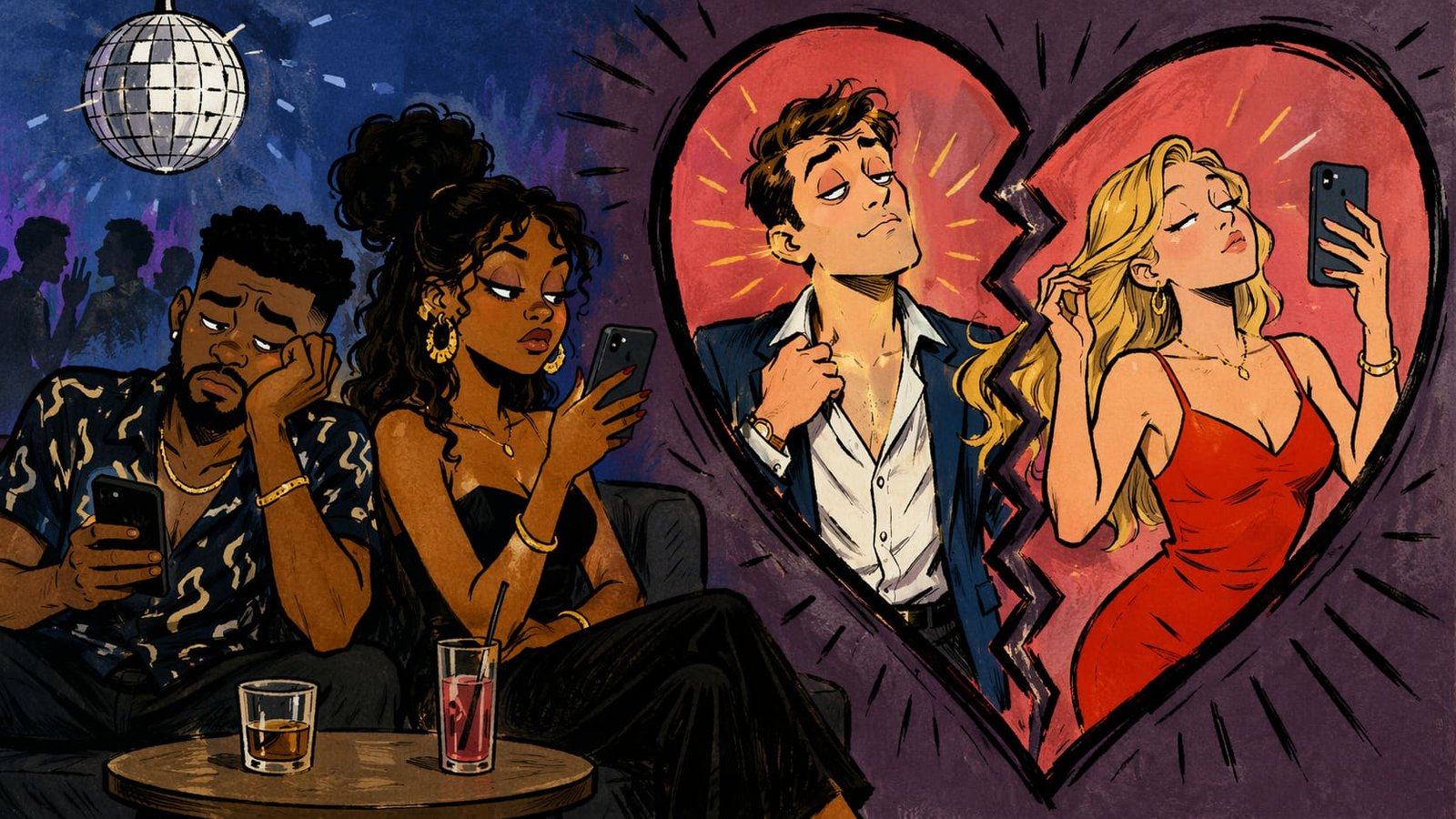
The bass still hits, heavy enough to rattle glass and blur the edges of thought, yet the room feels curiously contained, like a spectacle watching itself. Bodies move, but the movement carries a different intention now. Phones glow at chest height, faces angle toward invisible audiences, and the dance floor, once a place of collision and discovery, begins to resemble a gallery of self-curated moments. Nothing is technically wrong. The music is sharp, the lights precise, the outfits deliberate. Still, something essential feels absent, like heat without warmth.
Nightlife used to operate on a kind of beautiful unpredictability. You entered without knowing who you might meet, what song might change the mood, how a glance might turn into a conversation. The dance floor functioned as a social equalizer, dissolving hierarchy through shared rhythm. Desire moved outward, searching, responding, improvising. Now the direction has shifted. Desire folds inward, looping back toward the self, asking not who is here, but how am I seen here.
The transformation did not happen overnight. Platforms like Instagram and TikTok gradually reframed public space as content space. Every environment became a potential stage, every moment a potential clip. The club, with its lighting and energy, became especially susceptible. What was once ephemeral now carries the weight of documentation. Movement is no longer just felt. It is captured, edited, replayed.
This shift changes behavior in subtle ways. When people know they might be recorded, they adjust. Spontaneity gives way to control. Risk becomes something to manage rather than embrace. Dancing, at its core, is a form of surrender, a willingness to look slightly foolish in pursuit of connection or release. That surrender becomes harder when the possibility of exposure lingers. The result is movement that looks impressive but feels contained, expressive yet oddly distant.
A scene from a club in Miami captures the contrast. Rafael, a regular who had spent years immersed in nightlife, watched as a group near the center of the floor moved in near-perfect synchronization, each gesture crisp, each expression calibrated. It looked like choreography rather than reaction. At one point, someone stepped out briefly, checked a recording, adjusted their angle, then rejoined. The energy never quite broke, but it also never expanded. It hovered, self-aware.
The cultural narrative around nightlife has also evolved. Once framed as a space for escape, experimentation, even rebellion, clubs now sit comfortably within the broader economy of personal branding. Influencers document their nights as extensions of their online presence. Venues design experiences with shareability in mind, lighting optimized not just for atmosphere but for cameras. The feedback loop tightens. What performs well online shapes what happens offline.
Pop culture has begun to reflect this shift with a certain melancholy. Films like Spring Breakers hinted at a version of youth culture where excess and performance blur into something hollow, visually striking yet emotionally distant. The imagery is loud, almost hypnotic, but beneath it runs a quieter question about what remains when experience becomes spectacle.
There is also a psychological dimension that runs deeper than aesthetics. When attention turns inward, toward how one appears, it alters the nature of desire itself. Instead of reaching outward toward others, desire becomes self-referential. It asks how attractive, how interesting, how visible one is. This creates a subtle isolation even in crowded spaces. People stand close, yet remain slightly apart, each orbiting their own reflection.
Maya, a dancer in Berlin who once described the club as her sanctuary, noticed the change over time. She spoke about nights that used to feel like collective release, where the boundary between self and crowd dissolved. Recently, she found herself more aware of how she looked than how she felt. The music still moved her, but the movement carried an added layer of self-monitoring. It was not a dramatic shift, just enough to change the texture of the experience.
The economics of nightlife reinforce this dynamic. Venues compete not just on music or atmosphere, but on how visually distinctive they appear online. Patrons, in turn, participate in that visual economy, contributing to the club’s image while also shaping their own. The dance floor becomes a shared stage, but one where each participant is also an individual performer. The collective experience fragments into parallel acts of self-presentation.
There are still pockets where the old energy flickers. Smaller venues, less documented spaces, nights where phones are tucked away and attention returns to the immediate. In those moments, something shifts. Movements loosen, interactions feel less calculated, the air carries a different kind of charge. It is not nostalgia. It is a reminder that the underlying impulse has not disappeared. It has simply been redirected.
The tension is not between technology and tradition, but between presence and performance. Tools that extend visibility also reshape behavior. They offer new forms of expression, new ways to connect, but they also introduce a layer of mediation that can dilute immediacy. The challenge is not to reject the tools, but to understand how they influence the experience.
Somewhere in a dimly lit room, the bass continues, steady and insistent. A few people move without checking their screens, eyes closed, bodies responding to rhythm rather than reflection. Around them, others capture fragments, angles, moments designed to be shared later. Both realities coexist, overlapping without fully merging.
And in that layered space, a quieter question begins to take shape, one that lingers beneath the music and the lights: if every movement is shaped by how it will be seen, when does it still belong to the moment itself?
