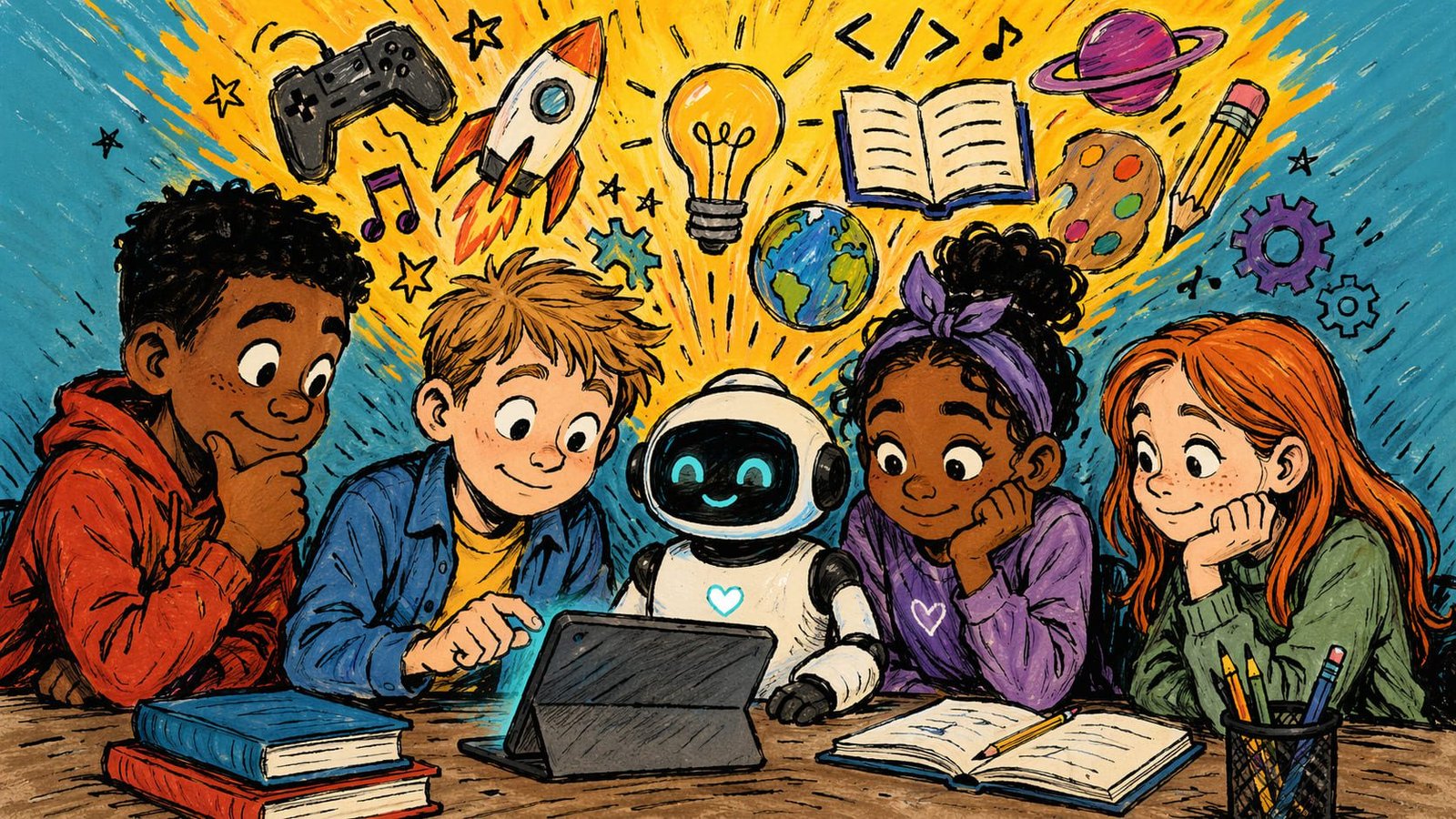
The classroom does not look unusual at first glance, rows of desks, soft murmurs, the low hum of fluorescent light. Then the detail slips in quietly. A child asks a question, not to the teacher, but to a screen. The response arrives instantly, polished, confident, oddly adult. The child nods, accepts it, moves on. No struggle, no pause, no friction. It feels efficient, even impressive. Yet something subtle lingers in the air, like a note slightly off-key. Learning has become faster, but it has also become quieter in a way that feels unfamiliar.
For decades, childhood was shaped by slowness. Curiosity unfolded through trial, confusion, and small failures that carried their own kind of joy. Now, artificial intelligence steps in as a silent partner, offering answers before questions have fully formed. Tools powered by systems like ChatGPT and platforms developed by OpenAI have turned knowledge into something immediate, almost ambient. The barrier between wondering and knowing has thinned to the point of near disappearance.
The shift carries a quiet contradiction. On one hand, access to information expands possibility. Children can explore complex ideas earlier, experiment with creativity, and engage with the world in ways that were once reserved for specialists. On the other hand, the process of discovery risks being compressed into a transaction. Curiosity becomes a prompt. Understanding becomes a response. The messy, human part of learning begins to fade into the background.
A small story captures this tension with unsettling clarity. Mateo, a twelve-year-old in Barcelona, used an AI tool to complete a history assignment. The essay was articulate, structured, and impressively detailed. His teacher praised the work, noting its clarity. Later, during a casual conversation, Mateo struggled to explain the core idea in his own words. The knowledge was present, yet it had not settled. It hovered, borrowed rather than owned.
The cultural response to this shift swings between excitement and anxiety. Tech leaders frame AI as a democratizing force, a way to level educational gaps and accelerate human potential. Critics worry about dependency, about a generation that might confuse access with mastery. Both perspectives hold truth, yet neither fully captures the deeper transformation. This is not just a change in tools. It is a change in the rhythm of thinking itself.
There is also a subtle psychological layer at play. Children are not simply absorbing information from AI systems. They are interacting with something that feels responsive, almost conversational. This creates a new kind of relationship with knowledge, one that blurs the line between authority and assistance. When an answer arrives with confidence, it carries weight, even if the child does not fully understand it. The risk is not misinformation alone. It is misplaced trust.
Consider Lila, a young student in Toronto who began using AI to help with creative writing. At first, it felt like magic. Stories came together faster, characters spoke with unexpected depth, plots unfolded smoothly. Over time, she noticed something quieter. Her own voice started to feel less distinct. When asked to write without assistance, she hesitated, as if waiting for an invisible collaborator to step in. The tool had expanded her output, yet it had also softened her sense of authorship.
Pop culture hints at this dynamic with eerie familiarity. Films like Her explore relationships between humans and intelligent systems, not as distant science fiction but as intimate, everyday interactions. The emotional tone is not fear, but ambiguity. The technology does not dominate. It integrates. That integration is where the real complexity lives.
Education systems are beginning to adapt, though unevenly. Some schools integrate AI as a learning companion, teaching students how to question, verify, and interpret machine-generated responses. Others attempt to restrict its use, treating it as a shortcut that undermines effort. Neither approach fully resolves the tension. AI is not a passing trend. It is becoming part of the cognitive environment in which children grow.
The deeper question is not whether children should use AI, but how it shapes their relationship with effort and meaning. Struggle has always been an essential part of learning, not because difficulty is inherently valuable, but because it creates ownership. When a child wrestles with an idea, the understanding that emerges feels earned. Remove that friction entirely, and something subtle changes. Knowledge becomes lighter, easier to acquire, but also easier to forget.
There is a moment many adults recognize from their own childhood, sitting with a problem that refuses to yield, feeling frustration build, then suddenly, clarity arrives. That moment carries a quiet satisfaction that no instant answer can replicate. It is not just about solving the problem. It is about discovering the capacity to solve it. AI, for all its advantages, risks compressing that experience into something more efficient but less memorable.
At the same time, dismissing AI as purely harmful misses its potential. Used thoughtfully, it can act as a guide rather than a replacement, a tool that expands curiosity rather than shortcuts it. The difference lies in how it is framed. As an answer machine, it narrows engagement. As a question amplifier, it can deepen it. The challenge is cultural as much as technological.
A teacher named Jonas in Copenhagen experimented with this balance. Instead of banning AI, he asked his students to use it to generate multiple perspectives on a topic, then critique each one. The classroom dynamic shifted. Students became less passive, more analytical. The tool did not replace thinking. It provoked it. The results were not perfect, but they hinted at a different way forward.
Still, the tension remains unresolved. Childhood is changing in ways that are difficult to fully articulate. The boundary between human effort and machine assistance is becoming increasingly porous. The skills that once defined learning are being reconfigured, sometimes subtly, sometimes dramatically. It is not a question of loss or gain alone. It is a question of transformation.
Somewhere in that classroom, the hum of fluorescent light continues, steady and indifferent. A child looks at a screen, then back at a blank page, then pauses longer than before. The pause feels significant, though it passes quickly. It is a moment where something undecided hangs in the air, a choice between accepting an answer and wrestling with a question.
And in that quiet hesitation, a deeper uncertainty takes shape, one that resists easy resolution: when answers arrive before understanding has time to grow, what kind of intelligence is actually being built?
