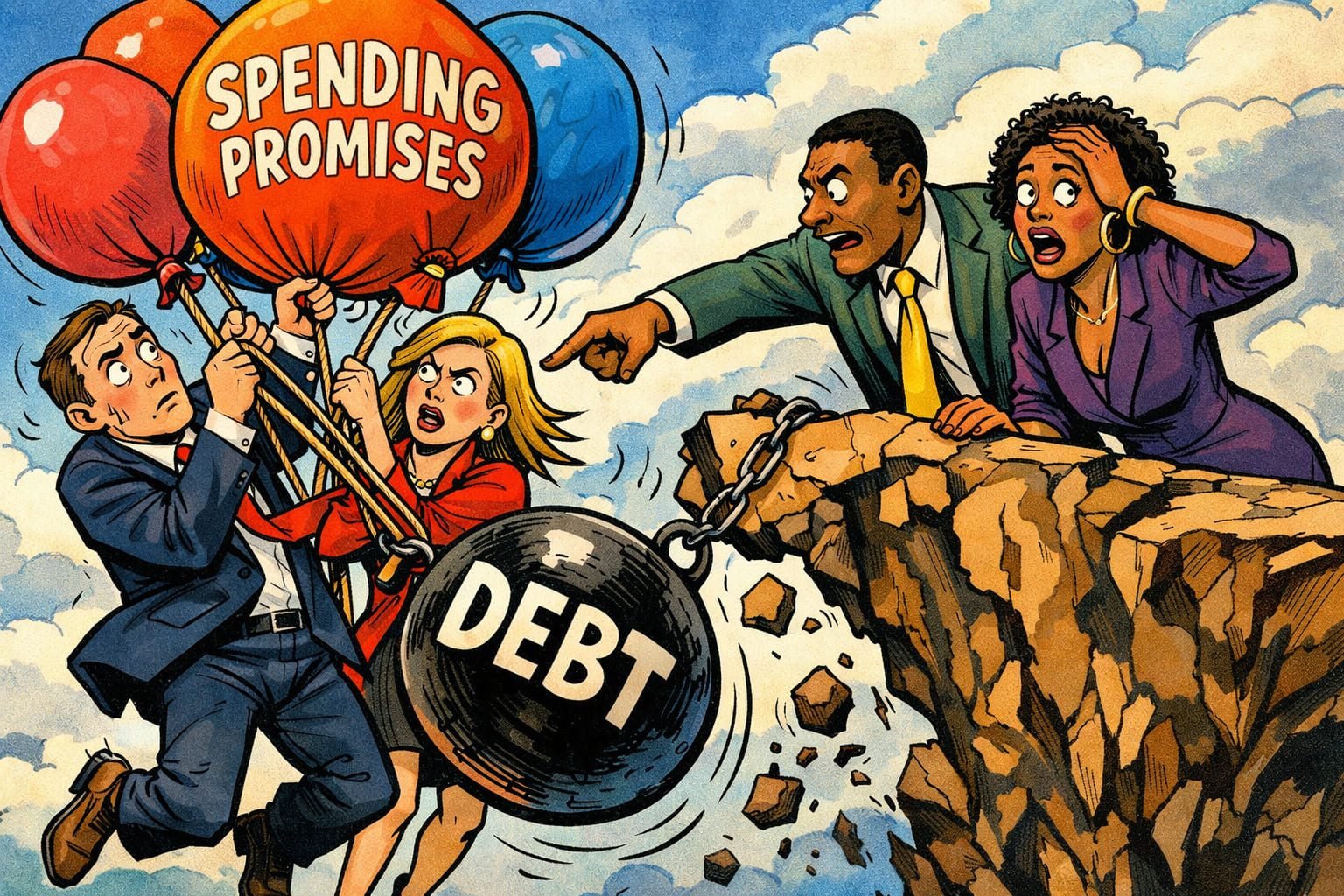
A campaign stage is one of the last places on earth where arithmetic is expected to clap on cue. The crowd roars for lower taxes, higher spending, better services, safer streets, cheaper energy, stronger growth, and somehow a balanced ledger gliding behind it all like a well-trained butler. Then government begins. Deficit politics returns every few years because promises are cheap, pain is deferred, and voters rarely meet the bond market until after the balloons have been swept away. That is why deficits are never just financial. They are the autobiography of political temptation.
The modern deficit is often sold as compassion, patriotism, urgency, modernization, or growth. Sometimes it genuinely contains all four. Crises justify spending surges, and rigid fiscal puritanism can be both foolish and cruel. Yet the danger begins when emergency logic becomes peacetime habit. The IMF has repeatedly warned that public debt remains elevated and that short-term stimulus works best when embedded in credible medium-term plans. That quiet second half is the part politicians like to mutter and then sprint past.
Deficit politics is seductive because it lets everyone feel rich before anyone feels the cost. Public employees avoid cuts. pensioners keep their support. contractors stay busy. households receive relief. ministers smile as though they have hacked reality. It resembles a streaming service free trial for a nation. The problem arrives when the subscription renews. Borrowing needs grow, interest costs rise, and the state discovers that yesterday’s applause has become today’s refinancing calendar. Promises meet gravity in exactly the way cartoon characters do. They keep running for a moment, then look down.
The heart of the problem is that deficits mean different things in different moments. A deficit during recession can stabilize demand and prevent deeper damage. A deficit during war can protect survival. A deficit used to fund productive investment may strengthen future capacity. None of that excuses lazy politics. Trouble starts when leaders treat all deficits as equally virtuous. They are not. Some are bridges. Some are crutches. Some are velvet curtains hung over structural decay. The public deserves more honesty than the ritual claim that every extra borrowed unit is an “investment” simply because someone said it near a microphone.
Europe and Britain have spent the last few years reminding policymakers that fiscal narratives can harden quickly. The ECB has noted that persistent deficits, higher debt-service costs, and large borrowing needs can increase concerns about fiscal credibility. That phrase sounds bloodless. It is not. Fiscal credibility is what keeps a government from paying panic prices for routine financing. Lose it, and the gap between political fantasy and market reality closes with a very loud snap.
The darker comedy is that deficit politics often returns disguised as anti-elite rebellion. A leader says experts are too gloomy, institutions are too slow, and fiscal rules are relics of timid minds. This message sells well because it flatters the public. It says the country has been held back not by scarcity, but by cowardice. Then the borrowing bill arrives and the romance curdles. The same establishment that looked dull in opposition suddenly looks useful when pension funds wobble, currency pressure builds, or interest payments start crowding out the very programs once sold as liberation.
There is a human reason this cycle keeps repeating. Voters live in the short run. Children need school places now. Hospitals need staff now. Families need price relief now. Politicians live in electoral seasons. Bond markets live in the future. That mismatch produces constant drama. A minister can survive tomorrow’s headlines by loosening the purse today. The market, annoyingly, is not soothed by a clever social media clip. It keeps asking the rude questions. Where is the growth? Where are the offsets? What happens when rates stay higher for longer? Who exactly pays later?
A city mayor once boasted that the budget had “protected everyone.” By winter, road repairs were paused, borrowing costs had risen, and a transit upgrade was shelved so debt service could be covered without breaching headline promises. The slogan had not been false. It had simply been incomplete. Protection for one season created fragility for the next. That is how deficits become political narcotics. They relieve immediate discomfort while quietly lowering a state’s tolerance for the future. The crowd remembers the sugar rush. The treasury remembers the invoice.
None of this means balanced budgets are a sacred object. That mistake belongs to another era of simplistic thinking. Blind austerity can damage growth, public trust, and social cohesion. The real challenge is far less theatrical and much more difficult. Governments need deficits that are purposeful, temporary where possible, and attached to credible plans for what comes next. That is not a slogan built for campaign buses, which explains why it so rarely wins the poster war. Still, durable states are not built by poster wars. They are built by institutions strong enough to say no while everyone else is drunk on yes.
The most interesting countries in fiscal history are rarely the most ideologically pure. They are the ones that know when to spend hard and when to step back. They understand that credibility is not austerity, and prudence is not paralysis. They also know something modern politics hates admitting: there are seasons when governments must disappoint people in order to protect them. Not punish them. Protect them. That distinction separates adult fiscal policy from the sugar-coated nihilism of endless deficit bravado.
The deficit debate, at its deepest level, is a debate about truth-telling. Does a government respect citizens enough to explain trade-offs, or does it keep handing out shiny promises until interest costs do the explaining? That is the real clash between politics and gravity. Political language can delay it, decorate it, or try to bully it. It cannot repeal it. Public finance has the eerie patience of a thriller villain. It waits in the corridor, calm as polished marble, until the speech ends and the doors lock.
Then the country hears the quiet sound it should have feared earlier, not outrage, not ideology, just the click of numbers aligning. In that moment the stage lights feel harsher, the slogans thinner, the room colder. Deficits were never the villain on their own. Delusion was. Gravity is not cruel. It is merely uninterested in excuses. The only question left hanging in the air is whether the next promise will finally be priced with adulthood, or whether the crowd will cheer again while the floor keeps giving way beneath the orchestra.
