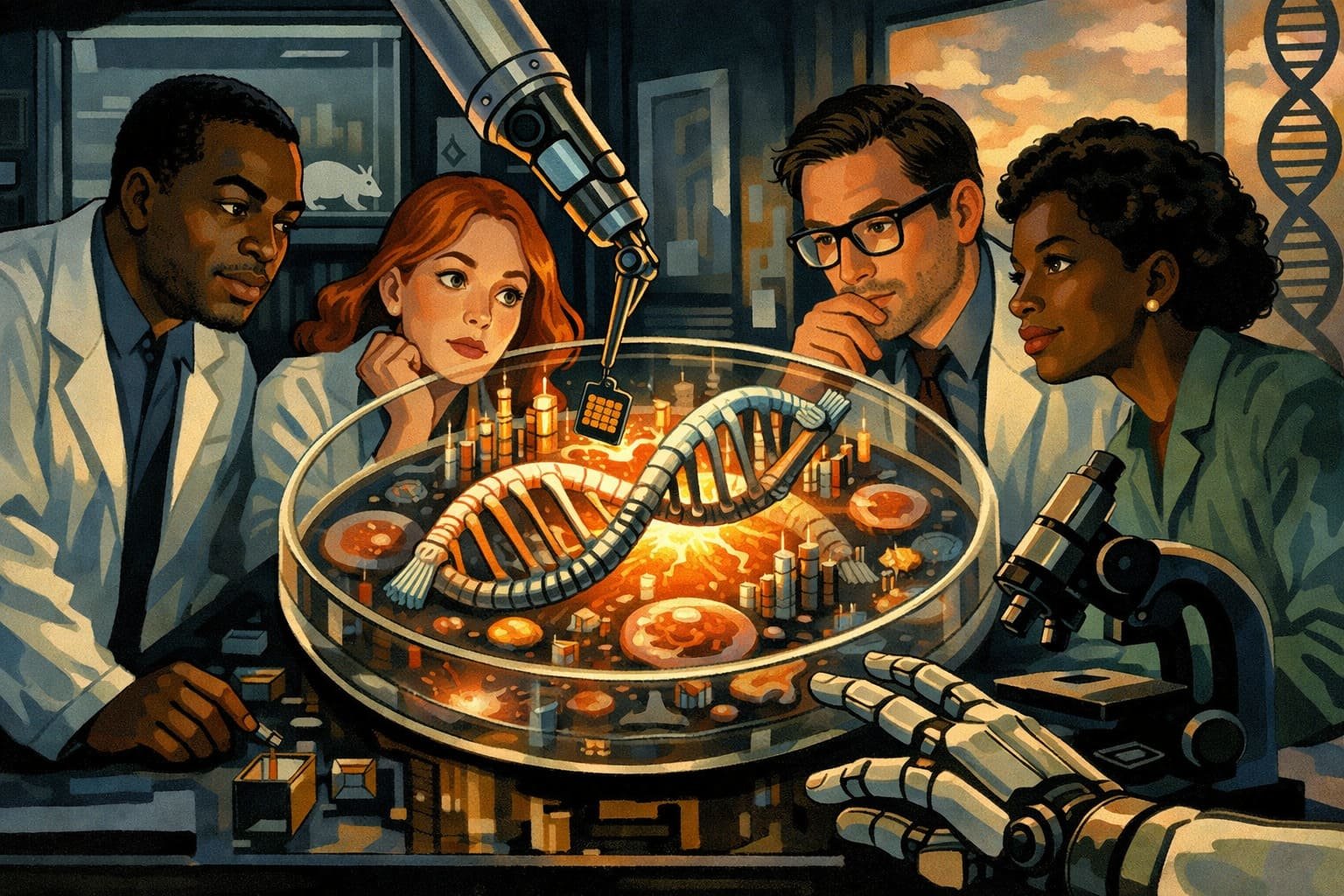
Once, biology felt like a cathedral. Vast, intricate, intimidating, and almost rude in its refusal to be rushed. Researchers studied cells the way archaeologists brush dust from fragile ruins, grateful for each clue, careful not to pretend control where only observation was honest. That posture is fading. Biology is starting to behave less like weather and more like code. Genes are edited, circuits are designed, cells are instructed, proteins are modeled, and the living world is being treated with the logic of engineering, though never with engineering’s comforting predictability. This shift is thrilling, unnerving, and morally explosive because programmable biology does not merely expand science. It reopens the oldest arguments about power, creation, error, and restraint. Reviews across synthetic biology and genome editing now describe a field moving toward designed cellular functions, synthetic communication, and more precise editing systems.
CRISPR cracked the door open by giving researchers a way to cut and edit DNA with startling precision. Then came base editing and prime editing, tools built to make finer changes without some of the collateral damage associated with older methods. The technical language can feel dry until its meaning lands: life is becoming editable at a deeper resolution. A mutation no longer looks only like fate. A cell no longer looks only like a thing to observe. It begins to look like a system with levers. Reviews of prime editing keep returning to the same promise, targeted changes without double-strand breaks, greater precision, more control. Precision sounds calm. In practice, it is revolutionary.
That promise has a seduction problem. Once people hear “programmable biology,” they jump straight to cure, optimize, upgrade, design. Silicon Valley hears a startup deck. Medicine hears therapeutic hope. Agriculture hears resilient crops. Defense planners hear possibilities that should make decent people uneasy. Parents hear miracles. Investors hear platforms. The phrase carries so much potential that it can smuggle in carelessness under the costume of progress. Living systems are not spreadsheets with metabolism. Cells are messy historians. They remember context, compensate, mutate, cooperate, drift, and occasionally mock human certainty by doing something nobody ordered. That is what makes the field exciting. It is also what makes hubris so dangerous.
Synthetic biology pushes this tension into the open. Researchers are no longer only tweaking one gene and stepping back. They are designing circuits, building systems that respond to signals, and exploring ways to make cells perform chosen tasks. Nature’s own coverage of synthetic biology in the past year reflects a field expanding toward programmable interactions, synthetic communication, and cell-surface logic. That sounds futuristic because it is. Yet the deeper story is older than futurism. Human beings have always wanted matter to obey intention. Fire, metal, steam, silicon, now cells. Each era says the same thing in a flashier accent: perhaps this time control will be clean. It never is.
A small lab story captures the emotional texture better than the headlines do. A young researcher working on engineered immune cells watched a test fail in a way that made no theatrical sense. The design looked elegant on the whiteboard. The components were right. The logic was tidy. Then the cells behaved like annoyed jazz musicians, improvising around the script. The setback did not kill the project. It improved it. The team stopped speaking about design as domination and started speaking about design as negotiation. That is the mature posture programmable biology requires. Not “life obeys now,” but “life can sometimes be persuaded if the system is understood well enough and respected enough.”
The boldest frontier may be where AI and biology collide. AI models are now helping design genome editors and predict molecular behavior in ways that let researchers imagine biological tools not handed down by evolution. A 2025 Nature paper on AI-designed genome editors argued that artificial-intelligence-enabled design can help overcome tradeoffs seen when natural CRISPR systems are moved into human cells. Read that twice. Biology is no longer just being edited. The editors themselves are being redesigned. That is the moment the floor tilts. The engineer is now engineering the thing that will engineer the cell. Anyone still treating this field as a niche technical beat is reading tomorrow’s mythology through yesterday’s press release.
Medicine will benefit from this. So will agriculture and industrial biotech. Engineered cells may someday deliver smarter therapies, sense disease states, produce useful molecules, or act with logic-like precision inside the body. Synthetic systems may help create better materials, cleaner manufacturing, and more responsive biological tools. Researchers at the University of Washington, for example, described programmable proteins using logic for targeted drug delivery, reflecting how design thinking is pushing biology toward conditional behavior rather than blunt force intervention. The imagination gap between biology and software keeps shrinking, though biology remains gloriously harder to bully.
Still, every expansion of creative power drags ethics in by the collar. What happens when editing becomes cheap enough, fast enough, and normal enough that restraint starts to feel quaint? What happens when therapeutic boundaries blur into enhancement, when safety culture loses a race against venture capital, or when governments discover that programmable systems have strategic value beyond medicine? The warnings around mirror microbes and other advanced synthetic possibilities show that scientists themselves are sounding alarms before capability hardens into routine. When researchers start publishing cautionary arguments about risks that sound like science fiction written during a fever, wise readers should stop treating governance as a boring appendix.
This is where the language of creation can get sloppy. Programmable biology does not make humanity divine. It makes humanity more consequential. That difference matters. Creation myths usually flatter the creator. Real labs are full of uncertainty, contamination worries, off-target concerns, strange behavior, regulatory hurdles, and the humbling fact that even brilliant design often survives only after many embarrassing failures. The honest emotional tone of the field is not godlike confidence. It is awe mixed with paperwork and occasional panic. That is healthier than the promotional posters suggest. It means the people closest to the work often understand its fragility better than the people selling its future on conference stages.
There is also a cultural shock hidden beneath the science. Biology used to be taught as inheritance, a story about what gets passed down. Programmable biology adds another grammar, what gets revised. That changes how ordinary people imagine disease, disability, aging, reproduction, and risk. It shifts expectations inside families and health systems. It changes the moral pressure parents may feel, the commercial pressure patients may face, and the political pressure regulators will inherit. A society that learns to edit deeper aspects of life does not simply gain tools. It gains new reasons to argue about what a person is allowed to refuse, accept, repair, or redesign.
One day, the field’s most lasting change may turn out not to be a single therapy or edited crop, but a new emotional relationship to living systems. Biology will seem less like untouchable destiny and more like a partner that can be read, nudged, and, under strict conditions, rewritten. That can liberate or corrupt. It can heal old fatalism or create fresh vanity. Like every serious tool, it reveals character as much as capability. The scientists worth trusting are rarely the loudest. They are the ones who can describe both the miracle and the mess without trying to hide either.
Late in the evening, somewhere under sterile lights and tired eyes, a dish of cells will respond in a way that feels almost indecently alive, as if the future winked back through glass. Not obedient, not magical, just responsive enough to remind everyone in the room that biology has entered a new era without becoming simple. The old rulebook is not gone, but it is no longer sovereign. Nature still writes most of the script. Human beings have simply begun scribbling in the margins with tools powerful enough to alter the next chapter. The danger is not that life can be programmed, it is that people may forget every line of code written into living matter also writes something back into the human soul.