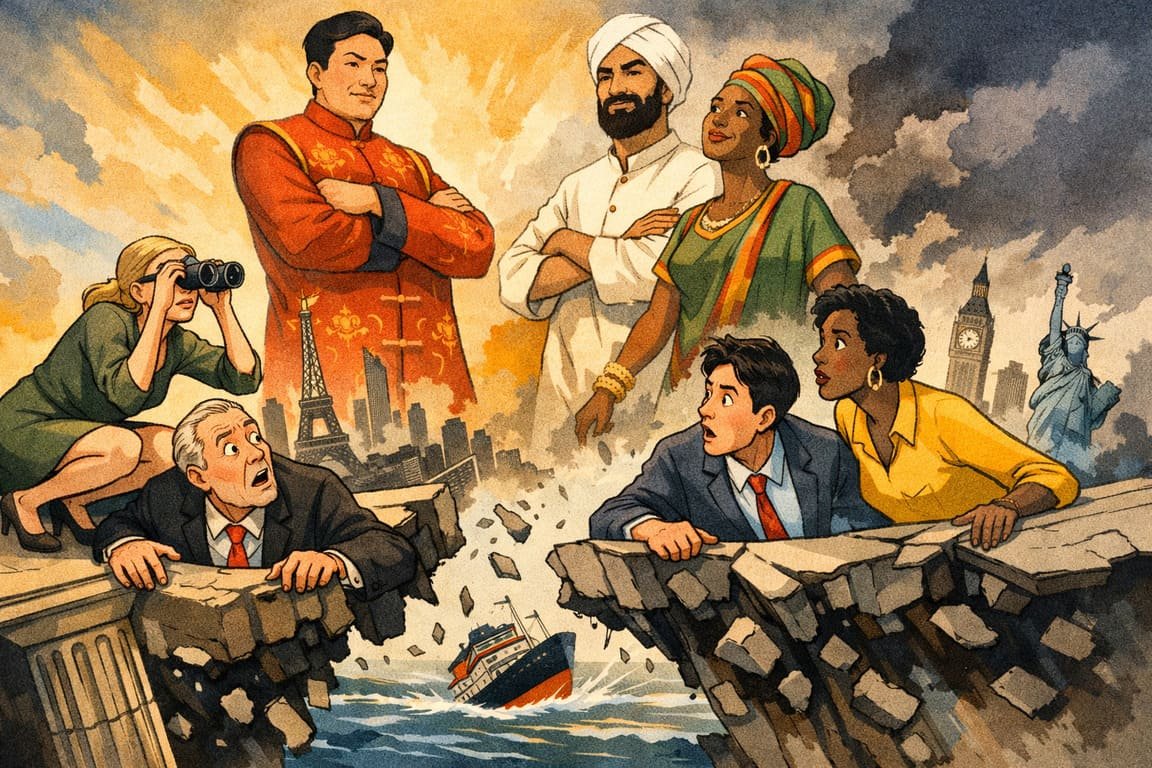
The trading floor glows before dawn, screens pulsing with numbers from cities that once sat at the margins of strategic maps. Currencies rise from unfamiliar capitals. Supply chains reroute without asking permission. Conversations sound different now, less certain, more alert. No alarms ring, yet a quiet realization spreads. Power is no longer moving in a single direction. The world did not flip overnight. It simply stopped waiting.
For decades, Western dominance felt less like a position and more like a condition. Economic leadership, cultural authority, technological standards, and political norms flowed outward from a familiar core. This was not always arrogance. It was routine. Institutions formed around it. Careers assumed it. Narratives reinforced it. The idea that progress followed one path became embedded so deeply it felt natural. That assumption has cracked, not because the West collapsed, but because others rose without asking to follow.
The rise did not arrive with spectacle. It accumulated through manufacturing capacity, education investment, regional trade, infrastructure planning, and patient strategy. While Western systems optimized for speed and quarterly returns, others optimized for endurance. Long horizons mattered. State coordination blended with market ambition. A logistics executive in Southeast Asia once remarked that patience had become their most undervalued competitive advantage. The results now appear in ports, railways, research hubs, and financial centers that no longer orbit Western approval.
What unsettles the West most is not competition, but unfamiliar rules. These emerging powers do not always prioritize liberal democracy, open expression, or Western legal frameworks in the same way. Their systems mix control with growth, collective stability with individual restraint, pragmatism with ideology. The success of these models challenges a long held belief that prosperity naturally produces Western style governance. That belief now feels less like principle and more like projection.
Cultural confidence followed economic strength. Music, film, fashion, technology platforms, and social norms now flow outward from multiple centers. Aspiration diversified. A teenager in Nairobi might dream of Seoul, Mumbai, or Shenzhen as readily as London or New York. Soft power fractured into many streams. The West no longer monopolizes imagination. Influence travels faster than instruction.
Western institutions struggled to adapt because they were built to lead, not to listen. Trade frameworks assumed alignment. Security alliances presumed hierarchy. Financial systems relied on compliance. When new powers declined to follow old scripts, the response leaned toward enforcement rather than recalibration. Sanctions lost leverage. Moral appeals sounded selective. A retired diplomat once admitted that authority weakens fastest when leadership confuses habit with legitimacy.
Economic anxiety sharpened the reaction at home. As manufacturing shifted and supply chains diversified, Western workers felt displacement they once associated with globalization elsewhere. Political rhetoric framed this as loss rather than transition. Nostalgia filled the vacuum where strategy should have lived. The rise of others became framed as decline, even when opportunity still existed in different forms.
Technology accelerated the redistribution of influence. Innovation no longer clusters in a few postcodes. Research ecosystems thrive wherever talent, capital, and policy align. Intellectual property flows both ways. Collaboration replaces imitation. The assumption that creativity belongs to one hemisphere no longer survives contact with reality.
The deeper disruption lies in narrative collapse. The story that progress follows a single model no longer holds. Multiple versions of modernity now coexist. Some succeed. Some struggle. None wait for permission. This pluralism unsettles those accustomed to setting standards rather than negotiating them. Power now requires relevance, not inheritance.
Adaptation remains possible. History favors societies that treat change as instruction rather than insult. Renewal comes through reinvention, not resistance. That means investing in people rather than defending nostalgia, cooperating rather than policing, and competing without demanding dominance.
Picture a round table growing crowded, chairs added where none existed before. The conversation becomes louder, more complex, harder to control. No one owns the room anymore. That discomfort signals reality, not decline.
The rise of non-Western giants does not announce the end of the West, but it does demand maturity, and the quiet question resting with you now is whether strength still means standing at the center, or learning how to lead when the center no longer belongs to anyone alone.
