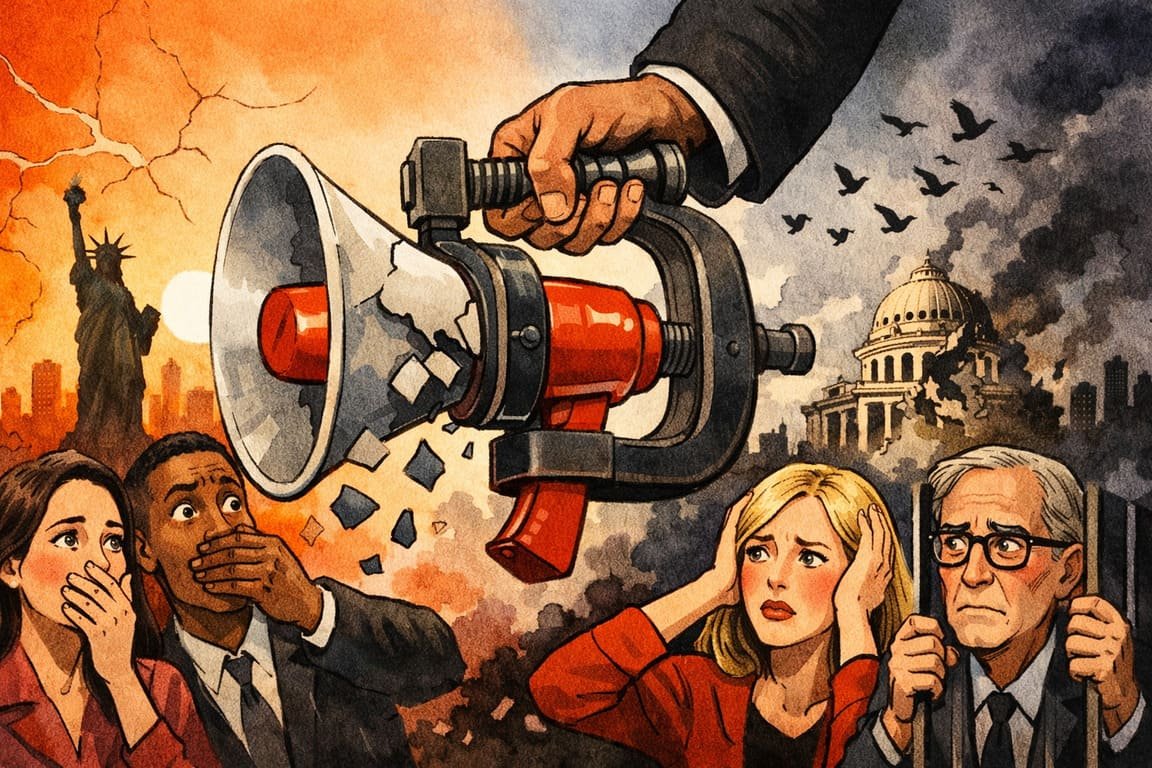
The hall was built for disagreement. Stone walls carried centuries of raised voices, pauses heavy with thought, arguments sharpened by the belief that speaking openly was not reckless but necessary. Now the air felt different. Words arrived cautiously, padded with qualifiers. Silence lingered longer than conviction. Nothing had been banned outright, yet something essential had begun to feel expensive.
Free speech rarely disappears through dramatic force. It thins through consequence. The rules remain printed. Rights stay framed on walls. What changes is the calculation people make before opening their mouths. A sentence is weighed not only for truth, but for fallout. Careers, friendships, reputations, and safety hover behind every thought like unseen toll booths.
Technology reshaped this balance without asking permission. Speech no longer fades into rooms. It travels, stripped of tone and context, preserved indefinitely. A comment meant for a moment can resurface years later, reframed, reinterpreted, weaponized. Platforms reward clarity over care, certainty over curiosity. Nuance dissolves quickly when compressed into feeds built for reaction.
Governments respond to this volatility cautiously and sometimes opportunistically. Laws aimed at reducing harm expand quietly. Language around safety grows elastic. Protecting citizens becomes a justification broad enough to include discomfort. Few argue against safety. Fewer notice when its definition stretches just enough to include dissent.
Culture compounds the pressure. Communities fracture along moral lines where words signal allegiance. Intent matters less than impact, yet impact remains subjective terrain. People learn which questions trigger backlash and which remain safe. Over time, curiosity adapts. It shrinks. Silence becomes social self defense.
A school administrator named Daniel once removed a discussion topic from a curriculum, not by order, but by instinct. Complaints had followed similar conversations elsewhere. No incident had occurred in his classroom. Prevention felt prudent. Months later, students debated less freely. The lesson landed without instruction. Certain thoughts were not worth voicing.
Democracy depends on friction. Ideas refine through challenge. When disagreement retreats underground, consensus becomes brittle. Policies pass smoothly, yet confidence erodes quietly. Public agreement masks private doubt. That doubt does not vanish. It accumulates, waiting for moments when expression escapes through less constructive channels.
Media navigates this terrain uneasily. Outrage drives traffic. Backlash shapes coverage. Editors anticipate reaction before publication. Stories soften or disappear. This is not always censorship. It is risk calculation in an environment where reputational damage travels faster than clarification. Over time, acceptable discourse narrows without formal decree.
Philosophically, the tension exposes a paradox. A society committed to dignity must still tolerate discomfort. Shielding people from offensive ideas may protect feelings temporarily, yet it weakens the muscles required for pluralism. Democracy asks citizens to endure disagreement without demanding erasure. That endurance is learned, not automatic.
History offers quiet warnings. Suppressed speech rarely dissolves peacefully. It resurfaces louder, angrier, stripped of nuance. Healthy democracies vent tension openly. Fragile ones store it until rupture. The difference lies less in law than in culture, less in permission than in courage.
Some spaces resist the drift. Classrooms that reward questions. Newsrooms that publish complexity despite backlash. Communities that treat disagreement as engagement rather than threat. These places feel slower, sometimes messier, yet they preserve the habits democracy requires to breathe.
The hall still stands. The walls remember. The echoes wait patiently for voices willing to risk misunderstanding. Whether democracy fades depends not on whether speech is allowed, but on whether enough people decide that the cost of silence has grown higher than the risk of being heard, because once a society learns to whisper its truths, it may struggle to recognize itself when it finally tries to speak again.
