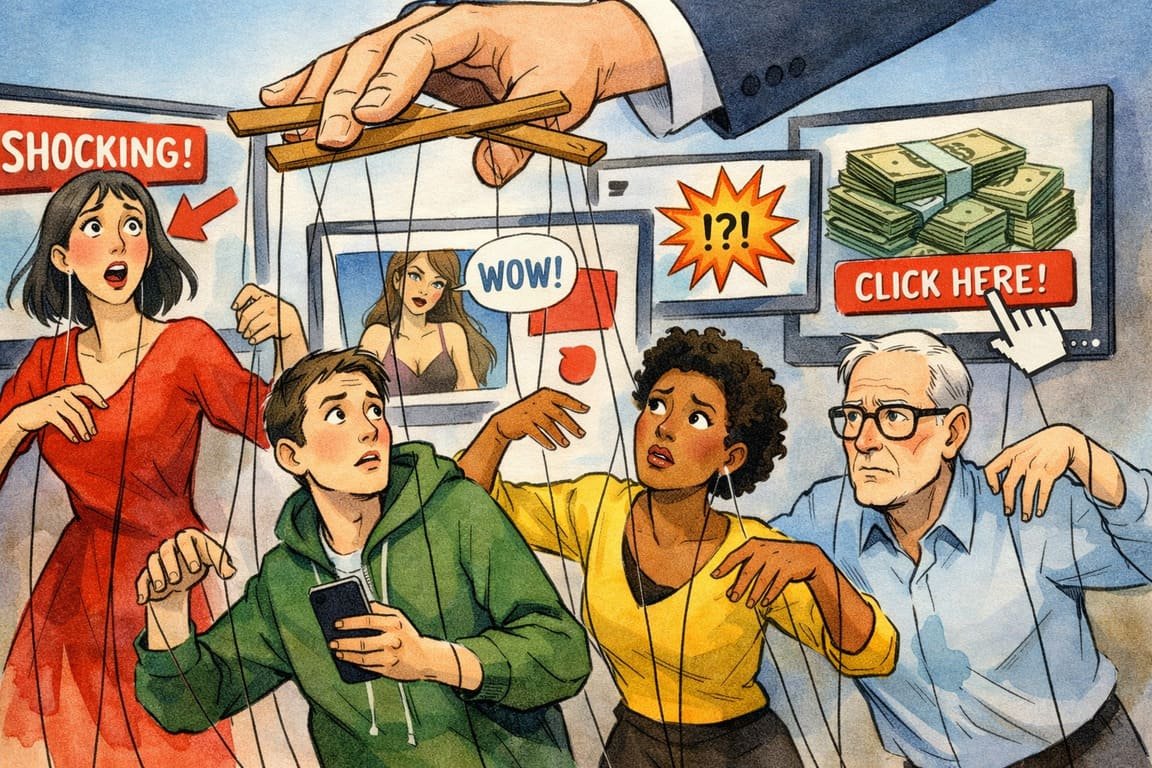
The newsroom glowed like a trading floor after hours. Screens pulsed with arrows and percentages, green for attention gained, red for attention lost. Coffee went cold. Copy desks stayed quiet. The loudest voice in the room belonged to a graph that refreshed every few seconds, judging sentences not by truth or craft, but by how fast they made a finger twitch. Nobody voted to replace editors with dashboards. It happened because speed paid better than patience.
Clickbait did not begin as deceit. It began as adaptation. A headline learned to lean forward, to tease without telling, to promise urgency. Readers rewarded it with clicks. Platforms rewarded it with reach. Publishers rewarded it with survival. What followed was not a conspiracy, but an arms race. Each outlet sharpened tone, trimmed context, and amplified emotion because the system measured success in reactions, not understanding.
The strings are pulled by incentives disguised as neutrality. Algorithms do not care about accuracy. They care about engagement signals that arrive clean and fast. Anger travels well. Fear travels faster. Nuance trips over itself and falls behind. A careful investigation competes with a sentence that sounds like a verdict. The latter wins more often, not because it is better, but because it fits the machine.
Editors feel the pressure first. A reporter spends weeks verifying a complex story. It lands quietly. Another piece, written in an afternoon with sharper edges, explodes. Lessons settle in the bones. Writers learn which words travel. Which angles spike. Which doubts kill momentum. Nobody issues a memo. Behavior changes anyway.
Platforms insist they do not choose sides. Yet every system chooses values. When outrage outperforms explanation, the feed fills accordingly. The result looks chaotic, but it is remarkably consistent. Content that confirms identity spreads. Content that challenges it stalls. Truth becomes less about accuracy and more about alignment with emotion.
Politics noticed early. Provocation mobilizes faster than persuasion. A headline framed as certainty, even when misleading, can shape belief before correction arrives. Corrections rarely travel with the same velocity. The first impression sticks. Campaigns learned to plant narratives that move independently of facts, hitching rides on outrage until repetition hardens familiarity into confidence.
Readers participate, often unwillingly. Every tap teaches the system. Complaints about manipulation coexist with habits that reinforce it. Curiosity drifts toward extremes because extremes feel decisive. Ambiguity demands effort. Over time, audiences grow cynical. If everything sounds exaggerated, skepticism replaces discernment. Trust erodes not from one lie, but from endless distortion.
A journalist named Maya once watched a sensational headline expose a local abuse of power after years of ignored reporting. The clickbait traveled. Officials responded. Change followed. The moment complicated her certainty. Sensation can illuminate when seriousness fails. The problem is not attention itself, but who controls it and why.
Culture absorbs the fallout. Conversations flatten. People argue headlines rather than ideas. Social bonds strain under constant performance. Silence feels safer than misinterpretation. The cost of being misunderstood rises. In that climate, truth must shout to be heard, and shouting reshapes truth.
Philosophically, clickbait reflects a deeper bargain. Attention has replaced time as the scarce resource. Systems compete for it ruthlessly. When meaning depends on metrics, values bend. The question becomes uncomfortable. Is manipulation imposed, or is it the natural outcome of monetizing human reflexes at scale.
Some creators resist. They slow down. They build audiences patiently. Newsletters replace feeds. Small communities value trust over reach. These spaces feel quieter, yet sturdier. They prove alternatives exist, even if they struggle against louder currents engineered for speed.
Real power lives upstream. Not with writers chasing clicks, but with those designing the rules of visibility. A single tweak can bury rigor and elevate spectacle. Accountability diffuses across code, policy, and profit, leaving no single hand to confront.
The screens keep refreshing. Another headline flashes, sharpened to a point. The choice arrives quietly, again and again, whether to reward urgency or depth, because the strings pulling the chaos tighten every time attention is given away without asking who truly benefits when truth learns to shout just to survive.
