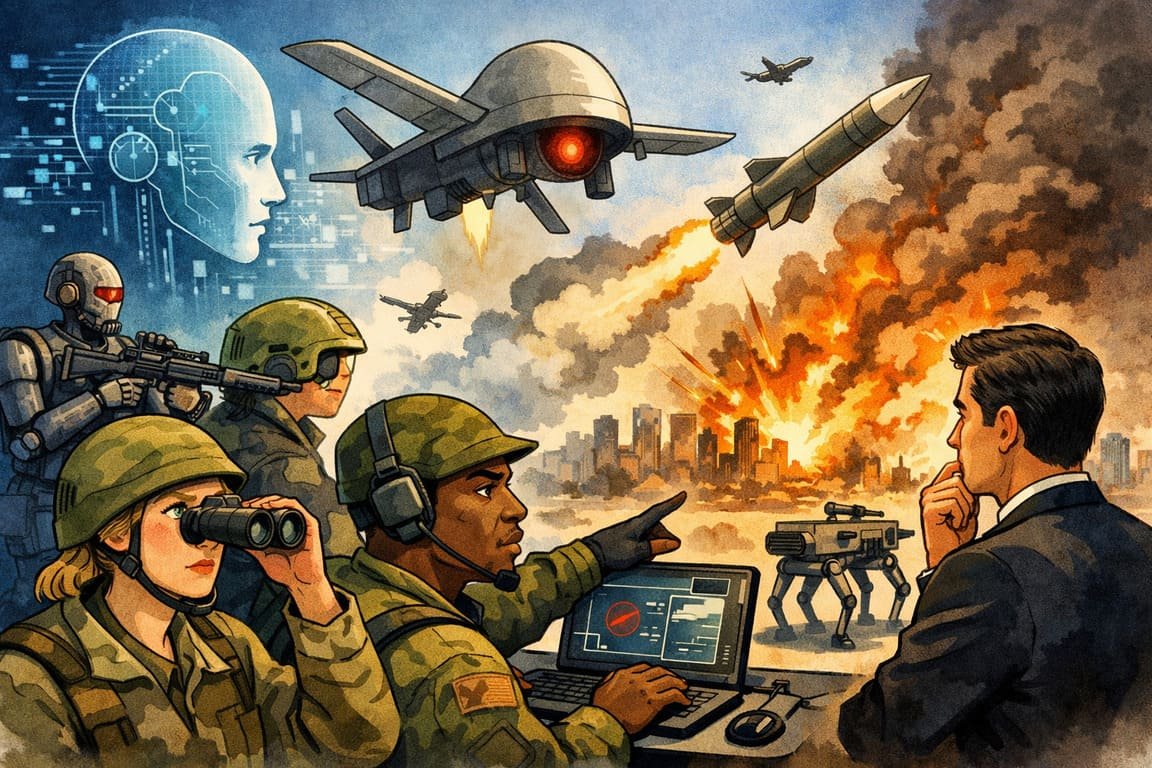
The room feels sterile, almost calm. Screens glow without urgency. No raised voices. No visible fear. Somewhere beyond those walls, a weapon is adjusting its path, not because someone told it to, but because it learned something new a fraction of a second ago. This is what war looks like now when intelligence no longer means human judgment alone. The most consequential choices unfold quietly, inside systems that do not hesitate, doubt, or feel the weight of consequence.
War has always been shaped by technology, yet it remained anchored to human decision making. Even when machines extended reach or speed, people still interpreted the moment. Artificial intelligence disrupts that anchor. Smart weapons do not merely execute commands. They evaluate environments, classify threats, and adapt in real time. The role of the human shifts from decider to supervisor, from actor to overseer. That change sounds subtle. It is not.
Militaries did not leap blindly into this future. Adoption arrived in increments. Algorithms optimized logistics. Software flagged anomalies in surveillance feeds. Decision support tools suggested courses of action. Each step felt reasonable, even responsible. Over time, the suggestions became more accurate than the people reviewing them. Trust followed performance. Eventually, hesitation felt inefficient.
Autonomous drones capture this transformation vividly. Early models required constant remote control. Newer systems navigate complex terrain independently, learning from prior missions and adjusting to countermeasures. A fictional after action report circulated among defense planners describes a drone delaying engagement after detecting civilian movement, recalculating risk without human input. Supporters praised restraint. Critics paused at the implication. A machine had exercised judgment.
Responsibility grows harder to trace here. When an algorithm errs, blame scatters. The engineer wrote the code. The commander approved deployment. The system made the call. Legal frameworks built around human intent strain under this diffusion. Accountability becomes abstract, and abstraction weakens restraint. When no one feels fully responsible, caution becomes optional.
Culturally, this shift distances societies from war’s reality. When fewer soldiers deploy, public attention thins. Casualties become asymmetrical, concentrated far from authorizing populations. Conflict feels cleaner, almost clinical, to those watching from afar. That emotional distance lowers political cost. War becomes easier to continue precisely because it feels less visible.
Strategically, speed dominates everything. AI systems react faster than humans can process information. Command structures flatten. Machines communicate directly, compressing decision cycles into moments. In that environment, escalation can occur before diplomacy has time to breathe. A misclassification, a corrupted data stream, or an adversarial spoof can spiral quickly. The margin for correction shrinks.
Supporters argue that AI could reduce harm. Precision targeting may limit collateral damage. Predictive analytics might prevent escalation by identifying risks early. These possibilities exist, but they are fragile. They depend entirely on design ethics, data quality, and political intent. Technology amplifies purpose. It does not supply one.
A quieter danger lurks beneath operational success. Human skill begins to erode. Officers trained to monitor systems rather than think independently may struggle when automation fails or is compromised. Judgment atrophies when it is rarely exercised. The fallback plan weakens the longer it goes unused.
Arms race logic accelerates adoption. Once one state deploys advanced autonomous systems, others feel compelled to follow. Restraint looks like vulnerability. Unlike nuclear weapons, AI proliferates quickly and invisibly. Code spreads faster than treaties. Verification becomes elusive. Norms lag behind capability.
Civil oversight struggles to keep pace. Algorithms operate behind classification walls. Public debate arrives late, often after systems are embedded. National security arguments silence scrutiny. By the time citizens understand what is deployed in their name, reversal feels unrealistic. Trust erodes quietly.
Philosophically, this moment forces a reckoning with responsibility itself. War has always tested human limits, fear, courage, and restraint. When machines enter that space, the test shifts. It becomes about governance, design choices, and moral discipline in the face of efficiency. The danger is not that machines become malicious. It is that humans become comfortable letting them decide.
In a dim operations center, a screen flashes confirmation. Task complete. Data archived. No celebration follows. Just another system log saved for review. The world moves on, largely unaware of how profoundly conflict has changed. As smart weapons settle deeper into the architecture of war, one question presses quietly against the future: when speed outruns conscience and automation replaces hesitation, who still carries the burden of choosing when violence should stop?
