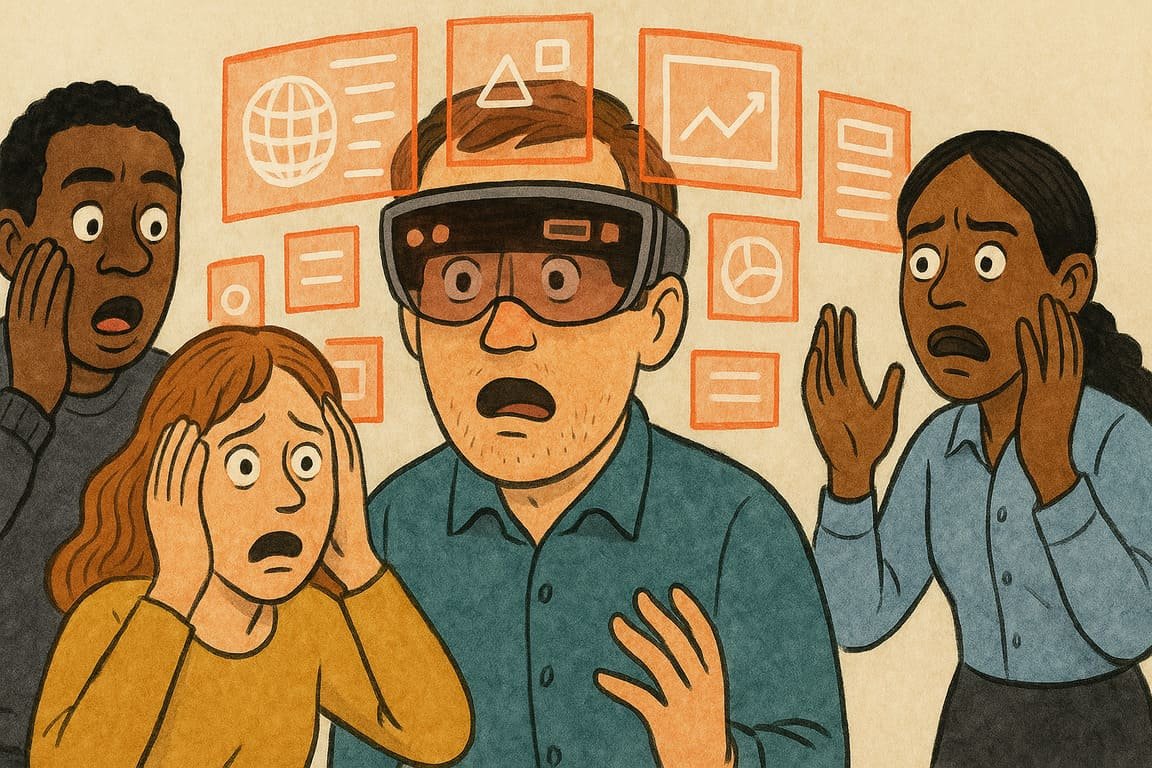
Beneath the polished marble floors of a tech expo, a quiet dread ripples through the crowd. Glasses shimmer with digital overlays, virtual widgets dart across the air, and menus hover inches above sweating hands. The old playbook dissolves as augmented reality, once a sci-fi dream, steps off the screen and into the mess of real life. Designers who built their careers on pixel-perfect rectangles now face a vertigo of possibilities, their comfort zone evaporating into thin air. Each glance, each gesture, redraws the boundary between digital and physical. Here, panic isn’t paranoia—it’s the new starting line.
Every decade brings its flavor of disruption, but nothing lands quite as jarringly as AR. You feel it in your bones when a familiar grocery aisle mutates into a jungle of floating coupons, or when street signs bloom with swirling data. The rules that guided screen design—grids, gutters, icons—suddenly feel quaint. “Everything is up for grabs,” muttered Jacob Lenz, lead AR designer at Meta, after a failed prototype demoed to silence. The job has changed overnight, and everyone knows it.
You’re part of a generation taught to make pixels sing, to tame chaos with order. Now, as AR layers digital ghosts atop messy reality, every surface is fair game and every mistake is magnified. Think of the dissonance when Pokémon Go players wandered into traffic, or the absurdity of AR shopping apps painting sofas in the middle of busy sidewalks. The invisible hand of the designer no longer hides behind a rectangle. It stands exposed, vulnerable, and in need of new instincts.
Fumbling with an AR wayfinding app in a labyrinthine airport, you realize that what works on a phone becomes a disaster in 3D space. The lines blur between user experience and physical safety. When a child’s toy menu floats just above a staircase, who owns the consequences? Designers—once protected by layers of abstraction—now face ethical dilemmas with every swipe.
AR platforms are still the Wild West. Each company stakes its own territory, yet no sheriff has stepped in to standardize anything. Apple’s Vision Pro, Google’s persistent attempts, and Microsoft’s HoloLens all make promises but hand designers a blank slate full of risk. Veteran UX leader Fiona Hayashi summed it up backstage at SXSW: “It’s like being asked to paint with wind.” That kind of uncertainty, she says, breeds both creativity and chaos.
You crave rules. You crave certainty. But AR punishes hesitation. The brave leap in, learning from mishaps like digital sticky notes that block emergency exits or interface elements that float away mid-demo. Every error becomes a public lesson. Real world case: an AR navigation app in Seoul routed commuters through a fountain, turning a promising launch into a viral meme. The lesson: context is king, but humility is queen.
AR shifts the designer’s audience from the mind to the body. No longer can you rely on familiar cues. Users walk, run, trip, laugh, and live inside your designs, not just with them. A failed UI in AR isn’t just confusing—it’s dangerous, embarrassing, and unforgettable. You watch the headlines for stories of accidents, and you know the world will judge the discipline by its worst blunders.
There’s opportunity here, too. Brands like IKEA, who transformed home shopping by letting customers place virtual couches in their living rooms, became the new heroes. Their designers reimagined every gesture and shadow, sweating the details nobody else saw. That’s the lesson: survival belongs to those who obsess over the invisible seams.
The AR gold rush has already begun. Venture capital chases every startup promising to tame the chaos. Designers split their time between learning Unity, sketching in 3D, and studying human gait. Conferences buzz with nervous jokes about abandoning Figma for Blender. You wonder if anyone is really prepared for this tidal wave of change, or if you’ll look back years from now and laugh at the primitive experiments of today.
Whispers of burnout flicker through online forums. Veteran designer Corey Mendez jokes, “AR made me a therapist for my own team.” This new discipline devours old assumptions, rewards curiosity, and crushes ego. Even the best stumble. In meetings, you watch bosses panic, clinging to wireframes that never make sense off-screen. It’s a humbling spectacle.
As you try a new AR meditation app, it becomes clear: design is no longer about arranging what’s inside a box. Now, you choreograph the air around you. Every decision must be bolder, every failure more public. This is not just a new tool. It’s an existential leap into the unknown.
Behind the hype lies the truth: most AR experiences today are clumsy, uncanny, and awkward. But so were the earliest websites, and before that, the first glossy magazines. What matters is not the novelty, but the courage to remake the rules for a world that never stands still. The ones who embrace this will define the language of the future.
On a rooftop overlooking the city, digital halos shimmer above passersby, each a testament to design choices made in distant studios. A designer watches their own work flicker across the skyline, aware that every mistake, every risk, hangs in the air for all to see. There’s no retreat now—no wall left to hide behind. The wind tugs at the edges of projected menus, and with each breath, the future redraws itself. The night asks one question: will you dare to shape a world you cannot control?
