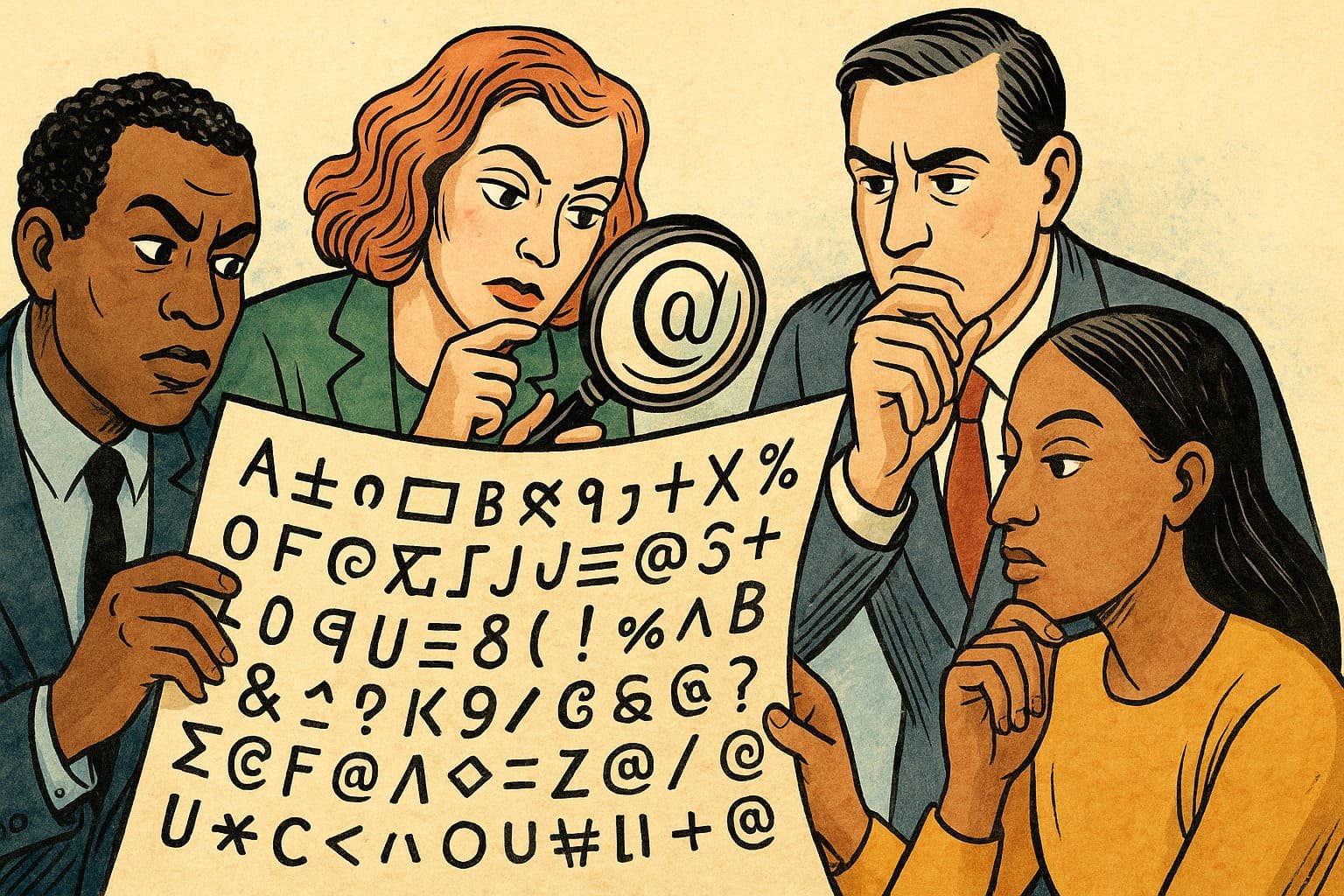
Behind every boardroom door, a silent performance unfolds. Fluorescent lights flicker overhead as nervous glances dart across the table, each executive clutching a script only they can read. Power hangs thick in the air, but the real dialogue happens offstage: a raised eyebrow, a hurried coffee refill, the haunting silence after someone dares to question the plan. It’s not the words that decide who rises or falls. It’s the code that hums beneath the invisible messages stitched through every conversation, email, and awkward pause. In this place, perception is currency, traded in nods and glances sharper than any memo. Just ask Hannah Lin, the marketing head who once salvaged her career with a well-timed sigh in a strategy meeting, the kind of sigh that said, “I know something you don’t, but I’ll let you think you figured it out.” Nobody remembers her bullet points. They remember the feeling of having missed something important.
Every workplace, every relationship, every news headline; these are just stages for the greatest illusion: that meaning lives in what’s spoken. The truth hides in the margins, where tone, timing, and subtext do their quiet work. If you think you’re immune, try recalling the last compliment you received. Did you trust it, or did your mind run wild searching for the catch, the motive, the unspoken warning? Most never realize they’re decoding, but the process never stops. Perception is the algorithm that rewrites reality without permission, turning harmless remarks into threats, and simple gestures into life-changing signals. That’s why legends aren’t made by shouting louder, but by mastering the hidden messages that shape everything.
There’s a name for this ancient magic. Some call it “emotional intelligence.” Others brand it “strategic communication.” But at its core, it’s a code; a living, breathing Perception Code. Those who crack it move through chaos with a sense of calm, never fooled by surface drama, always three moves ahead. While the masses scramble to say the right words, the masters listen for what’s missing. They see the world not as it is, but as it’s suggested to be. The real question isn’t whether you’re sending messages, but whether you control the code or the code controls you.
Welcome to the ultimate decoding game. Your place in this story isn’t in the audience. You’re center stage, whether you know it or not.
Quick Notes
- Every Message Lies Twice: The words you say never tell the whole story. The tone, pauses, and context do most of the talking. Like in the movie “Inception,” meaning is planted deep so deep you don’t know it’s there until it blooms.
- You Are Always Broadcasting: Whether you want to or not, your body, your silences, and your choices speak volumes. You might think you’re hiding your real opinion, but that side-eye at 3 p.m. just told your boss everything.
- Power Hides in Subtext: The strongest leaders win not with what they say, but with the signals they send. Watch how Apple’s Tim Cook uses a single raised eyebrow in an earnings call to set off a week’s worth of news.
- Culture Codes Are Invisible Walls: What feels friendly in Berlin can seem hostile in Nairobi. Every team, family, and society has its own codebook. Decode it, or risk being left out.
- The Real Fight: Fact vs. Feeling: Logic rarely wins against perception. A data report can die in seconds if the room senses doubt. People follow what feels true, not just what is true. Ignore this, and you lose the room before you start.
Signals in the Static—Why Meaning Is Never Neutral
Words are only half the story, and sometimes not even the most important half. In the echo chamber of modern offices, slack messages and emails create more confusion than clarity. People cling to punctuation marks like life rafts, decoding a period as anger, or a smiley face as passive aggression. Once, at a fintech startup, a junior analyst misread a curt “noted” from her supervisor as the kiss of death for her project. The fallout lasted weeks, not because of facts, but because of feelings layered under a single word.
Every digital ping and face-to-face chat is laced with cues only the hyper-aware can read. Leaders who thrive aren’t just articulate, they’re hyper-literate in reading the invisible ink. Elon Musk’s interviews, for instance, are masterclasses in controlling the subtext: he shrugs, smirks, and lets silence stretch, forcing listeners to project their hopes or fears onto his words. The less he says, the more people imagine.
In these high-stakes games, neutrality is a myth. Even silence signals intent. When a team leader stops replying in a group chat, the anxiety in the room doubles. Who did something wrong? Why now? A single non-response creates more havoc than a thousand official memos.
The Perception Code demands constant recalibration. What worked yesterday may backfire tomorrow. This reality is why veteran managers never rely on scripts. They read the air, sense tension, and pivot mid-sentence if they feel the wind change. A well-timed pause, a softened tone, or a deliberate glance can shift a team’s morale faster than any pep talk.
Humans are hardwired to read between the lines. This is survival, not strategy. Just ask any poker player, like rising star Chen Huang, who once won a championship not by the strength of her cards, but by the nervous twitch in her opponent’s eyebrow. The secret is always in the subtext.
The Invisible Script—How Hidden Messages Decide Who Wins
Every workplace drama unfolds like a script, but most never see the real lines. Hidden messages are the stage directions that determine who earns trust, who gets ignored, and who becomes a cautionary tale. Consider the infamous story of “Operation Y,” a project at a global consultancy where a junior consultant, Farah Mensah, solved a major bottleneck but never got credit. Her insights arrived wrapped in timid language, with too many apologies, so her ideas vanished. Six months later, a senior partner repackaged the same solution with assertive signals; steady eye contact, upright posture, and confident pauses. Guess whose name went on the award?
These invisible scripts start early. Schoolyard social codes reward charm and punish awkward honesty. Over time, people learn to hedge their opinions and read the crowd before speaking up. This code evolves into adulthood, shaping boardroom dynamics and even presidential debates. Candidates often win not by policy, but by how effectively they signal strength, empathy, or control; think of how a single misjudged gesture can decide an election.
Inside top tech companies, managers often play “status games,” sending subtle cues to establish hierarchy. A well-placed anecdote or laugh can win allies or isolate threats. In a famous Silicon Valley tale, a product manager turned a hostile team around simply by asking, “What’s the story behind this bug?” The room relaxed. No blame, just curiosity; a hidden message that changed the team’s mood overnight.
These scripts are universal, but the codebooks differ. A joke that builds trust in New York might destroy credibility in Tokyo. Netflix’s expansion strategy included training its leaders to read cultural cues across borders. Reed Hastings reportedly invested heavily in coaching managers to sense discomfort in meetings and adapt, creating a culture where perception wasn’t left to chance.
The lesson is ruthless: outcomes aren’t always determined by merit or logic. Hidden messages delivered through body language, timing, and subtext decide who advances and who gets left behind. Learn to spot the script, or risk becoming just another extra in someone else’s show.
Breaking the Matrix—Decoding Culture, Status, and Power
Culture is a machine built on hidden codes. Walk into any company’s headquarters, and you’ll feel it before you see it. There’s a rhythm to the jokes, a dress code nobody writes down, and an invisible protocol about who gets to interrupt whom. The unwritten rules run deeper than any company handbook. In the story of Amani, a Nigerian engineer hired by a European tech firm, the Perception Code nearly cost her her job. She was brilliant on paper, but her direct feedback style clashed with the local norm of hedged critique. It wasn’t the quality of her work that came under fire, but the way her honesty disrupted the unspoken dance of the team.
Office cultures shape perception by rewarding those who blend in and sidelining outliers. Some firms celebrate dissent, while others enforce conformity through subtle shaming. Netflix’s culture deck became famous for “radical candor,” yet even there, managers learned to soften critique with careful phrasing to avoid triggering backlash. When everyone knows the code, progress flows. When someone misses a signal, friction erupts.
Social status is the currency of perception. A person’s standing determines whose emails get answered first and whose ideas gather dust. The game can be ruthless. Look at the viral story of Rachel, a junior designer at a fashion startup. She dressed slightly out of sync with the office norm; brighter colors, bolder accessories. Her work was brilliant, but she wasn’t invited to key meetings until she adopted the office palette. Once she did, her influence soared. Her talent hadn’t changed; only her understanding of the code had.
Power is rarely about volume. True authority moves in whispers. In politics, subtle gestures like the infamous “power handshake” or a glance away at the wrong moment can reshape an entire negotiation. Case in point: When global leaders gather, their public words are less important than the private smiles, cold shoulders, and “accidental” touches.
The Perception Code rewards those who study culture, status, and power not as fixed rules, but as living, breathing languages. To break the matrix, you don’t just learn the code you rewrite it with every move.
Emotion as the Decoder—Why Logic Loses Every Time
Rational arguments rarely win hearts. What people remember, what makes them act, are the messages that trigger emotion. That’s the secret advertising agencies have known for decades. Nike didn’t sell shoes with technical specs. They sold a feeling of defiance, possibility, and belonging by embedding hidden signals into every campaign. The slogan “Just Do It” wasn’t a command. It was a whisper to the subconscious, telling the audience: You already have what it takes.
Inside organizations, logic alone can backfire. Share data without passion, and watch eyes glaze over. Tie your message to a story maybe the struggle of a frontline worker who turned a disaster into a breakthrough and suddenly the whole room is listening. The best leaders create movements by connecting with emotion first, fact second.
A case that’s become legend in the sales world involved a manager named Jonah. His team faced record-low morale. Instead of launching into numbers, he started a meeting with a story: how he’d once failed spectacularly, almost got fired, and clawed his way back. The team saw themselves in his struggle. Performance soared, not because of new targets, but because the emotional message; resilience is possible, changed their self-image.
Psychologists call this the affective filter: When people feel safe, excited, or inspired, they absorb messages more easily. When threatened or bored, the gates slam shut. The Perception Code exploits this by using emotion to slip messages past rational defenses. That’s why you remember the story of a lost dog on LinkedIn longer than any graph on market share.
When the code is cracked, you wield enormous influence. Not because you manipulate, but because you align truth with feeling. It’s the difference between a policy that gathers dust and a vision that sparks a revolution.
The Perception Code in Action—Mastery, Manipulation, and Mindset
The real world is an arena of perceptions, not facts. You live in a simulation built from signals; some conscious, most invisible. Those who excel don’t just “get it”; they design it. They know how to layer meanings, adjust tone, and plant ideas so subtly people believe they thought of them themselves. This is where mastery lives.
Take the story of Hugo, a restaurant owner in Paris. Faced with bad reviews, he didn’t overhaul his menu. He changed the lighting, retrained staff to greet every guest with genuine curiosity, and placed a vintage radio in the corner for atmosphere. The reviews flipped overnight, praising the “warmth” and “energy.” Nothing fundamental had changed except the emotional code he broadcast.
There’s a dark side, of course. Some exploit the Perception Code to manipulate: political operators use coded language to stoke division, influencers engineer outrage for attention, and businesses dress up empty promises with clever branding. The difference between influence and manipulation is intent and awareness.
The antidote is a mindset shift. Awareness creates agency. When you spot the code, you reclaim power. You can respond instead of react. You stop taking every slight or snub at face value. You start to design your own signals. Every meeting, pitch, and negotiation becomes a laboratory for your experiment in meaning.
This mastery is not about being fake. It’s about choosing your messages, owning your impact, and refusing to drift in someone else’s current. Once you see the code, you can never unsee it.
When the Mask Falls, What’s Left?
In a darkened studio, long after the applause fades and the spotlights cool, a single figure lingers on stage. The seats are empty, but the echoes of every word, every hesitation, and every calculated smile still vibrate in the air. For a moment, the performer stops performing. The armor drops. The world’s noise recedes, and only the truth remains; a voice within, questioning, doubting, daring to believe in something deeper than the script.
Outside, the city’s pulse continues. Neon signs flicker promises. Screens bombard passersby with urgent messages; buy, click, share, believe. But behind every screen and smile, the same code runs: hungry, restless, searching for meaning beneath the noise. Every leader, every team, every human is haunted by the same question: Am I shaping perception, or is perception shaping me?
Those who learn to see past the illusions find a strange freedom. They realize the real power isn’t in the lines you recite, but in the courage to see and shape the message beneath. The Perception Code isn’t a weapon for the clever. It’s a mirror for the brave.
Now ask yourself: Will you write your own code, or let someone else decide your meaning?
Partnered. Provocative. Worth Your Scroll.
This is a Promoted Post by ESYRITE—yes, it’s paid, but never filtered. Our voice stays raw, real, and razor-sharp. We team up with bold ideas, game-changers, and stories that spark something real. If it’s here, it earned its place—no fluff, just impact. We don’t just promote—we provoke. Stay sharp. Dive deeper.
