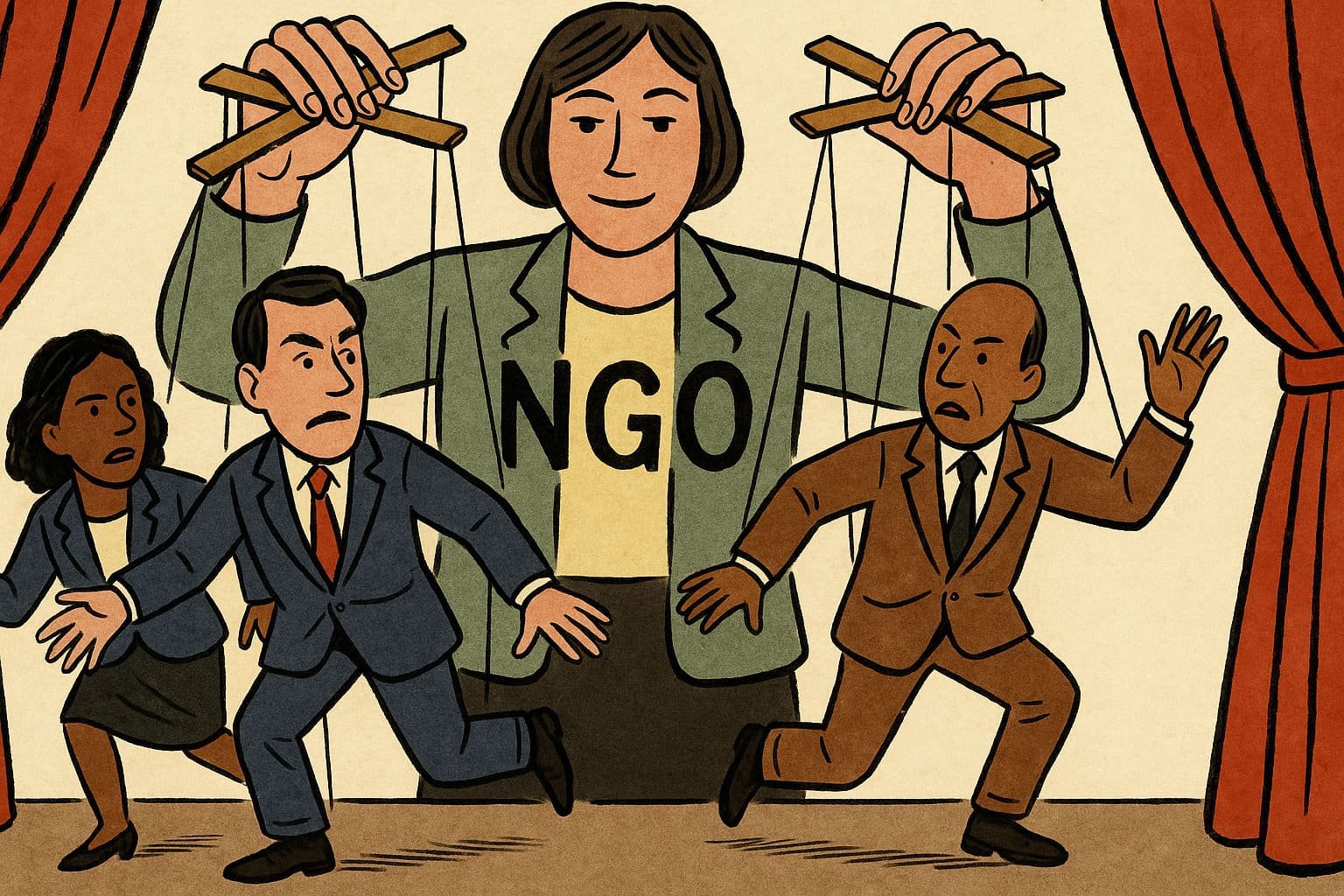
Picture a global stage crammed with seasoned politicians, brash billionaires, and restless citizens, each believing they’re steering the ship. But look closer, behind the velvet curtain, and you’ll see the real showrunners: non-governmental organizations, those shadowy figures gliding between crises, charities, and conference rooms. It’s the ultimate plot twist; one where the hands that feed the hungry, treat the sick, and champion justice are now flexing muscles in the political arena. The world always loved a good underdog story, but nobody predicted the underdogs would become the puppeteers.
Political earthquakes rumble not just from parliaments or angry street marches, but from the polished lobbies of NGOs. These organizations, once hailed as humanity’s safety net, are now rewriting power dynamics; sometimes with good intentions, sometimes with their own subtle ambitions. Forget the cliché of “servants of the people.” NGOs today are power brokers, kingmakers, silent strategists whose influence shapes everything from health policy to elections. It’s messy, fascinating, sometimes noble, sometimes terrifying.
This article will challenge everything you think you know about power, activism, and the political machine. We’ll dig into five game-changing realities: the subtle rise of NGO dominance, how these groups drive political narratives, the deals struck behind closed doors, the personal stories of insiders and whistleblowers, and the bigger philosophical questions nobody dares to ask. You’ll meet real-life actors, not faceless organizations; founders, workers, critics, and those quietly caught in the crossfire. If you think you know who runs the world, saddle up. This is a story that will leave you questioning every headline and hungry for the truth that rarely gets printed.
Quick Notes
- NGOs Steer More Than Relief-They Quietly Shape Law and Policy: The power of NGOs extends far beyond charity work; many drive policy change, often influencing government decisions behind the scenes with the agility politicians envy.
- Narratives Are Crafted, Not Found: NGOs don’t just respond to crises; they set the agenda, shaping media stories and public perception to push issues up the global priority list; sometimes at the expense of quieter but equally urgent problems.
- Deals Happen in Boardrooms, Not Just Streets: True power isn’t always loud; NGOs strike influential deals with corporations and governments that alter lives without ever making the news.
- Insiders and Whistleblowers Tell a Different Story: Beneath the glossy campaigns lie complex internal politics, real human struggle, and, occasionally, personal costs for those who challenge the status quo.
- Philosophy and Power Collide: The meteoric rise of NGOs prompts profound questions about democracy, accountability, and whether well-meaning activism can become its own brand of soft tyranny.
Beneath the Halo: The Secret World of NGO Power
There’s an old saying in humanitarian circles: “No good deed goes unpunished.” In the 21st century, it’s more apt to say, “No good deed goes unnoticed by those in power.” NGOs, once imagined as humble servants, have graduated to global power brokers with direct lines to presidents, prime ministers, and tech moguls. While politicians stutter through televised debates, seasoned NGO leaders; many former diplomats and CEOs trade WhatsApp messages with heads of state. They command resources, dictate narratives, and increasingly shape policies that reach millions.
Take the story of Oxfam, which began as a grassroots hunger-relief group but soon wielded enough influence to challenge governments on trade and aid. Its leaders, more at home in Davos than disaster zones, understood that changing laws could feed more children than soup kitchens ever could. That shift didn’t just reflect ambition; it highlighted a world eager to outsource tough problems to those with moral capital. But moral capital is still capital, and as it grows, so does the temptation to use it for leverage.
Ask any young idealist why they join an NGO and you’ll hear stories of hope: dreams of clean water, education, and peace. But climb a few rungs up the ladder and the air grows thin. There’s competition for influence, turf wars over funding, and a hunger for media coverage that rivals any political campaign. The result? Some NGOs have become more powerful than the ministries they claim to “support.” They set standards, allocate resources, and at times, play gatekeeper to entire industries. It’s not just about doing good; it’s about deciding what “good” even means.
Insiders whisper about the “NGO industrial complex” a phrase borrowed from critiques of the military-industrial complex. The lines blur between mission and ambition, between service and strategy. Consider how global health policy gets shaped: World Health Organization guidelines often emerge after heavy lobbying by NGOs with competing visions for vaccine access, drug pricing, and treatment models. Decisions that shape billions of lives might hinge on a handful of white papers or a few late-night calls.
And yet, in the glow of this influence, there are shadows. Governments, once wary of “foreign interference,” now actively court large NGOs, recognizing that endorsement from a respected non-profit can legitimize the most unpopular reforms. This backroom alliance means some policies get a free pass, while others, no matter how vital, are left in the cold. The public sees compassion; what they miss are the deals inked over catered lunches in Brussels or New York.
Writing the Headlines: How NGOs Set the Global Agenda
If you think the media tells us what matters, think again. The world’s headlines are often curated by NGO media teams working overtime to grab attention, sway opinion, and raise funding. These organizations are masters at turning a local tragedy into a global cause, deploying stories that stick in the mind and tug at the conscience. They don’t just follow the news; they create it.
The story of Malala Yousafzai, for instance, would not have become a global rallying cry without the backing of international NGOs orchestrating press tours, speeches, and campaigns. Malala’s courage is undeniable, but the amplification; the leap from local survivor to Nobel Laureate depended on the narrative machinery built by organizations skilled at storytelling and advocacy. This is not manipulation, but strategy. By shining a spotlight on one issue, others fade into the dark, waiting for their moment on the world stage.
Not all narratives serve the public interest, though. The Rohingya crisis, once a fleeting headline, grew into a sustained campaign after relentless NGO advocacy. But critics point out that in the race for attention, less “marketable” crises; think Yemen’s famine, Congo’s ongoing conflict, or indigenous rights struggle to break through. There’s a calculus to every viral campaign: emotional appeal, donor potential, political safety. The loudest cause isn’t always the most urgent.
Inside the newsroom, journalists lean on NGO press releases for stories sometimes out of trust, sometimes because deadlines loom. Many non-profits employ former reporters, knowing exactly how to pitch stories that editors can’t refuse. It’s efficient but raises ethical questions. Who decides what the world cares about? How many invisible tragedies remain, simply because they lack a strong media advocate?
Case in point: Greta Thunberg’s rise from solo protester to climate icon was turbocharged by environmental NGOs who recognized a once-in-a-generation messenger. By coordinating global school strikes, media blitzes, and diplomatic access, they transformed one girl’s voice into a movement. The world needs heroes, but it also needs transparency about who scripts the hero’s journey. Otherwise, we’re just applauding well-crafted theater, not spontaneous acts of justice.
The Silent Handshake: Deals Forged Out of Sight
While protest marches grab the headlines, real power often moves in silence. NGOs, once confined to lobbying, are now full-blown partners in policy creation. They sit on advisory panels, draft bills, and sometimes even implement programs once reserved for governments. It’s an evolution born from necessity; bureaucrats bogged down in red tape, citizens demanding action, and NGOs promising speed, flexibility, and credibility.
One of the most famous examples comes from the fight against HIV/AIDS in Africa. When governments faltered, it was NGOs like Médecins Sans Frontières and the Gates Foundation that stepped in, not just to deliver medicine, but to negotiate prices, build supply chains, and design health systems. Those victories were real and saved countless lives. But with great power comes new accountability. Who audits the auditors when the watchdogs become the policymakers?
Deals forged in boardrooms can outlast elected officials. Foundations with billions to spend offer grants but they also set conditions, priorities, and timelines. Governments, strapped for cash, have little choice but to comply. The risk? Policy gets driven by donors’ interests, not always by local needs. Imagine a country’s agricultural future decided by the latest “innovative” pilot from an NGO, even if it ignores traditional farming wisdom that’s worked for generations.
Some call it “philanthrocapitalism” a system where private wealth and non-profit ideals blend to produce change faster than public processes ever could. Critics worry it’s democracy by invitation only, with citizens left as spectators while deals get hammered out behind closed doors. One former UN official described it as “policy laundering” where controversial reforms pass under the banner of charity, shielding leaders from public backlash.
Still, it’s not all smoke-filled rooms and secret agendas. When the Ebola outbreak erupted, the coordinated response between NGOs and local leaders was the difference between catastrophe and control. What’s missing is oversight. Power wielded in secret no matter how benevolent always tempts excess. The challenge now: can society harness NGO speed without losing the transparency that democracy demands?
Insider Stories: Behind the Curtain of Activism
Beyond mission statements and annual reports lies a world of real people, each with a story far messier than the polished image NGOs project. Whistleblowers like Ravi Kumar, who once led field operations for a renowned humanitarian group, share tales of burnout, disillusionment, and internal power struggles that rarely make it into fundraising emails. The allure of “doing good” fades fast when idealists collide with political realities, bureaucratic infighting, and tough ethical choices.
Frontline staff recount moments of triumph and heartbreak; a vaccination campaign derailed by local corruption, a food drop sabotaged by militia, a water project repurposed for political gain. These are not failures of character, but symptoms of operating in volatile environments where good intentions must wrestle with ground realities. When mission meets money, lines blur. Workers face pressure to “prove impact” for donors, sometimes at the expense of honesty or long-term results.
Consider the story of Ana Morales, who left a high-profile women’s rights NGO after clashing with leadership over strategy. Her account reveals how internal politics; who gets funding, which issues get prioritized can mirror the very power struggles these groups were formed to fight. She speaks of an “activism bubble” where like-minded insiders reinforce their worldview, sometimes losing touch with the people they’re meant to serve.
Whistleblowers face steep consequences. In 2018, a group of insiders exposed exploitation scandals at a major international aid organization. Their courage sparked global debate but also retaliation; job losses, blacklisting, and personal attacks. True transparency carries a price. When the spotlight fades, those who spoke up often bear scars the public never sees.
Yet, in the chaos, hope persists. Workers on the ground, teachers in refugee camps, doctors in conflict zones, legal advocates for the marginalized fight daily battles that remind us why NGOs exist at all. The human stories behind the headlines ground lofty ideals in messy reality. If anything, their grit and resilience offer a crucial reminder: the machinery of change runs on human courage, not just mission statements.
Who Watches the Watchdogs? Democracy, Power, and the Moral Gray Zone
For every headline about NGO heroics, there’s a quieter question rumbling underneath: who holds these organizations to account? As NGOs become architects of policy, donors of billions, and voices for the voiceless, democracy itself faces an existential puzzle. How can power be held in check when the “good guys” answer to boards, not ballots? The tension is palpable; between trust and scrutiny, between speed and transparency.
Democracy, in its purest form, means governance by the people. But what happens when decision-making migrates from parliament to private foundation? The risk is a world where citizens watch from the sidelines while unelected experts set the rules. This “soft power” can feel more palatable than old-school strongmen, but it is no less consequential. The machinery of influence spins quietly, yet its gears reach every corner of society.
Philosophers like Amartya Sen and Hannah Arendt have long debated the dangers of well-meaning paternalism. When NGOs decide what matters, who gets a voice, and which crises deserve attention, they can inadvertently silence local perspectives. The road to “help” is paved with good intentions but also with choices made far from the communities most affected.
Take the global battle over internet freedom. Digital rights NGOs play hero, but even they admit to grappling with conflicting interests: privacy vs. security, free speech vs. hate speech, global standards vs. local autonomy. Every intervention is a negotiation. Whose values win out? Who decides what’s “right”? There are no easy answers.
Yet accountability is not an enemy of impact. It’s the necessary check that keeps power honest. Some NGOs are now experimenting with “participatory governance” inviting communities into boardrooms, publishing financial data, hiring independent watchdogs. The work is messy, slow, and sometimes unpopular. But if NGOs wish to wield real power, they must also accept the burden of public scrutiny. Only then can they move from puppet masters to trusted partners in a world hungry for change.
Welcome to the Age of Unseen Kings: Are We Ready?
We live in a world where revolutions don’t start with gunshots, but with hashtags, viral videos, and white papers drafted in air-conditioned offices far from the crisis at hand. Non-governmental organizations, once the quiet conscience of society, now operate as power brokers; alternately praised and feared, needed and questioned. Their rise is neither villainous nor purely heroic; it’s a messy, thrilling, and utterly human story. They answer crises faster than states, mobilize hope where governments stall, and spark conversations once deemed taboo.
But as the curtain falls, a harder truth lingers. Real power rarely comes with applause. For every life saved, there’s a trade-off made behind closed doors. For every hero anointed, a quieter voice is silenced. The challenge isn’t to banish NGOs from power but to invite light into their rooms; demanding not just compassion, but transparency, humility, and accountability. The transformation from underdog to puppet master is incomplete without the wisdom to share the stage, not hoard it.
So, the next time you see a viral campaign or a crisis suddenly “trending,” pause. Ask who wrote the script, who controls the spotlight, and whose stories remain untold. The age of unseen kings is here, and its rules are still being written. Will we dare to look behind the curtain or are we content to clap for the show? The answer, as always, rests with us.
When power is claimed in the name of good, how do we make sure it stays accountable? Who are the silent actors in your story, and what strings might they be pulling?
Partnered. Provocative. Worth Your Scroll.
This is a Promoted Post by ESYRITE—yes, it’s paid, but never filtered. Our voice stays raw, real, and razor-sharp. We team up with bold ideas, game-changers, and stories that spark something real. If it’s here, it earned its place—no fluff, just impact. We don’t just promote—we provoke. Stay sharp. Dive deeper.
