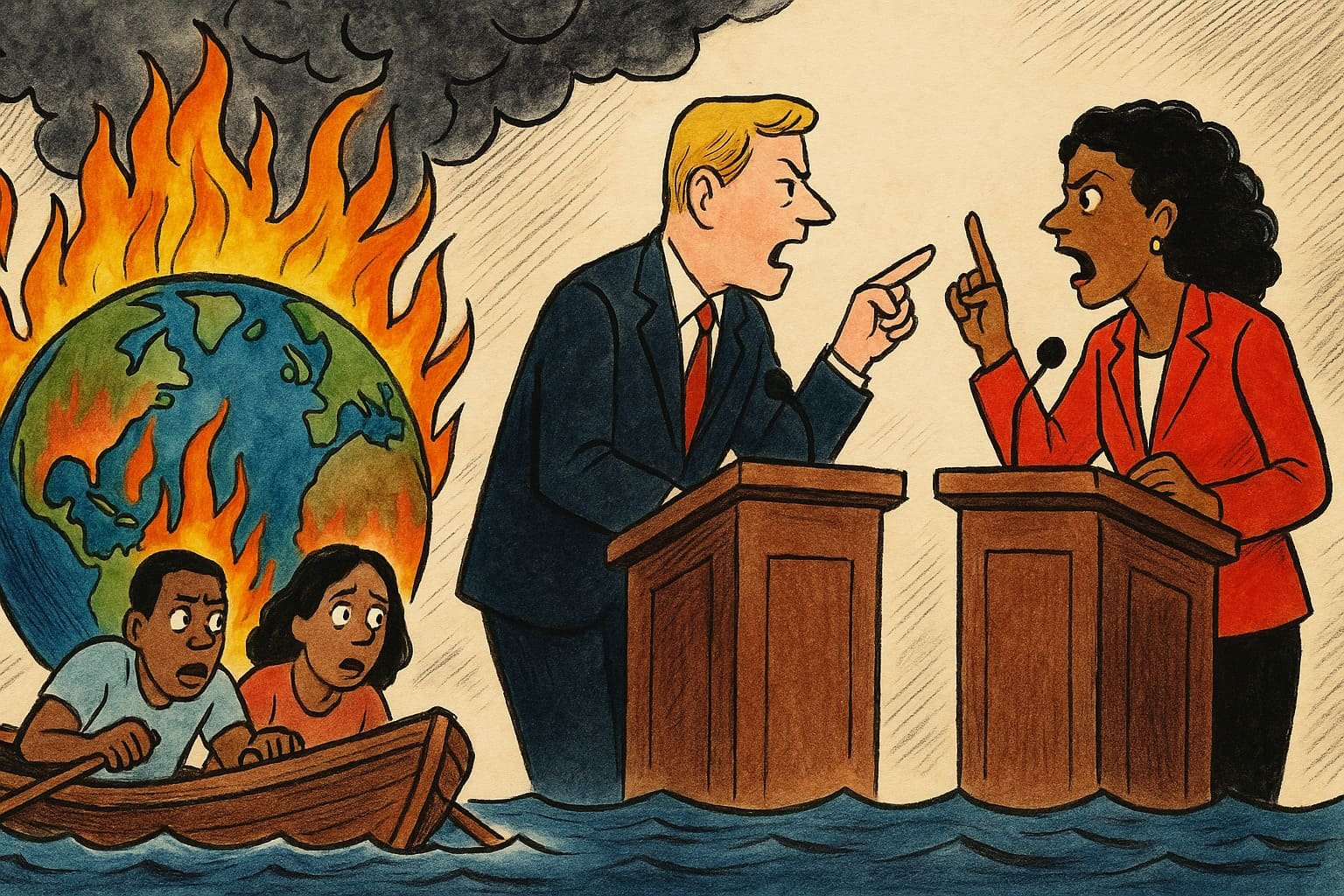
There’s a strange hush before a storm, a moment when the sky darkens and the air thickens with suspense. That’s where humanity sits right now: caught in the eerie stillness between warning and catastrophe, paralyzed by indecision as Earth’s fever climbs higher. Every breaking news headline screams of wildfires devouring entire towns, floods rewriting coastlines, and politicians spinning their wheels in halls of power. But behind the daily noise, a bigger drama unfolds; a race against time where politics either becomes Earth’s savior or its silent assassin. We live in a world where ice caps melt faster than broken promises, while leaders trade carbon credits like baseball cards.
People everywhere feel it: the dread, the urgency, the gnawing sense that everything might just slip away unless something real happens now. Here’s the twist: in this high-stakes battle, it’s not just about the next climate summit or the next green bill; it’s about whether our political machinery can actually rise above its own inertia. What if, right now, we’re witnessing not just environmental decline, but the last chance for politics to show it’s more than a self-serving game? Are we destined to watch the planet burn as leaders play chess with our futures or could this be the moment politics finds its soul and rewrites the rules? This story, raw and real, is about the ticking clock, the human cost, and why against all odds there’s still a shot at redemption.
Quick Notes
- Power’s Paradox: Political systems have enormous power to change the climate crisis, but they’re often trapped by short-term interests, creating a global stalemate that fuels public frustration.
- Human Toll and Political Games: Climate change isn’t just about numbers or science; it devastates real families and communities, but political leaders sometimes prioritize optics over urgent action, compounding the pain.
- Reform or Ruin? Some countries and leaders have pioneered bold policies that actually work, proving that visionary politics can outpace disaster when courage trumps calculation.
- Voices From Below: Grassroots movements and everyday people sometimes more than governments ignite true climate revolutions by holding power to account and inspiring mass change from the ground up.
- The Final Crossroads: We stand at a unique point in history where politics must transform or become irrelevant, and this generation’s choices will shape whether we inherit a planet of possibility or regret.
Power Games: When Leadership Holds the World Hostage
From the gilded halls of Congress to the storm-battered islands of the Pacific, political leaders sit at the helm of the climate ship. Their decisions shape policy, industry, and even the conversations we have at our kitchen tables. Yet, when it comes to climate action, political will is too often measured in poll numbers and election cycles, not by the roaring rivers or the withering crops outside. Take the example of a summit where world leaders gathered for three days of speeches and left with a handful of watered-down pledges. While the cameras flashed and social media hummed, real progress fizzled behind closed doors. These moments reveal a troubling truth: politics, designed to solve big problems, sometimes becomes the very obstacle to survival.
There’s a reason climate talks so often end in stalemate. The machinery of government runs on compromise and calculated risk, which works fine when debating tax codes but falters when facing a planetary emergency. Leaders worry about losing votes, jobs, or corporate backers if they push too hard for change. This inertia traps entire nations in a cycle of promise and delay, leaving the most vulnerable to pay the steepest price. In places like Bangladesh or Miami, people rebuild again and again, praying that next season’s storm spares their homes.
The paradox is stark: politics holds more power to change our climate destiny than any scientific breakthrough, yet it’s often hobbled by its own design. Former President Barack Obama once said, “We are the first generation to feel the impact of climate change and the last generation that can do something about it.” But slogans and reality rarely dance in step. Each election, hope surges that a new leader will finally break the deadlock, only for lobbyists and party lines to snap dreams in half.
For many, watching politicians debate while forests burn feels like a cruel joke. There’s an ache in knowing that the solutions exist; renewable energy, smarter urban planning, incentives for innovation but the gears turn so slowly. Families forced from their homes by floods or fires can’t wait for the next round of bureaucratic wrangling. The stakes are measured not in abstract numbers but in lost livelihoods and childhoods stolen by disaster.
Consider the story of Greta Thunberg, a teenager who skipped school to protest outside Swedish Parliament and ended up sparking a worldwide youth movement. Her simple question “Why are you not doing anything?” shamed global leaders and put a human face on political inaction. It’s a reminder that power in the climate fight isn’t just about positions or titles. Sometimes, the courage to demand better is what breaks the cycle and drags the debate into the real world.
Collateral Damage: How Climate Catastrophe Hits the Forgotten
While politicians argue, ordinary people live on the front lines of disaster. For every televised summit, there are thousands of families in Indonesia, California, or Madagascar who wake up to flooded fields or smoke-choked skies. It’s easy to speak in abstractions about “one-point-five degrees warming,” but every fraction of a degree is a story: a farmer losing his land, a mother evacuating her children, a city watching its future drown. These stories rarely make headlines, but they are the real casualties of political delay.
In the Australian town of Mallacoota, wildfires forced residents to shelter on beaches, clutching their pets and praying for rescue. The government offered condolences and staged press conferences, but for those who lost everything, speeches felt hollow. Moments like these expose a painful disconnect; policy debates are detached from lived experience, leaving those most affected feeling abandoned. This is not just a failure of imagination; it’s a profound moral failing.
Climate change deepens inequality in ways that politics is slow to address. Wealthy nations fortify their cities with sea walls, while poorer regions face relentless storms with little support. When Hurricane Maria struck Puerto Rico, it laid bare the consequences of political neglect, as recovery aid stalled and thousands went months without basic services. Such disasters are not “natural”; they are amplified by human choices, by who gets help and who is left behind.
The pain of climate catastrophe is not just physical; it’s psychological. Studies of survivors in places like New Orleans after Hurricane Katrina or Paradise, California after wildfires show that trauma lingers long after the cameras leave. Children develop anxiety, communities fracture, and trust in leaders erodes. Every political misstep leaves wounds that can last generations. The cost isn’t just measured in lost property, but in lost hope.
Yet even amidst tragedy, people find ways to adapt, resist, and rebuild. Consider the coastal community of Kiribati, where families have crafted floating gardens to survive rising tides. Their ingenuity speaks to human resilience, but also to the limits of what can be achieved when political leaders fail to act. These stories challenge us to see climate not as a distant crisis, but as an urgent reality shaping lives every single day.
Breaking the Mold: When Politics Actually Gets It Right
Despite all the gridlock, there are flashes of political courage that light a path forward. Some leaders refuse to play it safe, pushing for transformative policies that break the mold. The city of Copenhagen, for example, launched a bold effort to become carbon-neutral, betting its future on green technology and public transport. Critics scoffed at first, but the city’s relentless drive has made it a global model for climate resilience and economic growth.
Political transformation isn’t just a European story. In Costa Rica, leaders decided decades ago to ditch fossil fuels, investing in reforestation and renewables. The result? The country now runs on almost entirely clean energy, turning a once-poor nation into an eco-tourism powerhouse. Real-world results like these prove that visionary politics can rewrite destinies. It’s not about being perfect; it’s about daring to act when the stakes are highest.
Even in big, unwieldy countries, the right mix of leadership and public pressure can flip the script. California passed aggressive climate laws that spurred a boom in electric vehicles and solar power, inspiring other regions to follow. These victories didn’t come easy; industry pushback and political fights raged for years. But dogged persistence turned ambitious targets into everyday reality, showing that bold politics is not just idealism, but a practical engine for change.
Stories like these echo a powerful theme: transformation happens when leaders put legacy above expediency. When Jacinda Ardern led New Zealand’s ban on offshore oil exploration, it wasn’t just a policy; it was a message that protecting the future can mean taking real risks today. This kind of leadership demands more than clever soundbites. It asks for vision, integrity, and the willingness to weather storms, literal and political.
Every breakthrough has a ripple effect. As cities and countries show what’s possible, neighbors and rivals take note. Innovation spreads, old assumptions crumble, and a new political consensus can emerge. These moments prove that while the system can be slow, it is not doomed. There’s nothing inevitable about failure; sometimes, all it takes is for one leader, one city, or one country to stop waiting and start building a new way forward.
Revolution from Below: Grassroots Power and the Politics of Ordinary People
Real change doesn’t always start in parliament. Sometimes it begins with a child holding a sign, a grandmother planting a tree, or a neighborhood fighting to keep its water clean. The climate movement is packed with stories of ordinary people who refused to accept the status quo, using everything from art to protest to force change from the ground up. Think of the Standing Rock Sioux Tribe’s stand against oil pipelines; a struggle that drew global solidarity and showed that people, not politicians, often set the moral agenda.
Grassroots action is more than protest; it’s about building communities that thrive even when governments fail. In Brooklyn, a group of friends started a solar co-op to lower their bills and cut pollution. The idea caught fire, and now similar initiatives are popping up across the world. These movements don’t just fill the gaps left by political gridlock; they spark new ways of thinking about power, responsibility, and what it means to take action.
Political leaders eventually take notice when enough voices refuse to be ignored. Fridays for Future, the school strike movement started by Greta Thunberg, galvanized millions of young people and forced climate onto the global agenda. It’s easy to underestimate the power of a protest, but history shows that every major shift; civil rights, women’s suffrage, anti-apartheid, began with people demanding the impossible until it became inevitable.
The beauty of grassroots action is its unpredictability. Nobody in Flint, Michigan, thought their fight for clean water would inspire reforms in cities nationwide, but it did. These local struggles weave a tapestry of hope, creativity, and stubborn resilience. Each win may seem small, but together they tilt the balance of power away from complacency and toward justice.
Community-led movements remind us that politics is not just about elections. It’s about the daily choices people make to care for each other and their environment. This bottom-up pressure is essential for democracy and for the climate fight. Leaders can ignore a single protest, but they cannot withstand a tidal wave of public demand for real change. Ordinary people are not just victims of crisis; they are the hidden architects of our collective future.
The Tipping Point: Where Do We Go From Here?
History doesn’t move in straight lines. It lurches, stalls, then leaps forward when no one expects it. Right now, the world is teetering on a knife’s edge. The choices made in the next few years will reverberate for generations. This is more than just another climate deadline; it’s a crossroads where the old rules no longer fit and the new ones have yet to be written.
The reality is harsh but honest: politics will either adapt or fade into irrelevance. Governments that cling to outdated models will be left behind, their people turning to alternative forms of power; grassroots, corporate, or even technological. We already see this as cities sign their own climate agreements or businesses set bolder targets than national governments. Power is shifting, and those who cannot keep up will lose their seat at the table.
This moment demands something radical: a politics that doesn’t just respond to crisis but anticipates it, that values long-term survival over short-term gain. There are signs of hope; bold leaders, inspired communities, ingenious solutions but they need to become the norm, not the exception. To get there, voters must demand courage from their representatives and refuse to accept half-measures. True change comes when people recognize their own power to force the system to change or to build a better one in its place.
We also need a shift in mindset. It’s easy to see climate as a distant threat or someone else’s problem, but the truth is, every choice we make; what we buy, how we vote, the stories we tell, shapes what happens next. The biggest enemy is not denial but apathy. Once people see themselves as players in this grand drama, everything changes.
If there’s a lesson from history, it’s that turning points rarely feel comfortable. They’re messy, noisy, full of doubt. But they are also where heroes are born and the future is reclaimed. This is Earth’s last chance and ours, too. The world we inherit depends not on fate, but on the willingness to step up, speak out, and fight for something bigger than ourselves. Are we ready?
The Reckoning: Will We Write the Ending, or Just Read It?
Imagine waking up to a world where the last glacier has melted and the forests have gone silent; a world shaped not by the laws of nature, but by the failures of politics. That’s the nightmare nobody wants, yet it creeps closer with every missed deadline and empty promise. Still, if history teaches anything, it’s that the darkest moments often spark the fiercest hope. Right now, humanity holds the pen to its own story, teetering between defeat and the audacity to believe in a better ending.
Politics was never meant to be just about power or profit. At its best, it’s the art of coming together to build something lasting; a future where children run through green fields instead of sifting through rubble. We can be more than spectators to disaster. We can be the authors of a new era, one where climate justice is not a slogan, but a shared reality.
So here’s the real challenge: refuse to settle for despair. Demand better from leaders, and, just as importantly, from ourselves. It’s not too late unless we decide it is. The next chapter is unwritten, and the world is waiting. Will we leave a legacy of courage and renewal, or watch as the curtain falls? The answer isn’t in the hands of a few. It’s in the hearts of everyone willing to fight for Earth’s last, best chance.
What kind of world do you want your children to remember you for? The clock is ticking. The real story starts now.
Partnered. Provocative. Worth Your Scroll.
This is a Promoted Post by ESYRITE—yes, it’s paid, but never filtered. Our voice stays raw, real, and razor-sharp. We team up with bold ideas, game-changers, and stories that spark something real. If it’s here, it earned its place—no fluff, just impact. We don’t just promote—we provoke. Stay sharp. Dive deeper.
