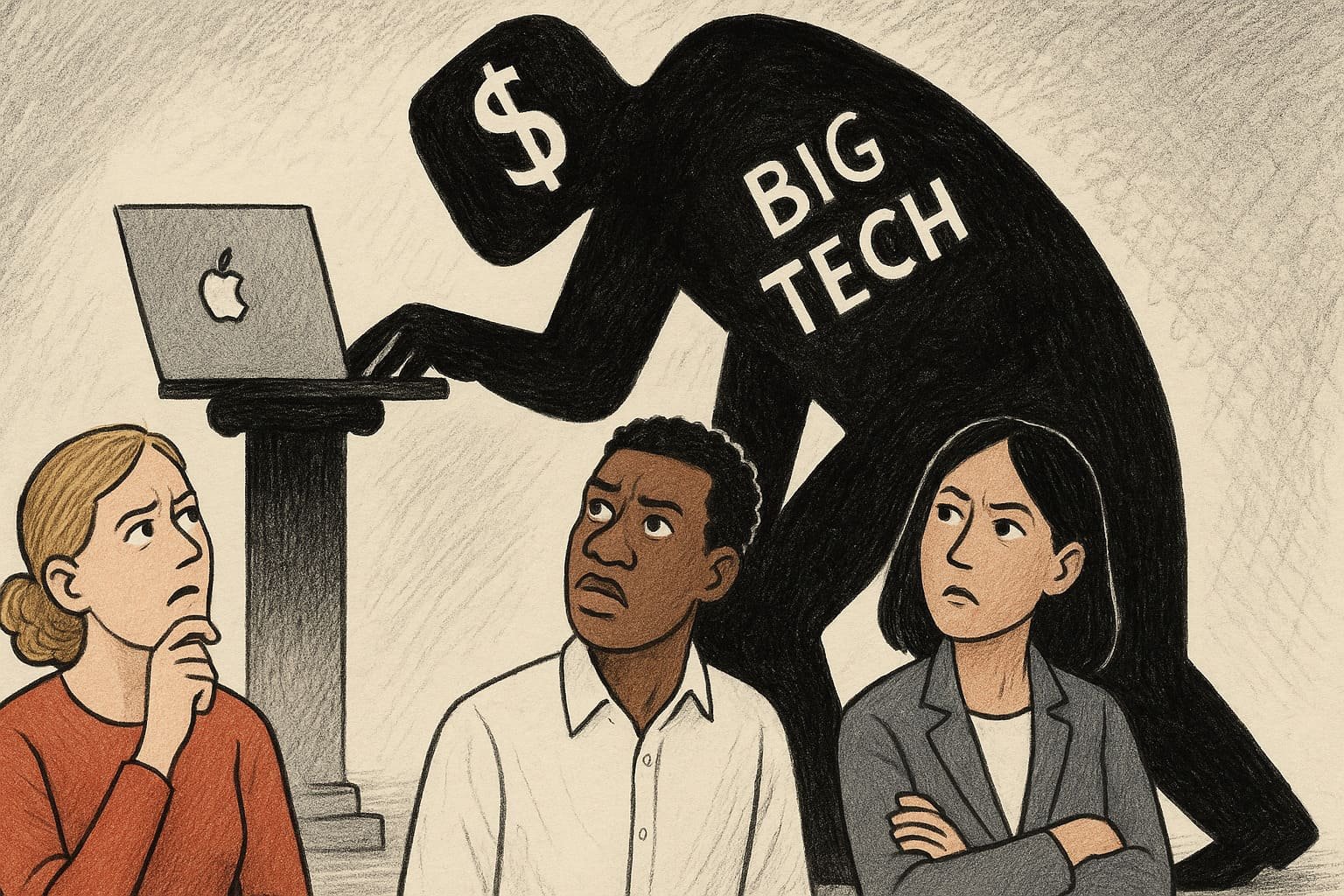
You wake up. Your alarm is an algorithm. Your breakfast choices? Influenced by targeted food ads. Your news? Filtered by mysterious code. You scroll, click, tap, swipe; day in, day out, while invisible titans play chess with your attention, your data, and, yes, even your government. This isn’t the plot of a dystopian novel. This is reality, unfolding on your phone, tablet, and every screen you touch. The question ricochets through every modern mind: Are we truly in charge of our digital lives, or have we quietly handed the keys to a handful of corporate giants whose boardrooms are more secretive than any political backroom? The answer isn’t just unsettling, it’s an existential riddle wrapped in a viral meme, reposted until we almost stop asking who’s really running the show.
Here’s the twist: Power used to belong to presidents, prime ministers, and parliaments. Today, it’s split, blurred, and, frankly, up for grabs. What happens when Silicon Valley’s CEOs wield more influence than elected leaders? Is democracy robust enough to survive when your voting preferences are as manipulatable as your Netflix recommendations? This isn’t just theory. It’s a new kind of power play, one that makes Cold War spycraft look quaint. In this deep dive, we’ll rip back the digital curtain and follow the money, the code, and the outrage to expose the real boss of our age.
Prepare for stories of whistleblowers, billionaires, and digital coups that sound ripped from Hollywood but are happening in real life. We’ll unpack the secret handshakes between tech and government, the micro-moments where you’re nudged and nudged until you’re someone else’s perfect customer or voter. Is Big Tech simply serving up convenience, or are we living in a carefully managed simulation of free will? If you think you’re immune, you’re already caught in the web. It’s time to face the truth, challenge the narrative, and reclaim your agency or risk becoming just another user, lost in the scroll.
Quick Notes
- Digital Titans or Public Servants? Tech giants have quietly outgrown governments, shaping laws, elections, and even public moods, often beyond public oversight.
- Surveillance Society, Rebranded: Convenience is the sugar that helps surveillance go down, but behind every personalized ad is a web of data extraction with real-world consequences.
- Government on Autopilot: Regulators and lawmakers often trail behind innovation, forced to react to crises rather than lead with vision, handing more leverage to private platforms.
- Culture and Chaos Powered by Algorithm: The ways we talk, laugh, protest, or even riot are increasingly choreographed by the hidden rhythms of recommendation engines, sparking new forms of social manipulation.
- The Future Is Up for Grabs: Real-world heroes, whistleblowers, and collective movements are challenging the digital oligarchy, proving that ordinary people still have power if they claim it.
The Billionaire Kings: How Tech Giants Quietly Took the Throne
Silicon Valley started as a quirky birthplace of garage innovation and digital dreams. Now, it resembles a monarchy where founders become kings, wielding powers that make most world leaders blush. Mark Zuckerberg began by rating faces in a dorm room, but his empire now sways elections, dictates speech, and even redefines privacy for billions. When Jack Dorsey launched Twitter, he couldn’t have imagined it would become a global battlefield for political discourse, outpacing state-run news in influence and reach. Elon Musk, once dismissed as an eccentric, now drives the conversation not only in tech but in geopolitics, with rockets, cars, and even tweets that can shake stock markets.
The old rules of power no longer apply. Amazon’s Jeff Bezos didn’t just reinvent shopping; he quietly reengineered labor, logistics, and even the infrastructure of the internet itself. Amazon Web Services powers government secrets, streaming platforms, and emergency services, making Bezos a silent king behind countless curtains. Tech titans now host world leaders at secret summits and have the ear of policymakers, blurring the lines between private ambition and public governance. Google’s Sundar Pichai, for example, has shaped more classrooms, offices, and kitchens than most education ministers ever could; one search, one YouTube video at a time.
Remember when Microsoft faced antitrust scrutiny and was humbled? The lesson for today’s giants: Grow bigger, faster, and learn to dance with regulation rather than fear it. Apple’s Tim Cook smiles gently as he fends off privacy lawsuits and defends App Store fees, never blinking as nations plead for cooperation. In private, tech leaders invest in think tanks, public relations firms, and even entire news outlets to soften scrutiny and maintain a benevolent public image. The result is a world where a handful of companies, steered by a tiny, ultra-elite club of decision-makers, dictate the terms of your digital existence without ever asking for your permission.
Mini-case study: When Australia tried to force Facebook to pay for news, the platform simply pulled the plug on all news links, holding an entire country’s information flow hostage for days. The government blinked first, caving to Facebook’s demands. This wasn’t negotiation; it was digital feudalism, proving that in the new world order, sovereignty is negotiable if you control the networks.
Daniel Pink’s “Drive” argues that autonomy is the ultimate motivator. Ironically, we hand over autonomy to Big Tech every time we agree to another update, another app, another “click to accept.” If Maslow’s hierarchy of needs were redrawn for the digital age, WiFi would sit at the base right next to oxygen.
Ask yourself: Would you recognize the moment when power slipped from public hands to private platforms, or did it already happen while you were busy scrolling?
The Surveillance Sweet Spot: When Convenience Costs More Than Cash
Think back to the last time you got creeped out by an eerily accurate ad. Maybe you muttered, “Is my phone listening?” The answer is both yes and no because it doesn’t need to listen. It already knows everything, from your favorite pizza to your deepest fears. Surveillance has been rebranded as personalization, and we line up for it like kids in a candy store, blissfully ignoring the trade-off: every touch, like, and comment is another data point added to our invisible dossier.
Consider the story of Edward Snowden, the whistleblower who risked his freedom to reveal that governments were tracking phone calls, emails, and location data on a massive scale. The outrage faded, but the tech giants that provided the tools for surveillance only grew stronger. Today, the same platforms that build connections also construct invisible cages. When you open TikTok for a burst of laughter, you’re also agreeing to be profiled, tracked, and subtly influenced. It’s the greatest trick ever played: Convince billions to surveil themselves and thank you for it.
This isn’t just about selling sneakers or streaming shows. The Cambridge Analytica scandal exposed how targeted messaging could sway elections, turning ordinary citizens into unwitting foot soldiers for hidden agendas. Your online footprint is now a political asset, bought and sold in digital marketplaces that operate with little oversight. Data brokers mine your habits to predict your next move before you do. You’re not just a customer; you’re the product and the profit center, bundled and resold to the highest bidder.
Pop culture embraces this paradox. On Netflix’s “Black Mirror,” dystopian futures feel chillingly plausible because we’re already living them. Characters barter privacy for fleeting pleasure, just as we do; one facial recognition scan, one “Accept Cookies” click at a time. The plot twist? Big Tech doesn’t need to break in. We leave the doors wide open.
Yet, resistance brews at the margins. Brave voices like Frances Haugen, the Facebook whistleblower, step forward to reveal the dark mechanics beneath the surface. Her disclosures didn’t bring the empire down, but they did shine a light into the shadows. This battle between convenience and control is far from over.
Reflect for a second: How much privacy are you willing to trade for instant gratification, and at what point does the cost become too high to ignore?
Regulators Chasing Shadows: The Political Power Vacuum
Governments once set the pace for progress, passing laws to protect citizens and rein in monopolies. Today, lawmakers look like underdogs chasing Ferraris down the freeway; outclassed, outcoded, and outmaneuvered at every turn. While politicians hold hearings and release soundbites, tech companies deploy fleets of lawyers, lobbyists, and engineers to rewrite the rules in real time.
Consider the GDPR in Europe, hailed as a landmark for privacy rights. What happened? Tech giants adapted, updated their terms, and continued collecting data with surgical precision. Regulation became just another line item in the budget; a hurdle, not a wall. U.S. attempts to break up monopolies or enforce transparency dissolve into years-long court battles, during which the platforms grow bigger, richer, and harder to touch. The tech sector moves at internet speed. Politics, in comparison, lumbers at the speed of bureaucracy.
Look at the story of the “Facebook Files.” Leaked internal documents showed executives choosing engagement over safety, knowing their algorithms spread misinformation and division. Lawmakers huffed and puffed on live TV, but meaningful change proved elusive. The real power lies not with the speaker at the podium but with the engineer adjusting the code behind the curtain.
Real-world consequences pile up. Misinformation goes viral before fact-checkers can react. Hate speech sparks violence before moderators intervene. Attempts to ban or limit platforms backfire, igniting protests about free speech or economic disruption. In India, efforts to regulate Twitter triggered international headlines and standoffs between the company and government officials, but ultimately, compromise favored the platform’s growth.
This power dynamic isn’t accidental. Big Tech invests heavily in politics, funding campaigns, sponsoring events, and even drafting legislation. Amazon, Google, and Facebook outspend entire industries on lobbying, often hiring former regulators to grease the wheels. The fox doesn’t just guard the henhouse; it builds the fence, writes the rulebook, and monitors the security cameras.
Ask yourself: If governments can’t keep up, who’s really watching the watchers? Is the promise of digital progress worth the cost of political impotence?
Algorithmic Chaos: When Culture Becomes Code
What we see, share, and believe is no longer the product of chance or personal taste. Algorithms shape the news you read, the friends you keep, the trends you chase. Once, television executives chose what made the evening news. Today, AI curates your world, feeding you what it calculates will keep you scrolling, laughing, or, often, outraged. Attention is the currency; you are the commodity.
The Arab Spring showcased the power and peril of social platforms. Movements for freedom ignited through Facebook, spreading hope at unprecedented speed. But the same tools that empowered activists now enable trolls, bots, and coordinated disinformation campaigns. Russian operatives sow discord in foreign elections from half a world away, never leaving their keyboards. The boundary between entertainment and propaganda blurs, as influencers and memes outpace traditional news.
Every day, new viral sensations good and bad sweep the globe. A teenager’s dance challenge becomes global entertainment. A rumor or conspiracy, algorithmically boosted, triggers real-life panic or violence. The human cost is real: Families torn apart by misinformation, friendships fractured by online feuds, democracies strained by digital manipulation. The platforms argue they’re neutral pipes, but code is never neutral. Someone chooses what rises and what sinks.
Mini-case study: After the Christchurch attack in New Zealand, footage streamed live on Facebook, spreading faster than authorities could react. The platform struggled to contain the damage, demonstrating the sheer scale and unpredictability of algorithmic influence. Regulation, human intervention, and AI filters collided, yet none could put the genie back in the bottle.
We live in a feedback loop of our own creation. Every like, comment, and retweet makes the code smarter, more attuned to our impulses. Cultural moments are now born, mutated, and discarded in days, leaving us dizzy and disoriented. When you stare into the feed, it stares back, calculating what will move you next.
So here’s the kicker: When the code decides what matters, whose values are encoded? And do you even notice when your worldview is nudged in ways you never chose?
Who Reclaims the Throne? The Battle for Digital Democracy
It’s easy to feel powerless in the face of all this. But history proves one thing: No empire lasts forever, and no power is truly absolute; not even in Silicon Valley. Whistleblowers like Chelsea Manning and Frances Haugen remind us that truth has its own momentum, sometimes breaking through even the tightest firewalls. Activists and ordinary users have forced platforms to backpedal, apologize, and, on rare occasions, reform. After #DeleteFacebook trended, the company changed its policies and even saw a dip in user growth; a rare admission that people, not platforms, hold the ultimate veto.
Public outrage can spark change. When Google secretly worked on a censored search engine for China, the backlash from employees and the public killed the project. Collective action works, especially when it leverages the same networks that power the platforms. Legislators who truly understand tech, like those who built their own startups or coded before campaigning, are finally gaining seats in parliaments and congresses. Their presence brings hope for smarter, faster, and more effective oversight.
Movements like the “Right to Repair” push back against corporate lock-in, demanding the ability to fix our own devices rather than buy new ones. Data privacy laws, though imperfect, reflect a growing awareness that surveillance shouldn’t be the price of admission to digital life. Even within tech companies, disillusioned employees form ethical councils or resign in protest, risking their careers to put values above profit. These cracks in the digital fortress reveal that control is never complete, and the future remains unwritten.
Mini-case study: When Apple refused to unlock an iPhone for the FBI, it sparked global debate about privacy, security, and state power. The outcome wasn’t neat, but it highlighted the possibility for even the biggest players to draw lines that governments must respect.
The real boss isn’t a CEO, a president, or an engineer; it’s the sum of our choices, our outrage, our willingness to ask hard questions and demand real answers. Democracy, digital or otherwise, isn’t a gift. It’s a fight, every single day.
So challenge yourself: Are you a passive participant, or will you seize your moment to shape the future? The next chapter is yours to write.
The Final Swipe: Why This Battle Isn’t Over and Why It Matters
Picture this: You’re standing at the crossroads of two worlds. On one side, convenience, speed, and endless entertainment; everything Big Tech promises and delivers, in glorious high definition. On the other, a lingering suspicion that something essential is slipping through your fingers: your voice, your autonomy, your right to shape society as more than a data point or a demographic.
It’s a story as old as power itself, retold in silicon and code, disguised as progress and wrapped in glossy UX. Every empire falls. Every new order eventually faces its reckoning. The only real question is: Will you watch from the sidelines, or will you step up, demand accountability, and help write the rules for the world you want to live in?
This isn’t about deleting your accounts or moving off-grid. It’s about awakening to the reality that power now moves at the speed of an update and that your choices, your voice, and your courage still matter. It’s about building digital literacy, demanding transparency, and refusing to trade freedom for frictionless convenience. Remember: The world isn’t changed by algorithms alone. It’s changed by the people who dare to challenge them.
So here’s your call to action; your invitation to step into the arena: Who’s really boss? In the end, it’s whoever refuses to give up the fight. Will you be among them, or just another user, scrolling on while the next decision gets made without you? Ready to question everything? The digital revolution isn’t done with you yet. Your move.
Partnered. Provocative. Worth Your Scroll.
This is a Promoted Post by ESYRITE—yes, it’s paid, but never filtered. Our voice stays raw, real, and razor-sharp. We team up with bold ideas, game-changers, and stories that spark something real. If it’s here, it earned its place—no fluff, just impact. We don’t just promote—we provoke. Stay sharp. Dive deeper.
