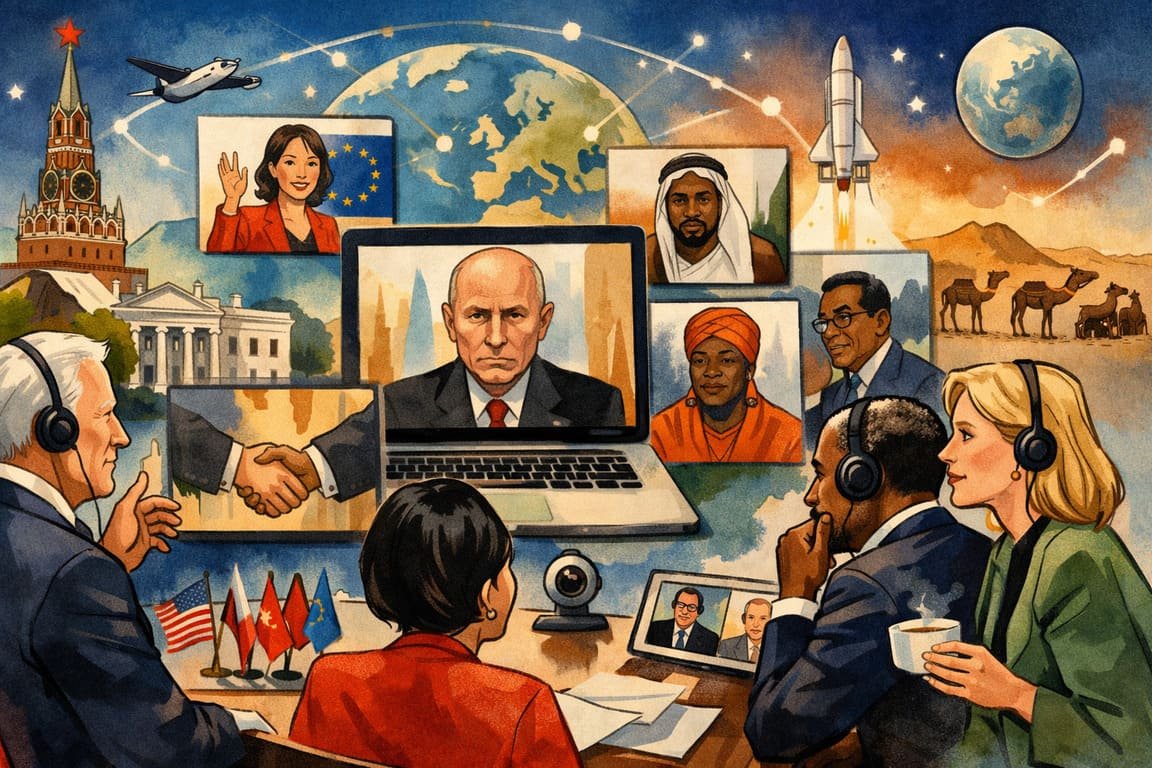
The meeting begins without footsteps or fanfare. No motorcades idle. No marble corridors echo. Faces appear in tidy boxes, authority compressed into pixels, influence measured by connection stability and camera angle. The world’s most consequential conversations now open with a chime. Power has learned to log in, and in doing so, it has changed how diplomacy works at its core.
Virtual summits arrived as an emergency fix, not a grand redesign. Travel froze. Crises stacked. Leaders adapted because delay was costlier than discomfort. Early sessions felt awkward, almost unserious. Heads of state fumbled with microphones. Translators raced against lag. Then something unexpected happened. Agreements still formed. Pressure still traveled. The rituals fell away, but the outcomes remained.
The loss of physical theater reshaped dynamics immediately. No grand entrances. No seating hierarchies. A small nation’s leader occupied the same screen space as a superpower. Symbolism flattened. That shift unsettled some and empowered others. A diplomat from a Caribbean state once said the virtual room felt less intimidating, as if history’s weight had stepped aside long enough for plain speech.
Informality crept in and brought consequences. Leaders spoke from offices, sometimes homes. Backgrounds revealed taste, restraint, or chaos. Authority felt more human. That humanity did not weaken leverage. It changed reception. Messages landed differently when delivered without pomp. Power began to feel conversational rather than ceremonial, and that altered negotiation tone.
What vanished, however, were the margins where diplomacy often succeeds. The quiet aside. The shared meal. The accidental trust built between sessions. Screens are efficient but sterile. Conversations end cleanly. There is no hallway to wander, no moment to soften a hard position. Precision increased. Flexibility shrank. Deals became tighter and more fragile.
Control shifted toward preparation. Virtual formats reward scripting. Microphones mute interruption. Agendas lock in. Leaders can exit instantly. That efficiency benefits those who arrive with leverage already secured. Persuasion through presence loses force. Optics and timing gain it.
Technology itself became an uninvited participant. Platform choice signaled alignment. Security concerns shaped attendance. Bandwidth became credibility. When a leader froze mid sentence or dropped entirely, influence evaporated. Digital diplomacy favors infrastructure as much as policy. Nations with stable networks gained quiet advantage. Others struggled to stay audible.
Public visibility expanded. Citizens watched summits unfold live, stripped of ceremony. Transparency increased, but so did performance. Leaders spoke knowing moments would be clipped and circulated within minutes. Diplomacy blurred into content creation. Nuance struggled against virality. The audience grew, and with it, the pressure to posture.
Culturally, virtual diplomacy fit a world already living online. Work, education, and activism had moved to screens. Seeing global leaders do the same normalized the format. For younger generations, the absence of physical spectacle felt practical, not diminished. The mystique of closed rooms looked outdated.
Environmental impact shifted quietly. Fewer flights meant lower emissions. Virtual summits reduced diplomatic footprints without debate or applause. This change rarely headlines analysis, yet it matters. Diplomacy adapted faster than many sectors, driven by convenience rather than conviction. Progress arrived sideways.
Critics argue that peace cannot be built through screens. They are not wrong. Trust still grows best through proximity. Conflict resolution demands presence at critical moments. Yet dismissing virtual summits ignores reality. Power adapts. It always has. The medium reshapes the message whether acknowledged or not.
A hybrid model now takes shape. Screens handle alignment. Physical meetings handle breakthroughs. Leaders choose formats strategically. Some conversations demand shared air. Others benefit from distance. Diplomacy becomes modular, its tools chosen as deliberately as its words.
Somewhere, a leader closes a laptop, the room suddenly quiet, no applause, no entourage, just the hum of equipment cooling. Influence lingers without spectacle. Diplomacy did not lose gravity when it went digital. It redistributed it. Power now moves through cables as comfortably as corridors, leaving one unsettling realization behind: when global decisions can happen anywhere, responsibility follows everywhere too.
