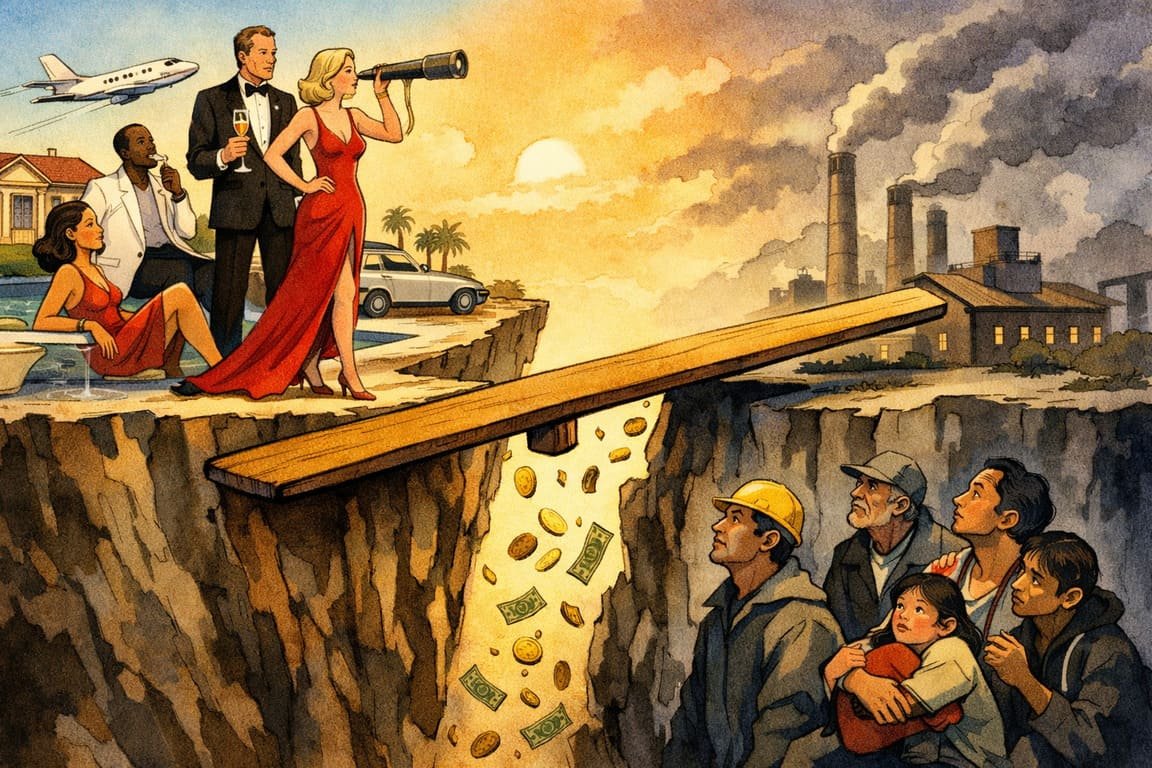
The city wakes in layers. In one building, lights glow before sunrise as markets open somewhere else. In another, alarms ring later because effort no longer guarantees momentum. Cafés serve different conversations depending on the street. No sirens mark the separation. No walls announce it. The divide has learned to live inside routines, polite enough to avoid notice, steady enough to feel permanent. Inequality no longer arrives as a crisis. It settles in as atmosphere.
The wealth gap is often explained as merit sorting itself out. Talent rises. Effort pays. Innovation wins. These stories are comforting because they turn structure into morality. Look closer and the machinery tells a different story. The system increasingly rewards ownership rather than contribution. Assets grow faster than wages. Capital multiplies while labor negotiates survival. The rules favor those who already arrived early enough to benefit from them.
Economic growth still happens, but its distribution has changed character. Productivity rises without shared reward. Work stretches longer while security shrinks. A mid-career professional once described earning more on paper each year while feeling poorer in real terms. Rent climbed faster than salary. Education costs turned into debt. Wealth accumulated elsewhere, quietly, compounding without effort or exhaustion.
Finance accelerates the separation. Money now reproduces itself with remarkable efficiency. Investments grow while paychecks tread water. Those with capital play a different game entirely. Time works for them. For everyone else, time becomes an adversary. A young teacher watching housing prices outpace savings learns a brutal lesson early. Patience no longer closes gaps. It widens them.
Technology deepens the divide in subtler ways. Automation boosts output while erasing roles that once anchored stability. New jobs appear, but often demand flexibility, retraining, and networks that not everyone can access. Platforms extract value globally while paying locally. Risk disperses downward. Reward pools upward. Innovation feels exhilarating from the top and disorienting from below.
Policy choices lock the pattern in place. Tax systems favor investment income. Safety nets shrink or stigmatize. Education becomes a toll gate rather than a ladder. None of these decisions feel dramatic alone. Together they form a quiet filter that sorts lives early and cushions outcomes permanently. Mobility slows. Birth circumstances harden into destiny without ever being declared official.
Culture helps make the system feel natural. Success stories dominate attention. Failure is framed as personal. Structural explanations sound abstract, even suspicious. A delivery worker scrolling through stories of sudden wealth absorbs motivation and blame at the same time. Hope keeps people trying. Shame keeps them silent. The gap widens without protest because the story blames individuals for outcomes shaped long before choice appears.
Wealth concentration reshapes democracy as well. Influence follows money with remarkable consistency. Lobbying outpaces voting. Policy bends gently toward asset protection. This rarely looks corrupt. It arrives as expertise, pragmatism, realism. Decisions feel reasonable in isolation. Over time, they form a pattern citizens sense even if they cannot diagram it. Trust erodes when representation feels conditional.
Communities register the impact first. Local businesses disappear. Public spaces degrade. Social ties thin. When neighbors live radically different economic realities, shared purpose fades. Resentment replaces solidarity. Political polarization thrives where material distance grows. Culture wars fill the vacuum left by economic despair.
The psychological toll runs quietly but deep. Constant comparison breeds anxiety. Worth becomes measured through consumption. Those behind feel invisible. Those ahead feel defensive. A startup founder once admitted fearing loss more than valuing gain. Inequality traps everyone in different forms of insecurity, each reinforcing the system that created it.
History offers a consistent warning. Gaps this wide rarely close on their own. Pressure builds slowly. Then abruptly. Reform arrives through courage or crisis. The machinery that widened inequality was designed. That means it can be redesigned. The obstacle is not technical. It is moral and political.
Picture a long escalator moving upward, crowded comfortably at the top, stalled near the bottom. People keep stepping on, told motion will come if belief is strong enough. Some reach the top and call it proof. Others never move and learn to blame themselves.
The wealth gap is not a mystery of fate but a mirror of collective choices, and the quiet question waiting for you is whether a system that normalizes inequality can remain stable once too many people realize it was never built for them to catch up.
