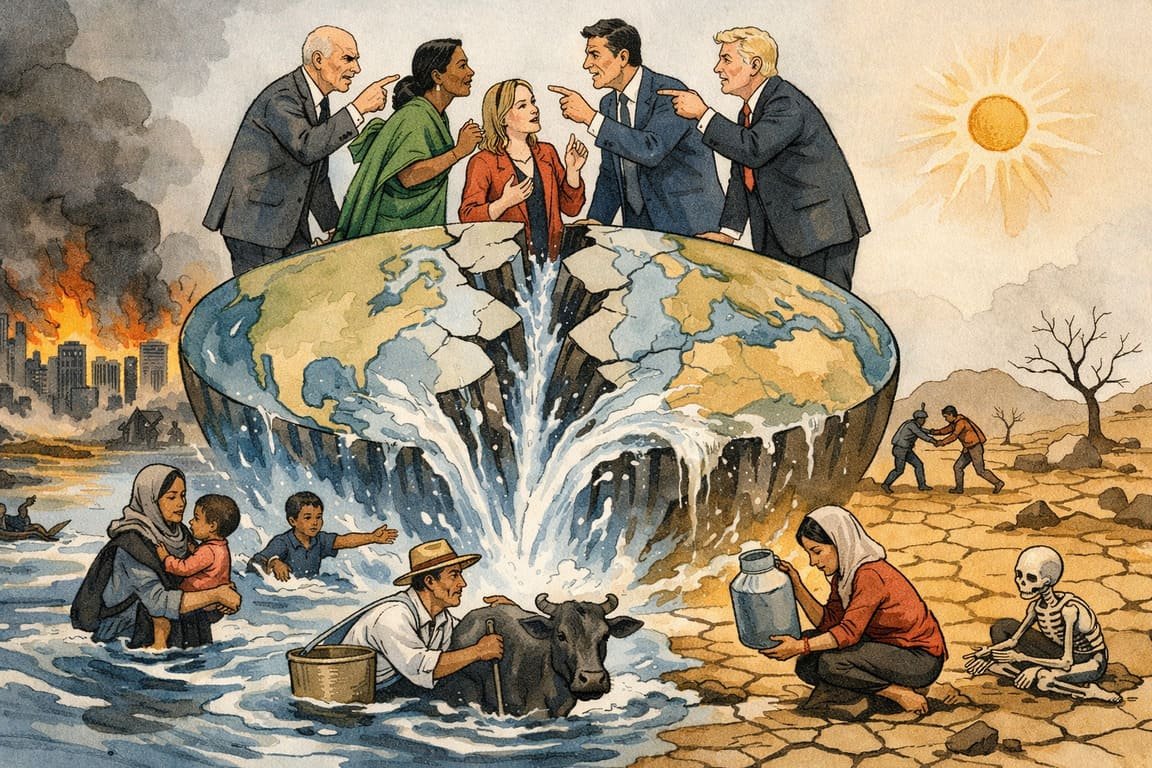
The river used to argue with gravity, pushing forward with confidence, shaping banks, feeding fields, reminding everyone who depended on it that permanence was possible. Now it hesitates. It thins. It vanishes in places where maps still insist it exists. Along its edges, officials gather with clipboards and talking points, describing resilience while the water quietly rewrites the truth. Civilization was built on the assumption that water would always show up. That assumption is breaking, and leadership is breaking with it.
Water scarcity exposes power faster than ideology ever could. When supply tightens, cooperation thins. Cities bargain against farms. Industries negotiate exemptions. Households are asked to conserve while leaks run beneath streets without urgency. Leaders speak in future tense, promising reforms that never quite arrive. The crisis is framed as complex, technical, unavoidable. Yet complexity often serves as camouflage for delay. Water does not care about electoral cycles. It responds only to use, misuse, and physics.
History has been warning quietly for a long time. Societies rarely collapse from sudden catastrophe. They erode when systems ignore limits. Ancient cities drained aquifers faster than rainfall could replenish them. Modern technology postponed that reckoning, but it did not erase it. Dams, pumps, and pipelines created the illusion of mastery. Climate pressure and population growth stripped that illusion away. What remains is exposure, and it is global.
In one agricultural valley, prosperity followed deep wells and generous irrigation permits. Crops flourished. Exports grew. Warnings about groundwater depletion sounded academic and distant. Then pumps began drawing sand instead of water. Fields fell silent. Farmers blamed regulators. Regulators blamed weather. Markets reacted without mercy. Food prices rose elsewhere, linking dinner tables to policy failures few could name. Scarcity revealed how interconnected neglect had become.
Cities carry their own contradictions. Urban growth assumes constant supply, yet infrastructure often predates current demand by decades. Pipes corrode. Reservoirs shrink. Conservation campaigns ask residents to shorten showers while approving developments that lock in higher consumption. The messaging feels hollow. Public trust erodes when sacrifice appears uneven. People comply less when fairness feels absent. Water stress becomes social stress.
Borders intensify the problem. Rivers ignore sovereignty. Aquifers stretch beneath multiple flags. When upstream decisions reduce downstream flow, diplomacy frays quickly. Treaties written for a wetter past strain under new realities. Negotiations stall because compromise reads as weakness. Water shifts from shared resource to strategic leverage. Conflict does not always follow immediately, but suspicion settles in quietly and stays.
Technology is often presented as salvation. Desalination plants rise along coasts. Sensors monitor usage. Data predicts shortages with startling accuracy. Yet solutions favor those who can afford them. Energy-hungry systems deepen inequality. Innovation without governance widens gaps. Tools exist. Direction lags. Progress becomes fragmented, impressive in isolation and insufficient at scale.
Leadership failure does not always arrive dramatically. It appears as deferral. Committees form. Studies circulate. Timelines extend. Each delay feels reasonable on its own. Collectively, they drain reservoirs. Water mismanagement compounds invisibly until crisis announces itself loudly. By then, options narrow. Emergency replaces strategy. Damage control replaces prevention.
Communities often adapt faster than governments. Local cooperatives ration fairly. Indigenous stewardship models restore balance through restraint rather than extraction. These approaches succeed because they respect limits and lived experience. They challenge centralized control that struggles to respond quickly. When authority feels distant, resilience grows locally. That contrast should unsettle policymakers.
Philosophically, water scarcity forces a reckoning with entitlement. Is access a right or a commodity. Markets argue pricing ensures efficiency. Ethics argue survival should never depend on income. Political systems wobble between these poles, often choosing ambiguity. Every allocation decision signals values, whether acknowledged or not. Avoiding the question is itself an answer.
Media coverage often frames water crises as natural disasters. Droughts. Floods. Acts of fate. That language absolves decision-makers. It dulls outrage. Scarcity becomes tragedy rather than indictment. When suffering is normalized, urgency fades. Accountability dissolves into weather reports.
Economic power is already adjusting. Investors assess water risk alongside stability. Corporations map supply chains against watershed health. Migration patterns reflect resource stress more than ideology. Water is becoming a quiet currency of influence. Those who manage it wisely gain resilience. Those who ignore it inherit volatility.
Near the shrinking river, a child fills a bottle from a delivery truck, watching adults debate responsibility. The water tastes faintly metallic. The moment is ordinary and defining. This crisis will not be solved by louder promises or clever slogans. It will turn on whether societies choose foresight over comfort, cooperation over dominance, humility over denial. When water finally demands its due, the only question left is whether leadership will still pretend not to hear it.
