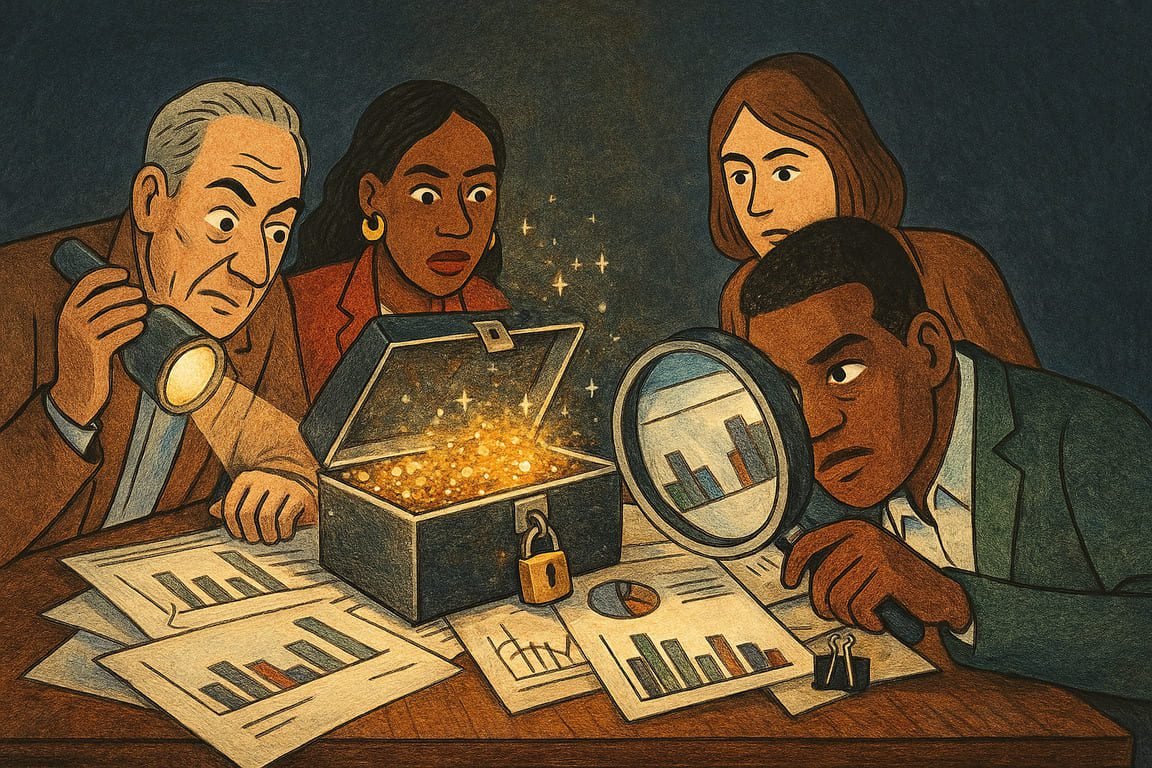
A solitary bulb flickers above a long wooden table, its yellow glow scattering across scattered papers and half-drunk coffee cups. Silence pulses through the space, broken only by the quiet scrape of a pencil and the hum of a battered laptop. Here, behind closed doors, researchers study columns of numbers like cryptographers in a Cold War bunker, searching for patterns nobody else can see. Every sheet of data sprawled across that table represents a potential earthquake in some distant market or policy, but right now, it’s just chaos—until, suddenly, the truth leaps from the noise. In this moment, the researcher’s pulse races faster than any ticker on Wall Street. The room, once filled with silent tension, now buzzes with the quiet certainty that something important has been found, something most of the world will never notice until it’s too late.
Raw data wears many disguises. To the untrained eye, it looks like clutter—rows and columns, numbers swimming in a sea of meaninglessness. Yet, in these patterns, fortunes rise and reputations collapse. The strange beauty is that data does not care for comfort or tradition. It will betray your assumptions and call your bluff. When global analysts combed through financial logs during the infamous banking crisis, they missed key signals buried beneath their own expectations. The consequences of overlooking the truth cost billions and redefined entire economies. Sometimes, the secret is hiding in plain sight.
You, reader, might picture data as a cold companion. Maybe you remember the glare of a spreadsheet at midnight, or the stubborn riddle of an incomplete survey. But the true power of data lies not in the numbers, but in the questions they dare you to ask. Every pivot table, every visualization, is a silent challenge: what are you overlooking, and what will it cost if you miss it? Real breakthroughs do not come from surface-level analysis. They come from asking uncomfortable questions and refusing to settle for the easy answer.
The world of raw data is a battleground where bias is the enemy. Look no further than the high-stakes world of sports analytics. In football, clubs once ignored obscure player statistics, relying on charisma and gut feeling. Then a new breed of data scouts, like Monchi at Sevilla FC, transformed the industry by finding undervalued stars through overlooked patterns. Their secret? Relentless curiosity and a willingness to stare into the mess until meaning emerged. Results followed, not by accident, but because they trusted the secrets within the noise.
You are not immune to bias, either. No matter how sharp your tools or clever your algorithms, you bring your own stories to the raw numbers. Sometimes, the most dangerous thing in research is the need to be right. Companies have built billion-dollar products on flawed surveys simply because they asked the wrong questions or ignored outliers that contradicted their hopes. It takes humility to admit when the data is whispering something you do not want to hear. That humility separates the lucky from the legendary.
Real transformation happens when you treat data as a living thing. Watch how Netflix engineers tweak their algorithms based on viewer behavior, constantly hunting for the next invisible trend. Their competitive edge doesn’t come from bigger budgets, but from sharper eyes and more flexible minds. They mine the data, then listen when it fights back. Every viral hit is a battle won against the tyranny of old assumptions.
Trust is another hidden current in the sea of data. You can have the best technology, the smartest people, the fanciest dashboards, but if your data is dirty, everything crumbles. Legendary investor Ray Dalio built his empire on a culture of radical transparency. His firm scrapes raw data from every corner of its operations, demanding total honesty in every line and cell. The results speak for themselves. Integrity in data is the difference between foresight and disaster.
Small teams often believe they can’t compete with giants, but that myth evaporates once you learn to interrogate your data ruthlessly. Take Basecamp, the project management startup. Their founders made a habit of running “data drills,” calling meetings just to poke holes in their own metrics and uncover the inconvenient truths. Their willingness to challenge their own stories helped them survive where flashier companies folded.
Finding hidden truths also means learning to embrace discomfort. Good data often arrives packaged with chaos. Consider the story of Dr. Michelle Wong, a medical researcher who uncovered a link between workplace stress and heart disease by digging into years of ignored patient files. Her discovery came only after months of false starts, dead ends, and late-night doubt. The truth, when it emerged, was undeniable—and it forced an entire hospital to rethink its approach to care.
As you sift through your own raw data, remember: secrets rarely reveal themselves to the casual observer. The most powerful insights come when you treat every anomaly as a potential clue, not a nuisance. You become the detective, the skeptic, the poet looking for meaning in the mundane. Raw data is not a riddle to be solved, but a story waiting to be told, and sometimes, its best chapters are buried beneath what everyone else ignores.
The difference between breakthrough and blind spot often comes down to one simple habit: the courage to dig deeper. Ask the extra question. Build the extra visualization. Challenge the accepted wisdom. Look for what doesn’t fit. Legendary brands and leaders are not born with superpowers. They just refuse to look away when the data gets messy or uncomfortable.
In the end, the data reveals only as much as you are willing to see. That is the final paradox: the deeper you look, the more you realize the biggest secrets are not in the numbers themselves, but in the willingness to question everything around them. What you do with those discoveries defines not only your career, but your legacy.
Lights fade in the old analysis lab, casting long shadows across tired faces and the gleam of aging monitors. Someone sets down a pencil, tracing invisible lines through the maze of their own notes. In that silent dusk, it becomes clear that the true search for meaning never ends. The best researchers grow comfortable with doubt, living for that sudden, electric moment when the facts crack open and something utterly new escapes.
Somewhere far from the bright stages and polished keynote speeches, a single analyst writes a note in the margins: “Did we miss something?” The question hangs in the air, more haunting than any answer. If you dare to ask it every day, the hidden truths will never stop speaking.
You stand on the edge, waiting for your own story to emerge from the noise. Are you brave enough to listen when the data whispers back?
