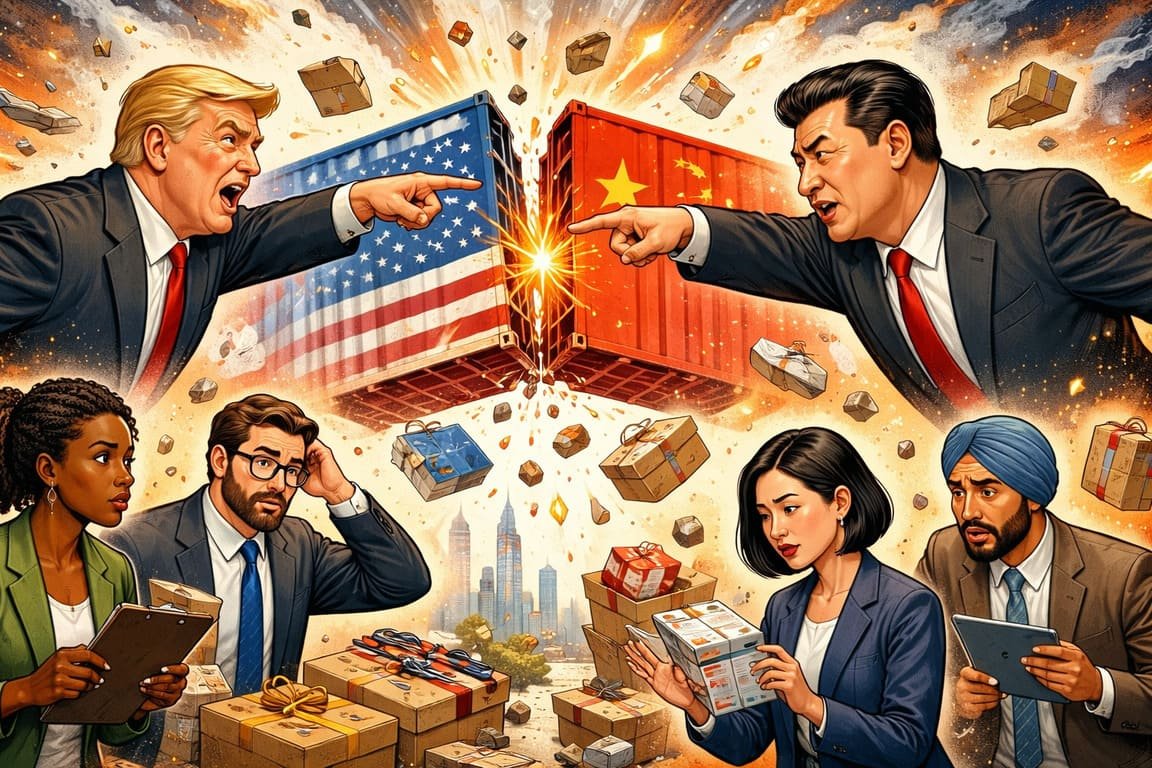
At the port, nothing looks dramatic. Containers rest in disciplined stacks. Cranes hover patiently. Paperwork moves faster than ships ever could. The calm is misleading. Beneath this choreography, a contest of influence is unfolding through tariffs, export controls, and carefully phrased regulations that sound procedural but land with force. The trade war between China and the United States is not about who sells more goods. It is about who gets to define how the future economy works.
Trade wars rarely declare themselves openly. They arrive as reviews, safeguards, and national security exemptions. Each step is framed as reasonable. Together, they alter the landscape. Supply chains that once prized efficiency now prize resilience. Certainty gives way to contingency planning. What felt like a shared global marketplace begins to resemble a network of guarded corridors.
At its core, the conflict reflects two competing views of economic power. One emphasizes long term state coordination, industrial strategy, and national goals. The other celebrates market driven innovation while quietly protecting its strategic sectors. Each side accuses the other of distortion. Both accusations contain truth. The real dispute is not fairness alone, but which model should anchor global growth.
Technology has become the sharpest edge. Advanced chips, artificial intelligence, and manufacturing tools now carry strategic weight equal to traditional weapons. Restrictions are justified as precaution, yet they function as brakes on competitors. Limiting access today is meant to shape capability tomorrow. The risk is that separation accelerates parallel ecosystems, fragmenting the digital world into rival standards.
Businesses absorb the shock long before consumers notice. A procurement director splits suppliers across regions, not to save money but to survive disruption. A manufacturer redesigns products to avoid controlled components. These decisions happen quietly, yet they rewire global trade more effectively than speeches ever could.
Consumers feel the war indirectly. Prices creep upward. Choices narrow subtly. Leaders promise protection and resilience. Households experience inflation and inconvenience. The gap between narrative and reality widens. Trade policy becomes personal when it reaches the checkout line.
Global institutions strain to stay relevant. The World Trade Organization was built to mediate disputes and discourage escalation. Its rules struggle when security exceptions override economic logic. Enforcement weakens when the largest players decide compliance is optional. The referee remains on the field, but the game has changed around it.
National pride keeps tensions elevated. No leader wants to appear soft. Compromise is framed as concession. Domestic politics reward toughness even when it complicates diplomacy. The feedback loop favors escalation over resolution, narrowing space for creative outcomes that would benefit everyone involved.
History warns against believing trade wars stay contained. Economic pressure bleeds into alliances, research collaboration, and cultural exchange. Trust erodes slowly, then suddenly. Once decoupling begins, reversing it becomes politically expensive, even when costs mount.
There are quieter moments that complicate the narrative. Negotiations resume despite rhetoric. Licenses are granted. Exemptions appear. These are not contradictions. They are acknowledgments of interdependence that ideology cannot erase. Complete separation would damage both sides more than any single tariff ever could.
Smaller nations watch closely, adjusting strategy in real time. Some hedge by diversifying partners. Others align decisively, hoping proximity to power brings security. The trade war becomes a global sorting mechanism, influencing development paths far beyond Beijing and Washington.
The human impact rarely headlines policy debates. Workers retrain. Communities adapt unevenly. Some regions benefit from relocation. Others hollow out quietly. Leverage is applied through lives that do not vote in foreign elections, yet absorb the consequences regardless.
The China–US trade showdown is less a single battle than an extended negotiation over influence, values, and economic gravity. Its outcome will not arrive with a treaty alone. It will emerge through countless decisions made far from podiums, in factories, labs, and ports like this one. The real question is not who wins the trade war, but whether the rules being written now will leave the global economy more resilient, or simply more divided than before.
