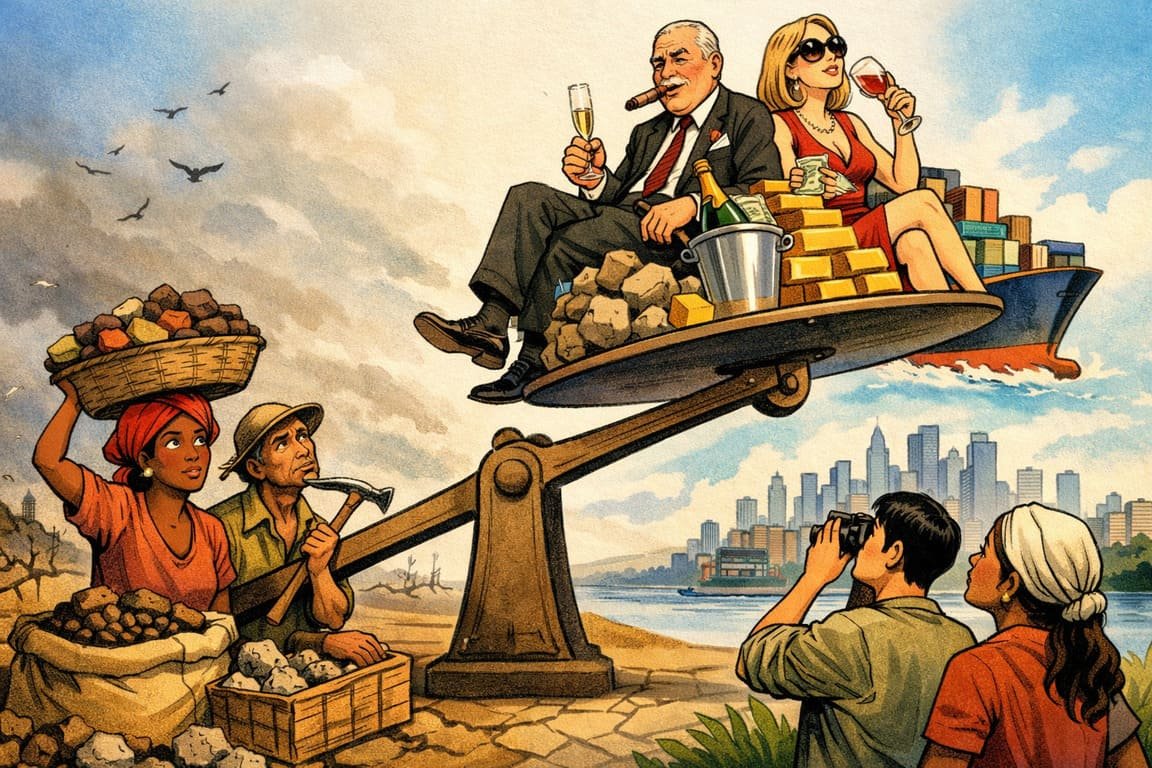
The port looks calm from a distance. Containers stack neatly. Cranes move with practiced patience. Ships wait their turn like obedient giants. Everything suggests order, efficiency, progress. Yet behind the choreography lies a quieter imbalance. The goods moving across these waters carry vastly different futures depending on where they land. Some containers deliver wealth. Others export dependence. The system insists this is trade. Those living inside it know it feels more like extraction dressed up as partnership.
Global trade was sold as a ladder. Open markets, integrate supply chains, attract investment, and prosperity would follow. The promise felt rational, almost mathematical. Yet for many poorer nations, the ladder was missing rungs from the start. They were encouraged to specialize in raw materials and low margin production while others captured processing, branding, and profit. Value traveled north. Risk stayed home. The imbalance hardened into routine.
Negotiations rarely occur on equal footing. Wealthy nations arrive armed with legal teams, historical leverage, and the luxury of delay. Poorer nations arrive under pressure. Debt obligations loom. Employment crises demand urgency. Political instability narrows options. Agreements become technically voluntary yet practically unavoidable. Consent exists, but choice feels constrained. A former trade negotiator from East Africa once admitted that saying no often meant watching investment disappear overnight.
Institutions meant to level the field often reinforce hierarchy. Compliance standards favor scale. Certification costs reward capital. Small producers struggle to meet rules written far from their realities. A textile cooperative in Southeast Asia spent years upgrading facilities to satisfy export requirements, only to be undercut by multinational competitors who could absorb the expense easily. Efficiency won. Community lost.
Agriculture exposes the contradiction most clearly. Farmers in poorer nations compete against heavily supported producers abroad. Subsidized crops flood local markets. Prices collapse. Rural livelihoods evaporate. Migration follows. The same countries that promote free trade then condemn border pressure. Cause and effect drift apart in public debate, but remain tightly linked in lived experience.
Intellectual property rules deepen the divide. Knowledge becomes gated. Seeds, medicines, and technologies travel behind legal tolls enforced globally. Innovation is celebrated. Access is restricted. A public health worker once described watching treatable conditions persist because solutions existed but remained priced beyond reach. Trade law protected ownership. Human cost became invisible.
Cultural narratives help obscure the structure. Poverty is framed as a failure of governance or effort rather than design. Trade rules fade into the background. Responsibility shifts downward. Consumers benefit from low prices while remaining insulated from consequence. Convenience comforts conscience. The system survives because its costs feel distant.
Even success stories carry tension. Some nations climb by embracing export driven growth. Industrial zones expand. Urban centers surge. Yet gains concentrate. Environmental damage accumulates. Labor protections strain. Progress arrives unevenly and demands endurance few can sustain indefinitely. Those who cannot are labeled uncompetitive, as though resilience were a personal flaw.
Reform efforts surface regularly. Ethical sourcing pledges. Fair trade labels. Development clauses. These initiatives matter, but they rarely challenge the core architecture. Real change would require wealthier nations to accept higher costs and slower consumption. That conversation struggles to move beyond rhetoric. Comfort resists redistribution.
The most revealing moments happen late in negotiations. Documents spread across tables. Translators exhausted. Coffee untouched. One side can wait. The other cannot. The deal closes. Headlines celebrate cooperation. The structure locks in for another generation. Trade continues. The imbalance remains politely intact.
The system persists because it feels abstract until traced back to everyday choices, and the unsettling question waiting for you is whether fairness still matters once injustice arrives wrapped in efficiency and delivered right on schedule.
