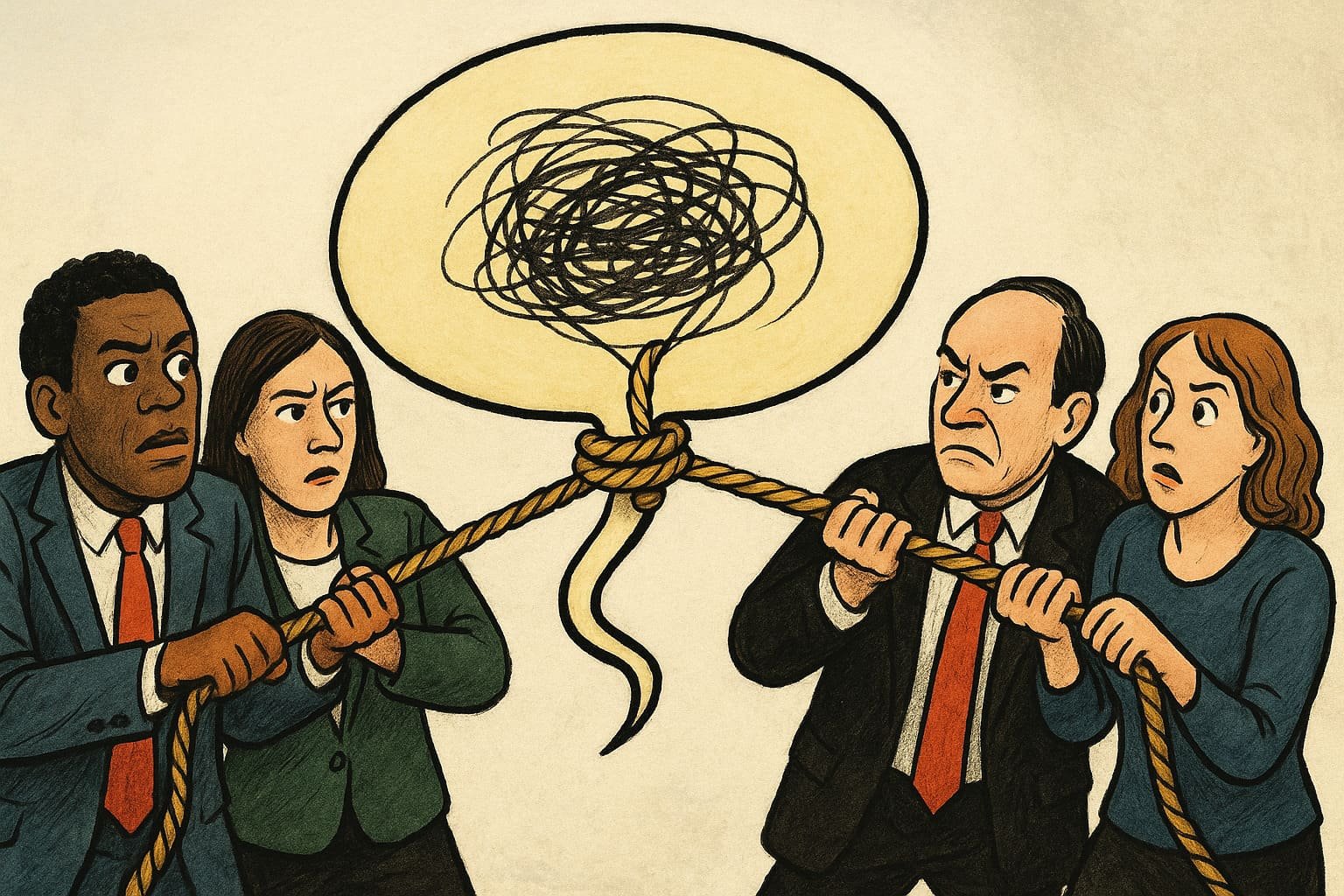
The conference room was filled with sound but strangely empty of meaning. Voices overlapped, slides flickered, and everyone nodded at the right moments. The meeting ended exactly where it began, with nothing decided and everyone slightly more tired than before. Modern life is saturated with words, yet starved of real communication. Conversations multiply while understanding quietly evaporates.
Language was once a tool for survival, storytelling, and connection. Today it often functions as noise management. People speak to fill silence, to perform intelligence, or to avoid discomfort. Talk becomes a shield rather than a bridge. The result is endless dialogue that feels busy but hollow, like a radio tuned between stations.
You can feel this erosion in social spaces where conversations never deepen. Small talk stretches endlessly without ever becoming meaningful. Questions feel scripted. Answers feel rehearsed. Nobody risks saying what they actually think. Politeness replaces honesty. Safety replaces truth. Communication turns into choreography.
A sales manager named Victor once noticed that his most productive meetings were also the quietest. He asked fewer questions and waited longer for responses. At first, the silence felt awkward. Over time, people started speaking more deliberately. The room shifted from performance to reflection. Decisions improved. Tension decreased. The absence of constant talking created space for clarity.
Culturally, silence is treated as failure. Someone who pauses is assumed to lack confidence or knowledge. This belief trains people to respond instantly, even when unsure. Opinions are formed before thoughts mature. The fastest voice dominates, not the most considered one. Talk becomes competition instead of exploration.
Philosophically, useless chat emerges from fear. Fear of being irrelevant. Fear of appearing ignorant. Fear of emotional exposure. Words become armor. Yet the more people hide behind language, the less authentic communication becomes. Real dialogue requires vulnerability, and vulnerability feels risky in environments built on status and image.
A therapist named Lena once described listening as the rarest social skill. Most people wait for their turn to speak instead of absorbing what is being said. They scan for openings, not meaning. Conversations become parallel monologues disguised as exchange. The mind stays busy, but connection never forms.
Political discourse suffers from the same pattern. Debates prioritize soundbites over substance. Talking points replace inquiry. Complex issues are reduced to slogans. The goal shifts from understanding to winning. This style of communication rewards volume and confidence, even when accuracy and nuance are sacrificed.
The stoic tradition treated speech as a moral responsibility. Words were seen as actions, capable of shaping reality. Speaking carelessly was considered a form of self-harm. Silence, when chosen intentionally, was viewed as strength. It protected the mind from unnecessary conflict and preserved energy for meaningful engagement.
A product team once implemented a simple rule. Nobody could speak twice until everyone had spoken once. The change felt artificial at first. Gradually, quieter members shared sharper insights. Dominant personalities learned restraint. The quality of discussion improved without adding a single extra word. Structure revealed what noise had hidden.
Modern technology amplifies useless chat. Messaging platforms encourage constant updates. Social feeds reward commentary on everything. People feel pressured to react to events they barely understand. The cost is cognitive fatigue. Attention fragments. Thought becomes reactive. Silence feels suspicious.
A journalist named Noor once stopped checking notifications for a month. At first, she felt disconnected. Then she noticed how much mental space returned. Conversations felt slower but richer. She listened longer. She interrupted less. The absence of constant commentary allowed her to hear her own thoughts again.
Communication becomes powerful when it becomes selective. Speaking with intention forces ideas to mature before expression. Listening with patience allows meaning to emerge without force. Silence becomes an ally, not an enemy. The mind stops chasing relevance and starts cultivating understanding.
In a crowded café, two strangers sat across from each other without speaking. Around them, conversations blurred into background noise. Their silence felt heavier, more present. When one finally spoke, the words landed with unusual clarity. Nothing had been wasted.
Useless chat thrives in environments where people fear stillness. Strangling it does not require rudeness or withdrawal. It requires courage to pause, discipline to listen, and honesty to speak only when something actually needs to be said. The most radical communication tactic is not saying more. It is knowing when silence carries the message better than words. And the question that remains, quietly unsettling, is whether you are speaking to be heard, or speaking to avoid hearing yourself.
