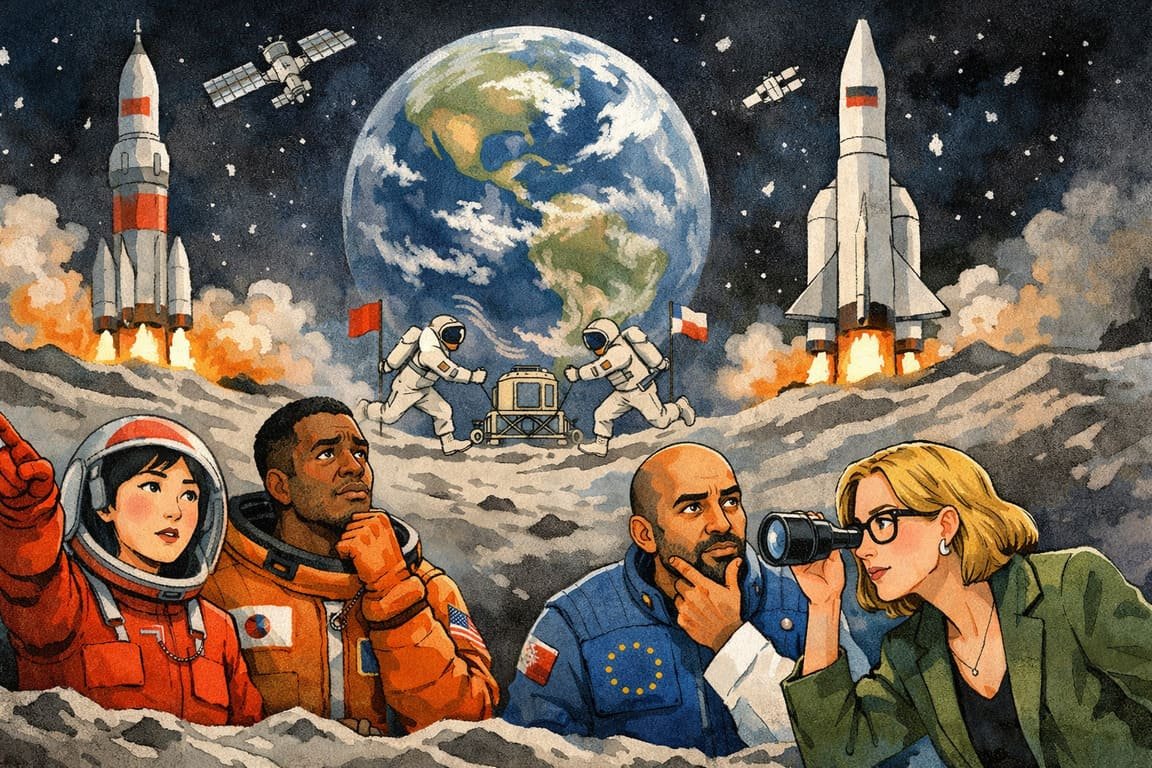
Above the planet, there is no noise. No chants. No applause. Satellites slide through darkness with mechanical grace, indifferent to the borders they orbit. From the ground, space still carries the language of wonder. From inside government briefings, it sounds more like leverage. The space race has returned, not with a single flag or a shared gasp, but as a quiet contest layered with strategy, pride, and unease.
This revival does not resemble the theatrical rivalry of the past. There are no singular moments designed for collective memory. Instead, launches happen often, sometimes privately, sometimes under classification. Space has shifted from symbol to system. It now underpins communication, finance, navigation, climate monitoring, and security. Whoever controls orbit controls the invisible scaffolding of modern life.
National ambition fuels this acceleration. Governments speak of exploration while calculating advantage. A satellite is never just a satellite. It is insurance, surveillance, and deterrence wrapped in aluminum. The language remains aspirational, yet the logic is unmistakably strategic. Space is framed as neutral terrain, even as every move anticipates another.
Private companies complicate the balance. Their rhetoric celebrates efficiency and innovation, but their launches rarely escape national gravity. Laws, subsidies, and security interests follow them into orbit. A rocket may carry a corporate logo, but its implications ripple through geopolitics. The boundary between civilian progress and military utility blurs easily when infrastructure serves both.
International rules exist, but they feel thin against modern pressure. Agreements written for an emptier sky struggle with congestion, debris, and dual use technology. Anti satellite tests scatter fragments that threaten everyone, yet deterrence logic keeps them alive. Each nation insists on defense. The result is collective vulnerability disguised as caution.
Astronauts often describe a shift in perspective when viewing Earth from above. Borders fade. Fragility becomes obvious. That clarity rarely survives reentry into politics. On the ground, funding cycles, threat assessments, and prestige reclaim control. The overview effect loses to rivalry, even as the planet remains visibly shared.
Engineers live inside the contradiction daily. A scientist collaborating on climate data may also know their work strengthens systems that could disable another nation’s satellites. Cooperation and competition coexist in the same lab, the same codebase, the same launch window. Progress advances alongside suspicion, neither able to fully cancel the other.
Space also magnifies inequality. Wealthy nations debate lunar bases and asteroid resources while others struggle for reliable connectivity. Satellite constellations promise global coverage, yet access follows profitability. The risk is not just domination, but normalization of exclusion, justified by technical complexity rather than moral choice.
Philosophically, the moment forces an old question into a new arena. Is exploration still exploration when every discovery is weighed for advantage. Humanity’s outward reach has always mixed curiosity with conquest. Space simply removes the illusion that there is somewhere untouched by power.
Hope survives in quieter channels. Joint missions continue. Data is shared during emergencies. Coordination appears when lives depend on it. These moments rarely dominate headlines, yet they prove rivalry is not inevitable. Trust exists, fragile but real, sustained by people who choose collaboration over applause.
Public imagination still matters. Films, books, and classrooms keep space alive as a shared frontier. That cultural memory shapes expectations. It reminds voters and leaders alike that space once represented possibility rather than possession. Narrative influences policy more than it admits.
The reloaded space race is not doomed to replay the past, but it is tempted by it daily. Technology is outrunning ethics. Ambition moves faster than restraint. The question is not whether humanity can reach farther into the dark. It is whether wisdom can travel at the same speed, or whether the silence above Earth will soon echo with the same rivalries that never learned to stay grounded.
