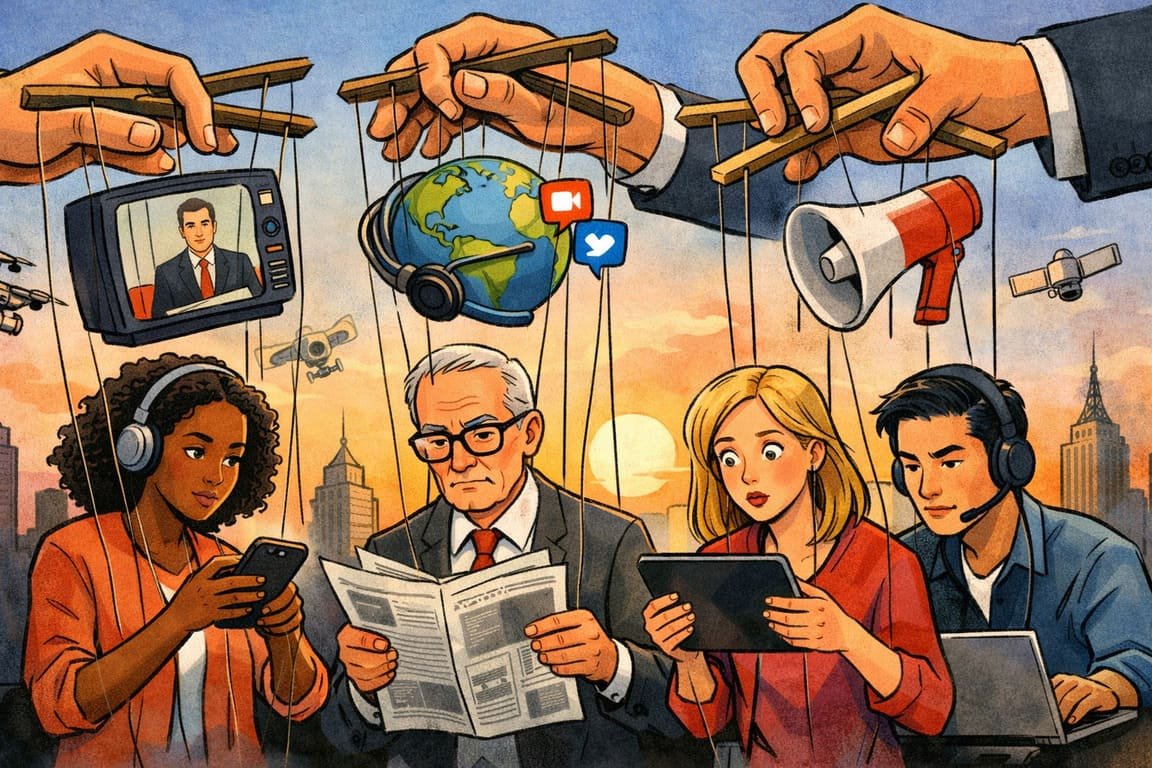
A quiet glow fills countless rooms before sunrise, screens humming with certainty, headlines landing like verdicts already decided. Somewhere between coffee cooling and notifications stacking, a story chooses its hero and its villain long before the reader notices the choice was made for them. This is not chaos. It is choreography. The modern news ecosystem feels spontaneous yet behaves with eerie discipline, guiding attention, outrage, and comfort in precise doses. What appears as freedom of information often operates more like a velvet rope, letting some narratives stroll confidently forward while others wait outside, unheard, unseen, and slowly forgotten by design rather than accident.
Media power rarely announces itself with trumpets. It whispers through repetition. Ownership concentration has quietly redrawn the boundaries of public debate, turning newsrooms into assets rather than civic institutions. When a handful of conglomerates shape what billions see, diversity of thought narrows without appearing to. A foreign conflict becomes simplified, labor struggles softened, financial excess reframed as ambition. The audience feels informed while absorbing a carefully edited reality. A former editor once admitted over drinks that the real censorship happens long before publication, during budget meetings and advertiser calls. Nobody orders silence. Silence simply becomes the safest option.
Algorithms now sit beside editors as silent partners, deciding which stories breathe and which suffocate. Engagement metrics reward emotional spikes, not depth. Rage travels faster than nuance. Fear converts better than patience. A reporter chasing context loses to a headline promising instant certainty. Over time, journalism adapts to survive, reshaping itself around clicks rather than clarity. A young freelancer once joked that the truth performs poorly unless dressed like a scandal. It was funny because it was true. When distribution systems reward outrage, even honest storytellers feel pressure to sharpen edges until complexity bleeds away.
Political narratives thrive inside this environment. Power understands media not as a mirror but as a lever. Campaigns frame issues with language tested like consumer products, searching for phrases that bypass thought and land directly in emotion. Viewers mistake familiarity for truth. Repetition becomes credibility. A policy proposal gains legitimacy simply by appearing everywhere at once. The line between reporting and amplification blurs. Journalists feel it. Audiences sense it. Trust erodes quietly. People begin choosing outlets like sports teams rather than information sources. Belief becomes tribal. Facts turn optional.
Culture absorbs these patterns and reflects them back amplified. Entertainment borrows journalistic tone. News borrows entertainment pacing. Everything accelerates. Stories shrink. Attention fragments. A filmmaker once noted that audiences now expect villains to appear within seconds, conditioned by headlines that frame complex systems as personal failures. Media simplifies morality because simplicity keeps viewers watching. The result feels comforting and dangerous at once. Problems appear solvable through outrage alone. Systems dissolve into characters. When disappointment follows, cynicism fills the gap.
Philosophically, this raises an uncomfortable question about consent. Can influence remain ethical when invisibility is its strength. Most readers never chose which stories disappeared before reaching them. They never voted on framing choices that shaped emotional responses. A communications professor once compared modern media to architecture. Buildings guide movement without instructions. Walls suggest behavior. Media works similarly, nudging thought through layout, tone, and omission. Responsibility becomes diffuse. Nobody feels guilty. Everyone benefits. The audience remains grateful for convenience while surrendering agency piece by piece.
Resistance exists, though it looks quieter than rebellion narratives suggest. Independent journalists carve spaces through newsletters, podcasts, and community funding, choosing sustainability over scale. Their audiences grow slowly but deliberately. A former television anchor left prime time for a subscriber model, trading millions of viewers for thousands of engaged readers. The shift felt risky but honest. Without advertiser pressure, stories breathed. Mistakes were corrected publicly. Trust rebuilt incrementally. These experiments reveal something important. People do not reject complexity. They reject feeling played.
Social responsibility cannot rest solely on creators. Audiences shape incentives through behavior. Every click votes for a future headline. Every share teaches an algorithm what to reward next. Media literacy becomes civic duty rather than academic luxury. Recognizing framing, questioning sources, and sitting with uncertainty require effort. It feels slower than scrolling. Less thrilling than outrage. A high school teacher once described watching students unlearn instant certainty, discovering that discomfort often signals growth. Democracy depends on that discomfort.
Economic pressure complicates reform. News organizations operate inside markets that reward scale and speed. Slowing down risks irrelevance. Simplifying attracts advertisers. Moral clarity competes with payroll deadlines. A newsroom manager once confessed that investigative work died quietly, not from censorship, but from spreadsheets. Long stories cost more than they return. Short outrage pieces keep lights on. This reality does not excuse manipulation but explains its persistence.
The psychological cost surfaces gradually. Constant exposure to conflict narratives exhausts empathy. Everything feels urgent. Nothing feels solvable. People disengage or radicalize. Both outcomes serve concentrated power. An overwhelmed public rarely organizes thoughtfully. Media saturation creates learned helplessness disguised as awareness. A therapist once noted clients arriving with anxiety sourced not from personal trauma but endless consumption of catastrophic headlines. Perspective collapses. Fear fills gaps where context should live.
History suggests cycles break when awareness sharpens. Printing presses once centralized truth. Radio followed. Television dominated. Each era produced gatekeepers and challengers. Today feels no different, only faster. The question is not whether control exists but whether people notice it early enough. Curiosity becomes rebellion. Slowness becomes strategy. Choosing fewer sources, deeper reading, and quieter reflection rewires influence pathways.
Late at night, screens dim, headlines fade, and silence returns briefly. In that pause lives a choice rarely acknowledged. The reader stands between comfort and curiosity, certainty and inquiry. Control weakens when attention turns intentional. The masters of media depend on habit, not force. Breaking habit feels small but compounds. Tomorrow’s narratives begin forming long before morning alerts arrive. What grows next depends on whether passive consumption continues or thoughtful resistance becomes routine, one deliberate click at a time.
