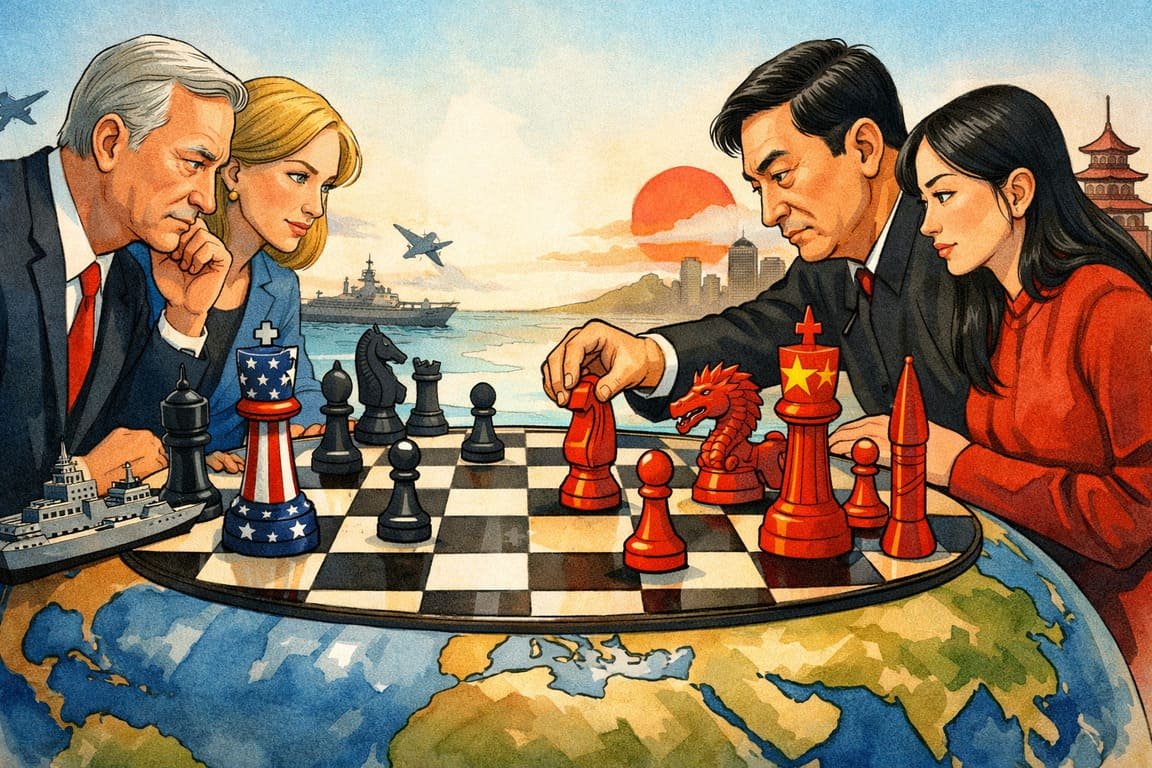
A long table sits under cold lights, polished to reflect faces trained to reveal nothing. Screens glow with maps, trade routes, shipping lanes, data flows. No soldiers march. No sirens scream. Yet every move carries weight measured in decades. The confrontation between the United States and China does not announce itself as war. It unfolds as strategy, posture, patience. Each side studies the other with the quiet intensity of grandmasters, knowing the game is not about winning quickly but about shaping a future where the opponent has fewer choices left.
Power today no longer relies on flags planted in foreign soil. It travels through supply chains, standards, and technological ecosystems. Washington speaks the language of alliances and values. Beijing answers with infrastructure, capital, and speed. Both believe time favors them. The competition hides inside semiconductors, shipping ports, rare earth minerals, and digital platforms. A factory relocation becomes a geopolitical signal. A trade regulation feels like a diplomatic message. Citizens notice prices changing without realizing those fluctuations reflect moves made far beyond grocery aisles and balance sheets.
The American approach leans on legacy influence. Military reach remains unmatched. Cultural soft power still shapes global imagination. Institutions built after World War II continue carrying American fingerprints. Yet confidence wavers. Political polarization weakens consistency. Allies grow uncertain about long-term commitments. A former diplomat once admitted that unpredictability erodes trust faster than disagreement. Strategy depends on reliability. Without it, even strong players lose leverage. The chessboard punishes hesitation. Every delayed move creates space for another actor to advance quietly into contested territory.
China plays a different tempo. Long planning cycles favor endurance over urgency. Infrastructure projects stretch across continents. Technology investment follows state-backed coordination. The Belt and Road initiative reflects ambition wrapped in development language. Critics warn about debt and dependence. Supporters see opportunity and growth. Both views hold truth. Beijing understands that influence grows when needs are met faster than alternatives allow. Power arrives disguised as partnership. A port upgrade becomes a foothold. A fiber optic cable becomes a nervous system. Presence deepens without confrontation.
Technology sharpens the rivalry. Artificial intelligence, quantum computing, and advanced manufacturing redefine advantage. Whoever sets standards controls ecosystems. Whoever controls ecosystems shapes behavior. Export controls feel defensive but provoke acceleration elsewhere. A chip restriction becomes motivation for domestic innovation. Decoupling sounds clean in theory but fractures global networks built over decades. Businesses feel caught in between, navigating compliance while trying to remain competitive. A technology executive once described the moment as living inside overlapping rulebooks that contradict each other, forcing choices with geopolitical consequences rather than purely commercial ones.
Culture absorbs the tension unevenly. In the United States, China often appears as an abstract threat. In China, America appears as a declining hegemon unwilling to accept change. Narratives harden. Media amplifies extremes. Nuance struggles to survive. Ordinary citizens on both sides share similar hopes for stability, opportunity, and dignity. Yet they inherit suspicion shaped by rhetoric beyond their control. A student exchange participant once remarked that personal friendships felt easier than political conversations. People connected. Systems collided.
Philosophically, the clash raises questions about order itself. Is the future multipolar or hierarchical. Can differing political models coexist without dominance. The post Cold War assumption that economic integration leads to ideological convergence now looks naïve. China integrated without transforming politically. America globalized while fracturing internally. Each side views the other as evidence that its own fears are justified. That mutual suspicion fuels defensive aggression. The chessboard tightens. Moves become reactive. Vision narrows.
Smaller nations feel the pressure most. Choosing sides risks retaliation. Staying neutral invites suspicion. Southeast Asia, Africa, and parts of Europe navigate carefully, extracting benefits while avoiding entanglement. A trade deal with one power complicates relations with the other. Sovereignty becomes negotiation rather than declaration. Leaders balance pragmatism with principle. A regional official once described diplomacy as walking a bridge while both ends are being rebuilt simultaneously. Stability depends on constant adjustment rather than fixed alignment.
Economic interdependence complicates escalation. Supply chains bind rivals together. Financial markets react nervously to rhetoric. Sanctions threaten blowback. Full separation would hurt everyone. This creates a paradox. The rivalry feels intense yet restrained. Competition escalates below the threshold of open conflict. Cyber operations, influence campaigns, and regulatory pressure replace tanks. The absence of war does not equal peace. It signals a new form of confrontation designed to exhaust rather than explode.
History offers warnings about miscalculation. Great powers often stumble not through intention but through assumption. Each believes the other will blink. Each trusts its resilience. The slow pace of this rivalry increases risk. Prolonged tension normalizes hostility. Escalation becomes incremental. Lines blur. A naval maneuver feels routine until it suddenly is not. The chessboard rewards patience but punishes arrogance. Hubris remains the most dangerous piece on the board.
Late in the game, spectators often mistake stillness for resolution. The board appears stable. Pieces hold position. Yet beneath that calm, calculations multiply. Futures diverge silently. The United States and China continue circling, testing, adapting, shaping a world that will feel their rivalry long after current leaders exit the stage. The match remains unfinished. What matters now is not who wins but whether humanity learns to survive a contest where power moves quietly, consequences travel globally, and the final checkmate may not look like victory at all.
