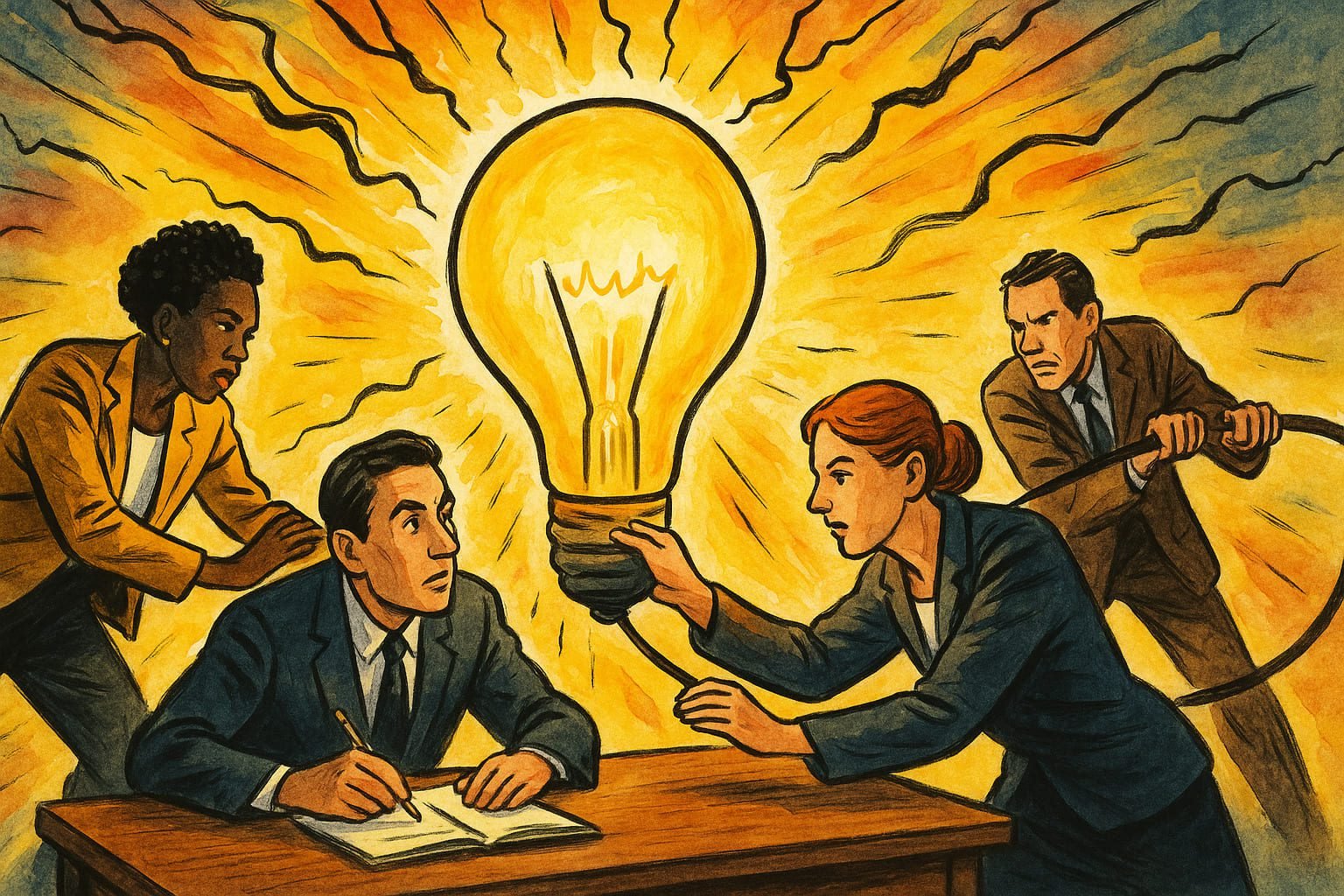
Imagine Picasso trapped in a spreadsheet or Da Vinci buried in an Excel formula. That, my friend, is what most modern businesses look like: breathtaking ideas suffocated by systems. But there’s a rebellion underway. A quietly disruptive movement that is shifting the power back to curiosity, empathy, and storytelling. It’s called design thinking, and it’s not just a trendy buzzword. It’s the weapon of choice for businesses tired of stale boardroom thinking and ready to spark the kind of innovation that flips industries on their heads.
Design thinking isn’t just about drawing wireframes or sketching on sticky notes. It’s about radical human-centric problem solving. It’s empathy meeting strategy. It’s art having coffee with logic. It asks one critical question: What would happen if we designed businesses around people, not PowerPoints?
From Apple’s product universe to Airbnb’s guest experiences, design thinking is the unsung hero turning bland businesses into beloved brands. It uncovers friction points others overlook. It transforms complaints into blueprints for reinvention. And it does it without needing a crystal ball or a billion-dollar R&D lab.
In this deep dive, we’ll show how design thinking can be your business’s unfair advantage. You’ll learn how it dismantles outdated processes, sparks untamed creativity, and builds brand intimacy so strong it borders on cult-like. This isn’t theory. This is the future of intelligent growth and it starts with asking better questions.
Quick Notes
- Human-Centered Innovation Outpaces Strategy-Centric Planning: Traditional business plans often miss emotional insight. Design thinking flips that. It roots innovation in real human needs, making solutions more relevant, sticky, and profitable.
- Empathy Is the New Strategy: Empathy isn’t soft. It’s surgical. Teams that master empathy uncover unmet needs that competitors can’t see. This gives birth to category-defining products and services.
- Prototypes Beat PowerPoints: Design thinking forces action. Ideas don’t die in committee rooms. They get tested in the wild. Prototypes don’t need to be perfect; just provocative enough to learn.
- Cross-Disciplinary Collaboration Beats Siloed Expertise: When marketers, engineers, and designers sit together, sparks fly. Design thinking shatters departmental silos and opens space for hybrid, disruptive ideas.
- Failure Isn’t the End; It’s Data: Rapid iteration turns failures into insights. Design thinking encourages experiments that teach fast and build resilience. The goal isn’t perfection; it’s evolution.
Empathy Is a Business Strategy, Not a Soft Skill
Too many executives treat empathy like a nice-to-have, not a game-changer. But the best brands understand that true innovation begins with understanding people at a cellular level. Design thinking starts with ethnographic research, shadowing real users, and asking deeper questions than “What do you need?” Instead, it seeks, “What frustrates you, delights you, and keeps you up at night?” That emotional excavation builds products customers feel were made just for them.
Take Intuit, a fintech company that turned empathy into a growth engine. By embedding design researchers into households, they uncovered how financial anxiety crippled user behavior. That insight didn’t come from a spreadsheet; it came from watching a mother cry over a confusing tax form. They used those emotions to reinvent TurboTax into something both intuitive and empowering. Sales skyrocketed.
When you anchor product development in genuine human needs, you create loyalty that outlives marketing trends. Customers don’t just buy features; they buy resonance. Businesses obsessed with metrics miss this. They tweak, test, and A/B their way into mediocrity. But companies that listen, really listen, build cult followings. Empathy becomes a moat competitors can’t cross.
Empathy also rebuilds broken team dynamics. When employees feel heard and seen, they unleash their creativity. That’s not fluff; it’s fuel. Design thinking turns empathy inward first, then outward. It rewires the company culture to value perspectives beyond data points. That internal shift becomes the foundation for extraordinary external results.
If empathy isn’t guiding your strategy, you’re building in the dark. Customers may still buy, but they won’t remember why. They’ll forget you the moment someone else sees them better. The design-led companies? They get remembered. And revisited.
Prototypes Speak Louder Than Forecasts
It’s ironic: companies spend months perfecting business plans no one reads but balk at building prototypes users could actually test. Design thinking flips that logic. It prioritizes building fast, failing forward, and learning in real time. Prototypes make strategy tangible. They move conversations from “what if” to “here’s what.”
IDEO famously used this approach to help a major airline redesign the boarding experience. Instead of crafting reports, they built a cardboard terminal in a warehouse. Real travelers walked through it. What surfaced wasn’t theory; it was raw human behavior. That low-fidelity prototype unveiled high-value insights, like spatial anxiety and unexpected choke points. The airline reimagined its customer experience, increasing satisfaction scores overnight.
Prototypes remove ego from innovation. They welcome critique, iteration, and real-world validation. And they do it cheaply. No one gets married to a cardboard mock-up. But they do get invested in what it reveals. That humility accelerates alignment and innovation.
Perfectionism is the enemy of progress. Design thinking embraces the mess. It invites rough sketches, role play, even duct-taped solutions if they push ideas forward. Every prototype is a data point. Every data point tells a story. That story either validates your vision or improves it.
The MVP mindset redefines success. It’s not about wowing with polish. It’s about provoking the truth. What do people actually do, not what do they say? Design thinking lives in that gap. It lets the product speak first.
Creative Tension Builds Category Kings
Most businesses crave clarity, but creativity thrives in chaos. Design thinking embraces the tension between opposing forces: logic vs. emotion, speed vs. precision, constraints vs. ambition. It doesn’t seek harmony; it leverages conflict. That tension births category-defining innovations.
Apple’s legendary design team didn’t avoid friction. They used it to sharpen their edge. Steve Jobs demanded beauty and utility. Jony Ive obsessed over simplicity and delight. Their debates weren’t distractions—they were design rituals. From that heat, the iPhone was forged. Not through consensus, but through creative friction.
Design thinking creates space for conflict to be constructive. It treats disagreement as a design tool, not a political liability. When cross-functional teams collide, they reveal blind spots. Engineers temper idealism with feasibility. Marketers inject emotion. Designers demand clarity. The result? Bold, balanced innovation.
Creative tension is also where new categories are born. Netflix didn’t improve Blockbuster’s model; it obliterated it. They saw friction not as a problem, but a portal. The pain of late fees, the inconvenience of physical returns; those tensions became launchpads for a streaming revolution.
Avoiding tension creates safe ideas. Safe ideas die young. Design thinking encourages leaders to sit in the discomfort. It trains teams to translate conflict into creation. Because friction isn’t the enemy. Complacency is.
Collaboration Isn’t a Meeting. It’s a Mindset.
Design thinking isn’t a solo act. It’s jazz, not a solo piano recital. It thrives on interdisciplinary improvisation. True collaboration doesn’t happen when departments send each other memos. It happens when they share pens, post-its, and purpose.
At IBM, the shift to design thinking wasn’t about hiring more designers. It was about transforming engineers into empathy-driven innovators. They paired developers with users in design sprints. Suddenly, backend coders were sketching storyboards and talking to end-users. That collision of perspectives unlocked deeper insights and faster iterations.
Collaboration changes when hierarchy takes a backseat. The most junior team member can voice a billion-dollar idea in a well-run design sprint. Design thinking democratizes creativity. It removes “who said it” from the table and focuses on “does it work for the user?”
Culture eats strategy for breakfast, but collaboration is the main course. Without trust, play, and shared stakes, ideas stay locked in departmental silos. Design thinking trains organizations to listen actively, respond curiously, and build together. It rewires meetings from presentations into co-creations.
True collaboration isn’t just faster. It’s smarter. It bypasses politics and unlocks performance. Because when everyone feels ownership, innovation becomes a team sport, not a solo race.
Fail Faster, Learn Quicker, Win Bigger
Fear of failure kills more ideas than failure itself. Design thinking builds resilience by making failure part of the design. It reframes mistakes as experiments. The goal isn’t to avoid missteps but to extract wisdom from them before they scale.
Amazon’s culture of innovation is built on this. Jeff Bezos famously encouraged failed projects if they taught the team something new. Fire Phone flopped, but its lessons helped birth Alexa. The same spirit guides design thinking: fail small, fail early, and harvest insight fast.
Learning cycles are the heartbeat of design-led teams. Every prototype, interview, and post-mortem is a feedback loop. That loop sharpens instincts. It speeds up adaptation. In fast-moving markets, the ability to learn faster than your competitors is your only edge.
Failure also builds emotional safety. When teams know that risk is rewarded, not punished, they take bolder swings. That courage compounds. One brave idea begets another. Design thinking nurtures this culture by decoupling ego from output. Feedback isn’t personal; it’s directional.
The biggest risk in business today? Playing it safe. Design thinking turns risk into rhythm. It helps teams dance with uncertainty instead of dodging it. And that mindset doesn’t just create better products. It builds unshakable confidence.
The Future Belongs to the Curious
Design thinking isn’t a hack. It’s a habit. It’s a way of seeing, asking, building, and rebuilding that keeps businesses human, relevant, and resilient. The companies that dominate tomorrow aren’t the ones with the biggest budgets. They’re the ones that care the most about solving real problems for real people.
What makes design thinking revolutionary is that it’s not revolutionary at all. It’s ancient. It’s how artists create, how children explore, how cultures evolve. Business just forgot. Now it’s remembering.
So here’s the quiet truth: design thinking isn’t a department. It’s a decision. To stay curious. To stay generous. To keep solving from the heart and building from the gut.
And ask yourself this: Are you building something people need-or just something you want them to buy?
