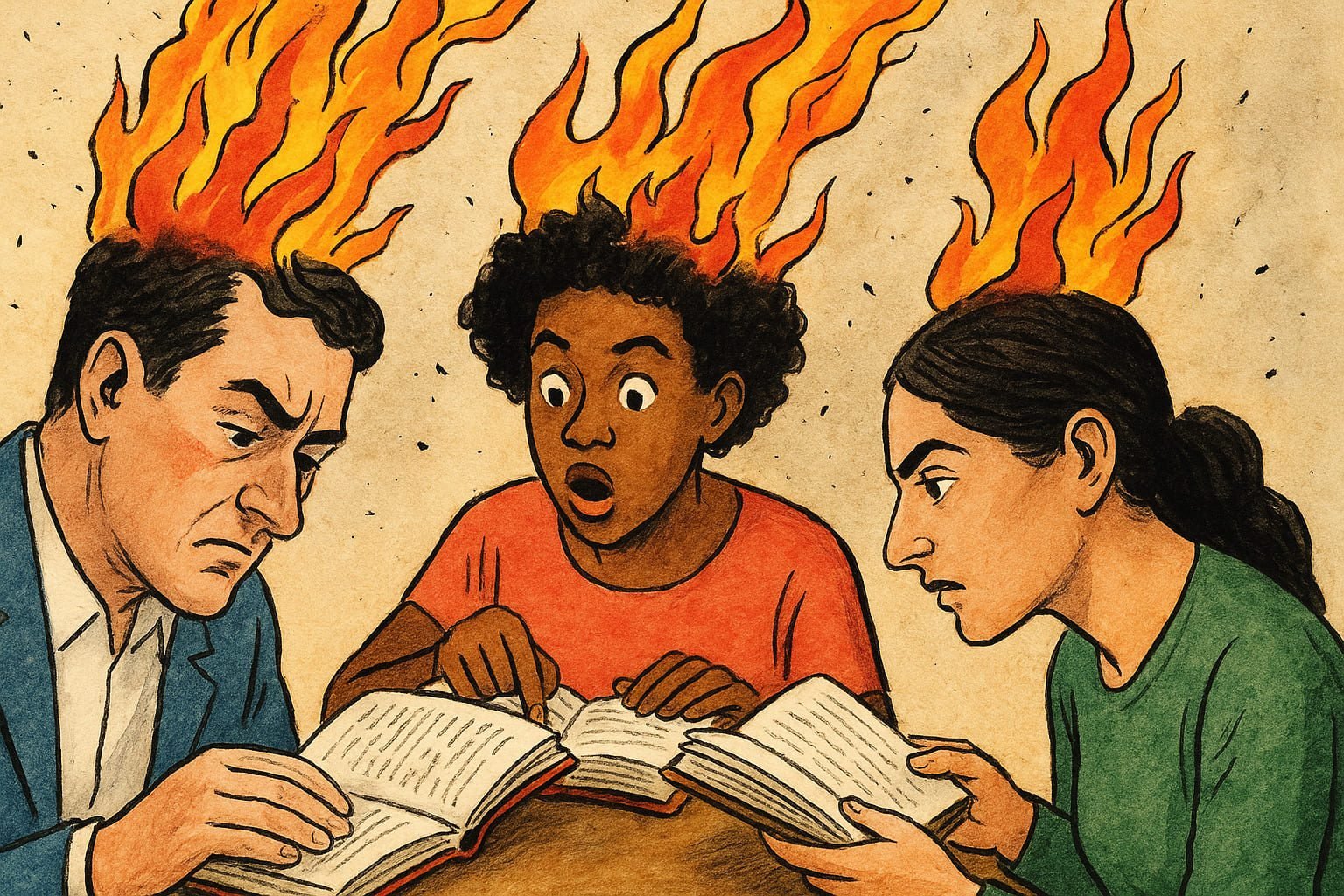
The library had long lost its purpose, yet people still drifted through it like ghosts rehearsing a forgotten ritual. Screens glowed where shelves once stood, offering infinite answers without the patience once required to earn them. Somewhere between the hum of machines and the quiet tapping of keyboards, learning had become frictionless and strangely hollow. It looked efficient from the outside, but something vital had gone missing. Knowledge no longer felt dangerous, rebellious, or alive. It felt safe, sterile, and endlessly disposable, like fast food for the mind.
Genius was once imagined as a rare spark that struck a chosen few, but the modern world rebranded it as productivity dressed in clever language. The student who memorizes fastest wins praise, while the one who struggles quietly feels defective. Schools reward compliance, workplaces reward speed, and society rewards whoever looks confident while repeating what already exists. The irony is brutal. Every system claims to value creativity, yet trains people to fear mistakes, ambiguity, and deep thinking. What gets lost is not intelligence, but courage.
You can feel this erosion when learning becomes a chore instead of a hunger. The mind stops asking wild questions and starts chasing neat answers. Many adults still remember a moment when curiosity died, often without realizing it. A teacher who mocked an idea, a boss who punished experimentation, an exam that reduced thought into checkboxes. Over time, the brain learns to conserve energy by avoiding risk. It becomes efficient, yes, but also smaller, quieter, and easier to control.
A product designer named Liora once described her breakthrough as accidental. She had been stuck on a problem for weeks and finally gave up, choosing to walk through a crowded market instead. Watching people negotiate prices, complain, improvise, and adapt gave her more insight than any whiteboard session. The solution arrived not from harder effort, but from richer exposure. Learning did not happen in isolation. It happened in chaos, observation, and emotional friction.
This is the part most systems ignore. The brain does not grow through repetition alone. It grows through contrast, discomfort, and meaning. Neuroscientists often point out that memory strengthens when information connects to emotion. A fact learned in boredom fades quickly. A lesson tied to embarrassment, excitement, or surprise stays for decades. Genius learning is not about consuming more content. It is about building experiences that leave a psychological trace.
Culture plays a silent role in shaping how people approach knowledge. Societies obsessed with credentials tend to confuse intelligence with status. Degrees become identity badges, and learning becomes a performance instead of a practice. The result is a generation fluent in terminology but afraid to admit confusion. Real understanding feels risky because it requires saying, out loud, that something is not yet clear. In many professional environments, that vulnerability feels more dangerous than ignorance.
A former journalist named Tomas once confessed that his best stories came from pretending he knew nothing. He would ask obvious questions that embarrassed experts, forcing them to explain ideas without jargon. Readers loved his work because it felt honest and accessible. His secret was simple. He treated ignorance as a tool, not a flaw. That mindset allowed him to learn faster than colleagues who guarded their reputations too carefully to look curious.
Philosophers have long argued that wisdom begins with recognizing how little one knows. Socrates built an entire legacy around that insight, yet modern culture behaves as if certainty equals strength. Social media rewards instant opinions. Algorithms amplify confidence, not depth. The loudest voice wins, regardless of accuracy. In that environment, learning becomes reactive. People collect arguments instead of understanding systems. They memorize positions instead of exploring perspectives.
The brain, however, thrives on slowness. Deep learning requires time, silence, and mental wandering. It needs space for half-formed ideas to collide and reshape each other. This is why long walks, idle moments, and even boredom often produce breakthroughs. The mind uses those gaps to integrate information in ways structured environments rarely allow. When every second is optimized, nothing has time to ferment.
An engineer named Farid once redesigned his study routine after burning out. Instead of reading nonstop, he limited himself to one complex concept per day. He spent hours explaining it aloud, drawing diagrams, and connecting it to unrelated topics like music and politics. His productivity appeared to drop, but his comprehension exploded. Within months, colleagues began asking him for guidance. He had not learned more. He had learned better.
Critical thinking emerges from tension, not comfort. It requires holding conflicting ideas without rushing to resolve them. This ability feels uncomfortable because it resists closure. Yet it is precisely what separates surface knowledge from deep insight. When people learn to tolerate uncertainty, their minds become more flexible. They stop seeking validation and start seeking patterns. That shift feels subtle, but it rewires how problems are perceived.
Politically, this kind of learning threatens systems built on predictability. A population trained to question narratives becomes harder to manage. It demands nuance, context, and accountability. Authoritarian structures fear that kind of intelligence because it cannot be easily packaged into slogans. Even in democratic societies, shallow learning serves power better than deep understanding. Simplicity spreads faster than truth, especially when attention is scarce.
In a dim café at the edge of the city, an aging professor once watched students argue over trivial facts while ignoring the larger question. He stirred his coffee slowly, amused and uneasy. The world had never had more information, yet people seemed less willing to sit with complexity. The tragedy was not ignorance. It was impatience disguised as efficiency, speed mistaken for wisdom.
The real challenge is not acquiring knowledge, but protecting the conditions that allow it to mature. Genius learning is less about intelligence and more about posture. It favors humility over ego, exploration over performance, and reflection over reaction. It asks for a different relationship with time, one that values depth even when metrics reward volume. The mind does not need more tools. It needs fewer distractions.
So the fire does not start with better systems or smarter apps. It begins with a quiet rebellion against convenience. It grows when confusion is treated as fertile ground, not personal failure. And it becomes dangerous when curiosity replaces certainty as the dominant instinct. The question that remains is simple and unsettling: are you learning to accumulate answers, or learning to become someone who cannot stop asking?
