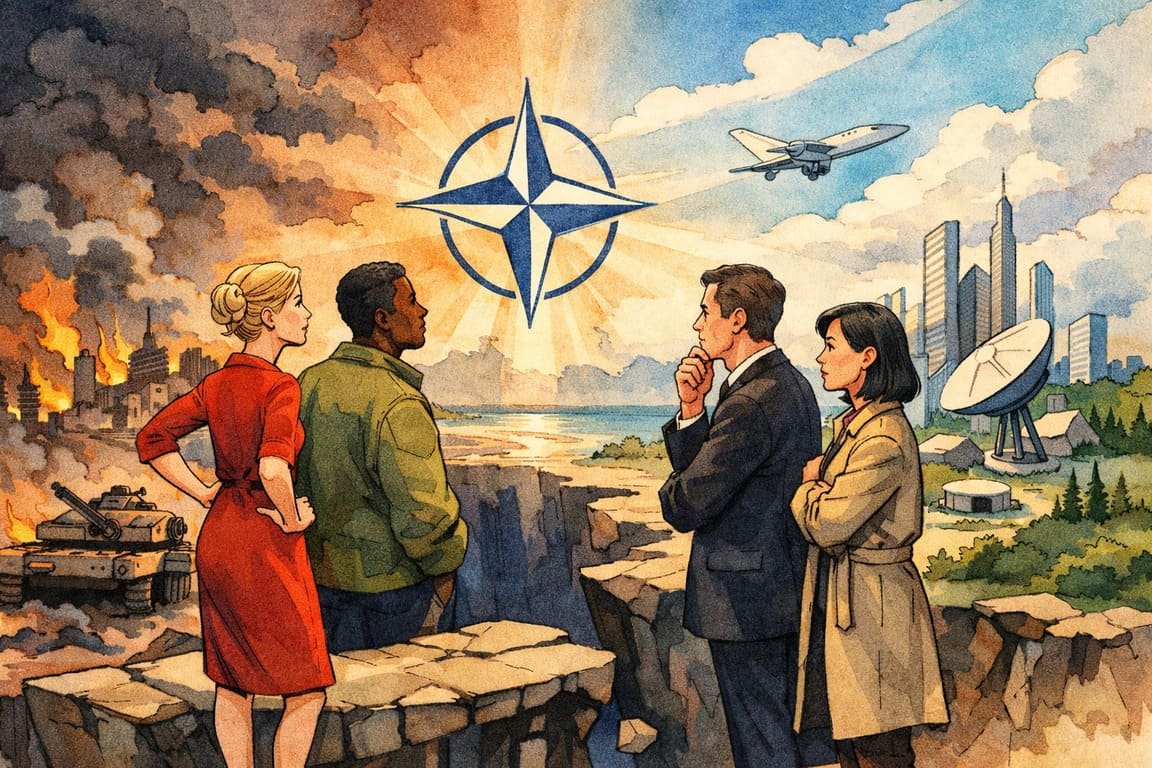
Inside a fortified room designed to survive catastrophe, chairs sit in careful symmetry. Flags stand motionless. Microphones wait patiently. The setting signals permanence, yet the atmosphere betrays doubt. An alliance forged in fear of annihilation now confronts a quieter threat, uncertainty about its own place in a transformed world. NATO still projects strength, but strength without clarity can feel hollow.
The alliance was born with uncommon precision of purpose. Collective defense promised that unity itself would deter aggression. An attack on one would trigger a response from all. That clarity anchored trust for decades. It shaped military planning, political alignment, and public expectation. NATO outlived the Cold War it was built to fight, a success so complete it became destabilizing. Victory removed the enemy that once justified unity.
The years that followed expanded NATO’s mission. Peacekeeping, counterterrorism, crisis response, and partnership building layered new responsibilities onto an old structure. Each expansion carried logic. Together, they blurred focus. Members disagreed on priorities. Threats multiplied without a single face. An alliance thrives on shared perception of danger. Ambiguity strains cohesion.
Russia’s return to overt aggression briefly restored clarity. Eastern members felt vindicated. Defense spending rose. Exercises intensified. The alliance rediscovered its deterrent posture. Yet beneath renewed urgency, familiar fractures persisted. Burden sharing debates resurfaced. Political trust wavered. Solidarity appeared reactive rather than instinctive. Unity under pressure differs from unity at rest.
Generational change complicates matters further. Younger populations experience insecurity differently. Cyber disruption, climate instability, and economic volatility feel more immediate than armored divisions. NATO adapts its language, but structure lags perception. Military alliances excel at confronting visible threats. They struggle with diffuse risks that ignore geography and blur civilian and military domains.
Domestic politics inside member states add strain. Populist movements question commitments. Multilateral institutions attract skepticism. Security is framed transactionally, as a service rather than a bond. This logic erodes deterrence. Credibility depends not only on capability, but on belief that commitments will hold even when inconvenient.
Technology accelerates pressure on decision making. Advanced weapons compress timelines. Autonomous systems reduce margins for error. Miscalculation grows more dangerous. NATO’s strength lies in coordination, yet coordination requires deliberation. When speed becomes decisive, consensus can feel like liability. Balancing democratic process with rapid response becomes an existential test.
Partnerships beyond formal membership blur boundaries further. Cooperation expands reach but complicates responsibility. Ambiguity can deter adversaries. It can also provoke them. Managing this tension demands strategic clarity that political cycles often resist. Expansion debates expose fault lines between principle and pragmatism.
Economic reality whispers where ideology shouts. Defense budgets compete with social priorities. Public support depends on perceived value. When peace feels normal, preparedness feels optional. NATO’s greatest success undermines its appeal. Insurance is easiest to question when disaster feels distant.
The alliance also carries moral tension. It presents itself as a community of values, yet members diverge in democratic practice and rule of law. This inconsistency weakens narrative authority. Values lose force when selectively applied. Adversaries exploit these fractures, framing NATO as hypocritical rather than principled.
Still, declaring NATO obsolete misses its enduring influence. Its presence shapes behavior. It reassures allies. It constrains escalation. No alternative offers comparable coordination at scale. The question is not whether NATO should endure. It is whether it can adapt without losing the credibility built on collective trust.
Adaptation demands honesty. The alliance must articulate what it defends and why in language that resonates beyond military circles. It must integrate new domains without diluting purpose. It must rebuild internal confidence before projecting external strength. Above all, it must remember that alliances are living arrangements, not historical monuments.
In a quiet corridor after the meetings conclude, footsteps fade and flags remain. The symbols still stand, waiting for renewal or neglect. NATO occupies a hinge moment, neither relic nor guarantee. And as uncertainty deepens across the global landscape, one question presses with uncomfortable urgency: when the next crisis arrives without warning, will collective defense rise as instinct shaped by shared belief, or hesitate as an inheritance still searching for its reason to exist?
