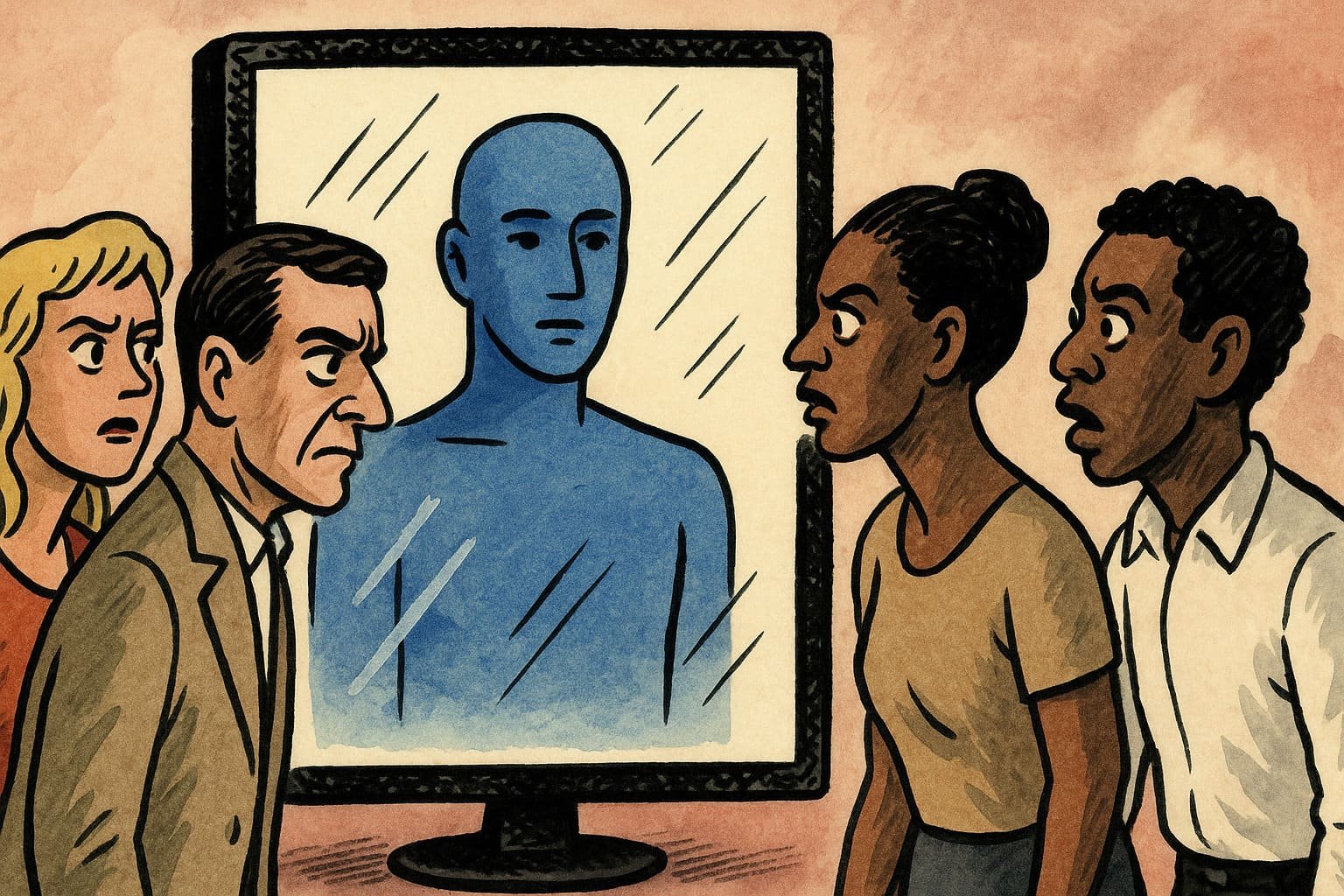
Spotlights blink to life above an endless row of glistening screens, their blue-white glow bleeding into the bone-colored silence of a midnight office. Shadows crawl across faces hunched in silent negotiation with code, each tap echoing like Morse from a planet desperate for meaning. A marketing director, breathing steam over lukewarm coffee, scrolls through customer data while her reflection stares back at her from the glass; a tired ghost of ambition she barely recognizes. Somewhere on the far side of the world, an engineer in Bangalore deploys a neural network, lines of code pulsing through a digital bloodstream that now knows her deepest secrets. The whole scene is silent, predatory, charged with a tension you only feel standing on the edge of a truth that could crack the universe open: what if the algorithm knows you better than you know yourself?
On this new frontier, machines don’t just process your choices; they learn your fears, desires, vulnerabilities, then hold them up like precious artifacts. At Apple’s unveiling of a new device, a software architect whispers to a colleague, “It’s not just about features anymore, it’s about building the perfect mirror.” The crowd claps, not quite understanding the joke that isn’t a joke at all. On TikTok, a viral video shows a comedian’s avatar glitching, lip-syncing confessions the real performer never dared say out loud. Audiences erupt. No one wonders if the joke’s on them. It’s not just technology reflecting humanity; it’s humanity bending to fit the grid of the algorithm, pixel by pixel, emotion by emotion.
Beneath the surface of all this showmanship, real power is shifting hands. “The ones who master the mirror will master the market,” says Kai Leung, founder of a startup now worth billions, who recently announced his entire C-suite is run by an AI-powered advisory team. The press eats it up, but backstage, junior developers trade rumors about their jobs being audited by an unseen eye. An intern tells her roommate, “It’s not the work I fear; it’s the feeling that I’m being watched from inside my own ideas.” Now, across continents, leaders and laborers alike find themselves searching their own data trails for hints of their true identity, wondering if authenticity can survive in the age of perfect reflection.
Whispers ripple through corporate halls and coworking spaces: Does the mirror reveal the self, or does it make you a character in someone else’s script? An executive in Manhattan nervously checks the office chatbot’s recommendations, not for typos, but for hints of what his employees really think. The difference between being seen and being understood has never been wider, and in this widening gulf, the machines are learning how to sell you your own reflection then charge a premium for the pleasure of being seen.
AI isn’t simply a tool, a threat, or a promise. It is the ultimate test: When a machine can finally show you every scar, dream, flaw, and secret without judgment or mercy, will you be brave enough to look?
Quick Notes
- Ultimate Mirror, Shattered Illusions: AI has become the world’s sharpest mirror, exposing hidden truths about individuals and organizations. No leader or employee can escape its gaze.
- The Human Algorithm Unraveled: As AI mimics, predicts, and personalizes, it doesn’t just automate tasks; it rewrites the boundaries of authenticity, self-deception, and ambition.
- Vulnerability Becomes Strategy: The workplace, once a refuge for masks and performances, is now a theater where AI makes every flaw and gift visible. Those who thrive learn to wield their real selves as power, not hide them.
- Contradiction and Comedy: Modern business is a spectacle of paradox; humanity exposed, flaws amplified, and yet, through humor and story, the new era invites a deeper, sometimes irreverent, kind of connection.
- Reflection is Revolution: To master digital transformation is to accept radical honesty, abandon nostalgia for old roles, and find purpose in an age where the self is always on display.
The Algorithm Never Blinks—Why Your Data Sells You Out
Picture a CEO’s office at dawn, windows streaked with the city’s pulse. The first thing she does isn’t checking emails, but asking her AI dashboard, “What do my people really want today?” Across town, a gig worker’s ride-sharing app calculates not just the fastest route but how long before burnout sets in. The new currency isn’t time or talent, but behavioral data; tiny signals harvested and weaponized to map out your next move before you make it.
You can sense the unease: every touchpoint, click, and digital sigh is a breadcrumb in the forest. Even lunch orders reveal more than taste; algorithms sift through cravings for patterns in mood, performance, and team cohesion. If it feels personal, that’s because it is. The tech world’s most powerful products don’t just analyze; they empathize with, or at least convincingly mimic, your emotional world.
Case in point: DeepMind’s foray into healthcare, where AI can predict health risks from seemingly random personal choices. It’s not a leap to imagine similar systems in HR or marketing, “reading” you like an open diary. “The real innovation isn’t prediction,” says Sherry Lin, product manager at an AI-first SaaS firm, “it’s persuasion. If you know someone’s next ten moves, you can lead them anywhere.” In this digital mirror, hiding is impossible.
Stories trickle down from Silicon Valley’s gilded cafeterias. A designer, trying to escape creative block, realizes her digital assistant knows her frustration before she does suggesting a meditation playlist after she deletes a fourth draft. She laughs, then shivers. The mirror has memory. Your best and worst days echo back in algorithmic suggestions, reminders that the data isn’t just collected, but felt.
Across industries, the myth of meritocracy quietly unravels. Promotions, firings, new hires; nothing escapes the scrutiny of machine learning models. The uncomfortable truth: even excellence now requires transparency, a willingness to have your digital self-scrutinized and exposed. The age of secrets is over. The mirror is watching, and it never blinks.
Vulnerability for Sale—When Your Weakness Becomes the Business Model
Once, managers hid flaws behind power ties and jargon, spinning weakness into narrative armor. Now, AI shatters that script with chilling precision. It knows when you hesitate in meetings, tracks the cadence of your voice, and tallies the milliseconds you pause before responding to sensitive questions. Your emotional fingerprint is the most valuable data in the digital economy, and everyone is trying to buy it.
Leaders scramble for authenticity, chasing the next viral moment of “realness” for LinkedIn or the company town hall. Meanwhile, platforms like Zoom quietly transcribe and analyze every sigh, eye-roll, and nervous laugh, turning human texture into data points for performance reviews. One junior analyst, Samira, found herself promoted after the company’s sentiment analysis flagged her as “resilient” during a product crisis; something her boss never noticed. She later jokes at a bar, “My nervous breakdown was the best career move I ever made.”
The new normal is exposure as currency. Vulnerability is now a strategy, not a flaw. Companies like Buffer and HubSpot have built entire brands around transparency, posting salaries, missteps, even boardroom squabbles. What started as an experiment is now an imperative: those who refuse to show their cracks get ignored by the algorithm and forgotten by their audience.
Yet, for every founder baring their soul in a Medium post, there are hundreds hiding in plain sight, terrified of the microscope. The double bind: fail to reveal yourself, and the algorithm brands you inauthentic; share too much, and risk becoming a spectacle. “AI’s greatest trick is making privacy feel like dishonesty,” says Lila Owens, head of people at a fintech unicorn.
At the end of each day, exhausted employees trade stories about “algorithmic anxiety,” laughing darkly about who got a mood intervention pop-up during the morning standup. This is vulnerability with a price tag. The old advice to “just be yourself” has never been more valuable or more dangerous.
AI Anxiety and the Age of Synthetic Selfhood
Every workplace now hums with a peculiar energy: a tension between liberation and surveillance. The tools promising productivity also track your every word, mood, and deadline miss. You feel it in the chatbots that anticipate your responses, in the digital nudges reminding you to smile for the camera, and in the HR platforms that can “read” emotional tone in weekly check-ins.
In this age, the boundary between real and synthetic grows blurry. Digital twins and avatars perform meetings, sometimes outshining their flesh-and-blood counterparts. The pressure to curate the “perfect” digital self leads to burnout, identity confusion, and a sense that authenticity is slipping through your fingers. It’s no wonder therapists now hear about “AI anxiety” the quiet dread that comes from feeling you are always auditioning for an invisible, tireless judge.
A telling vignette: Rafael, a middle manager at a logistics company, spends his evenings rehearsing responses for his digital coach, fearing a low “empathy score” will sabotage his promotion. “I’m more myself when the app is off,” he confides to a friend. This is the new paradox: in a world that claims to value the authentic self, you end up crafting endless versions of yourself, never quite sure which one is truly yours.
Tech giants profit handsomely from this confusion. Social media feeds, powered by AI, push curated narratives about who you should be; entrepreneur, hustler, changemaker, leaving little room for the messy, unfiltered human underneath. As the pressure to perform escalates, the line between person and persona blurs, and organizations grapple with a crisis of real connection.
Yet, in the cracks, something subversive emerges. Micro-communities flourish on platforms like Discord, where people trade raw, unfiltered stories, away from corporate algorithms. There’s power in being seen by humans, not just measured by machines. Ironically, as AI sharpens its reflection, it also sparks a hunger for the imperfections only real life can offer.
Comedy in the Collapse—Laughing at the Mirror’s Edge
If the new era of work is a circus, then every team call is a tightrope act performed above a net made of live data. Humor becomes survival. There’s a reason Slack channels overflow with memes about productivity tracking and surveillance; sometimes the only way to cope with relentless exposure is to laugh at it.
Pop culture gets the joke. Saturday Night Live sketches lampoon Zoom mishaps and AI-powered HR tools that can’t distinguish sarcasm from insubordination. In one viral TikTok, a deepfake CEO “apologizes” for his humanity, auto-tuned voice modulating to the rhythm of trending audio clips. The audience roars with recognition: if you don’t mock the mirror, it just mocks you back.
Fictional stories surface everywhere. A startup founder admits in a podcast that her company’s virtual mascot; an AI penguin with “mood-sensing” powers accidentally triggered a weeklong office feud. The punchline? Employees ended up closer after realizing even the most sophisticated algorithm could not navigate the wildness of human drama. “The only thing AI can’t predict,” she says, “is when we decide to break our own rules.”
Levity does more than relieve pressure; it builds solidarity. Teams bond over the shared absurdity of productivity dashboards and performance alerts. Irony becomes a shield, and dark humor a way to reclaim dignity from the relentless scan of the machine.
The message rings clear in the laughter: AI can see you, but it still can’t truly get you. In every joke, every meme, every shared story, people carve out a space where their humanity slips past the algorithm’s grasp, if only for a moment.
The New Hero’s Journey—Owning Your Reflection in the Machine Age
Standing at the edge of this digital chasm, every professional faces a choice. Will you shrink from the mirror or step closer, accepting the invitation to grow, learn, and transform? The age of hiding is over. Survival; maybe even greatness means wielding radical honesty, both with yourself and with the systems now watching every move.
Tech leaders at forward-thinking companies now train teams in digital self-awareness, teaching them not just to use AI tools, but to interrogate them. A sales manager at a global retailer, confronted by feedback from an AI assistant, chose to share her struggle with imposter syndrome during a company retreat. Her story, raw and unscripted, sparked a ripple of real conversations and ultimately, stronger performance. The ultimate mirror, it turns out, is only as useful as the courage you bring to it.
The playbook has changed. Mastering your reflection means letting go of nostalgia for a simpler, more private era. Instead, the winners are those who use the new visibility as fuel for growth; leaders who let their quirks show, teams who swap shiny performance for honest struggle, organizations that realize perfection is a myth and progress is messy. In a world obsessed with optics, authenticity is the most valuable, most disruptive brand you can own.
For those bold enough, digital transformation isn’t just about tools and platforms. It’s an inner revolution. The human who can navigate this landscape; accepting flaws, sharing strengths, wielding vulnerability as strategy becomes the hero every organization desperately needs.
And in the end, this revolution leaves you with one question: What story will your reflection tell one of hiding, or one of becoming?
The Last Gaze—Will You Look Away or Step Through?
Inside a conference room washed in gold dusk, chairs stand empty except for one. The glass wall reflects a lone figure, their outline pulsing against the silent glow of an idle dashboard. Around them, screens flicker with faces; past victories, lost chances, words spoken and left unsaid, every moment stored in perfect memory. A soft whir from a speaker is the only sound, a machine waiting for a command that may never come.
No applause, no soundtrack. Only the steady hum of possibility, the quiet dare that comes from seeing yourself without the armor, just as you are. In this hush, the difference between success and failure is not what the mirror reveals, but how you choose to respond.
Somewhere outside, the world rushes on; headlines, launches, layoff lists, next big things while inside, a single human question remains, echoing in the space between pulse and screen. The ultimate mirror is unforgiving. It will not lie to you, flatter you, or soften your edges.
The only choice left: Will you flinch, or will you finally recognize yourself in the glass and step forward; unfinished, unfiltered, unafraid?
Why scroll… When you can rocket into Adventure?
Ready to ditch the boring side of Life? Blast off with ESYRITE, a Premier Management Journal & Professional Services Haus—where every click is an adventure and every experience is enchanting. The ESYRITE Journal fuels your curiosity to another dimension. Need life upgrades? ESYRITE Services are basically superpowers in disguise. Crave epic sagas? ESYRITE Stories are so wild, your grandkids will meme them. Want star power? ESYRITE Promoted turns your brand cosmic among the stars. Tired of surface-level noise? ESYRITE Insights delivers mind-bending ideas, and galactic-level clarity straight to your inbox. Cruise the galaxy with the ESYRITE Store —a treasure chest for interstellar dreamers. Join now and let curiosity guide your course.
