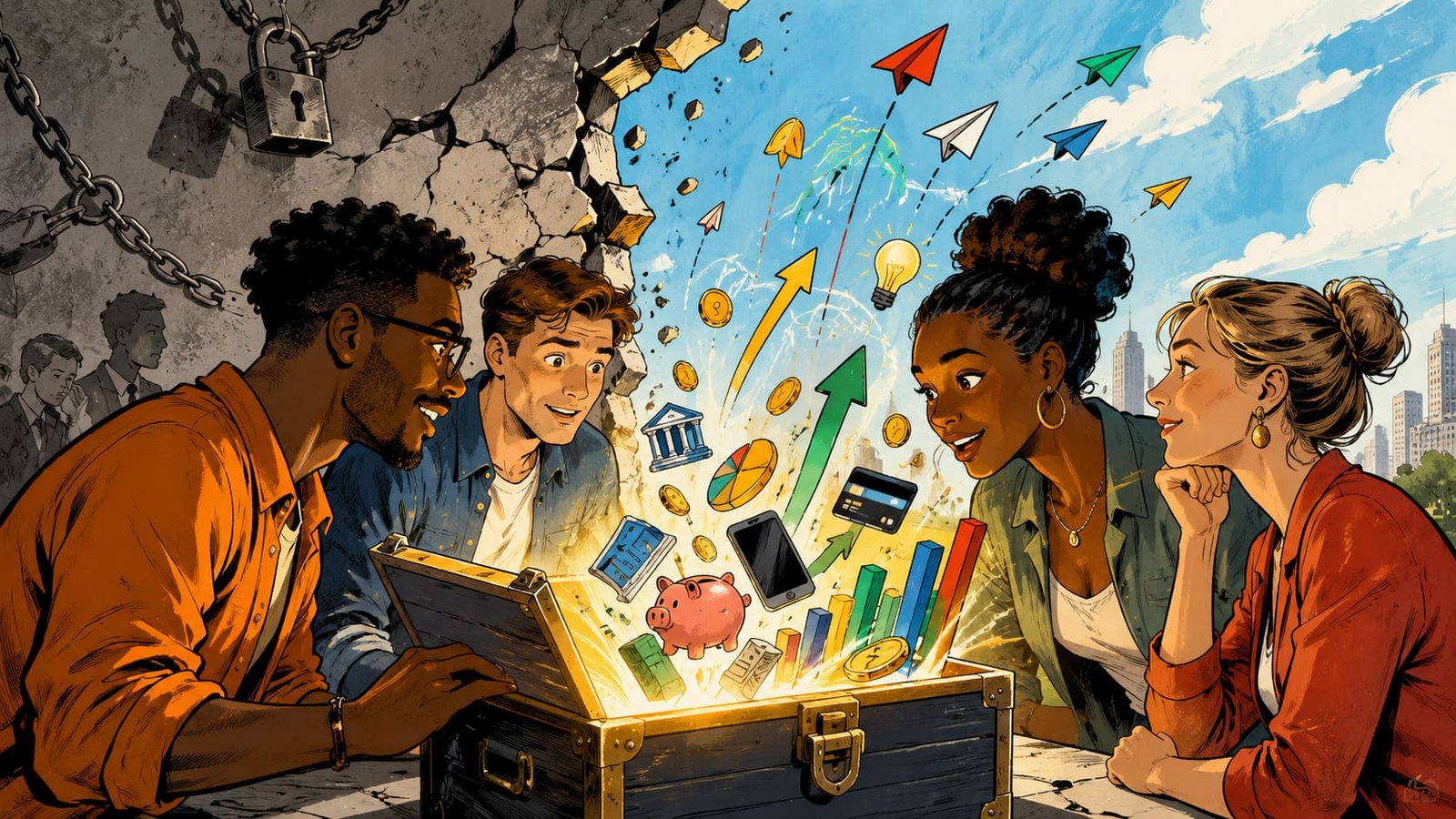
A battered cash box sits beneath a market stall while a nearby customer taps a phone and completes a payment before the shopkeeper finishes smiling. Two worlds briefly occupy the same pavement, one built on worn banknotes and memory, the other on invisible code moving at astonishing speed. Money has changed its language. Financial technology is quietly rewriting who gets to build a business, who gets access to opportunity, and who no longer has to wait for permission to participate.
Traditional finance rewarded those who already possessed established banking relationships, collateral, and documented financial histories. Countless entrepreneurs with practical ideas remained locked outside formal systems despite their determination and talent. Fintech has challenged that pattern by reducing barriers through mobile payments, digital lending, online banking, and accessible investment platforms. Access still is not equal. Yet technology has widened economic participation by allowing millions of individuals and small enterprises to enter financial ecosystems previously beyond their reach.
Grace spent years baking specialty bread from a modest kitchen while neighbourhood demand steadily outpaced available cash. Local banks viewed her business as too small and too risky, leaving expansion plans trapped inside notebooks instead of becoming reality. A digital lending platform assessed trading history rather than traditional collateral, providing working capital that helped her purchase equipment, hire staff, and transform loyal customers into a thriving enterprise. One financial decision changed the direction of an entire family.
Real businesses continue demonstrating how digital finance reshapes commercial possibilities across diverse industries. Stripe simplified online payments for countless startups by removing technical barriers that once discouraged small merchants, while M-Pesa transformed financial inclusion by allowing millions to send, receive, and store money securely through mobile phones. Their success reflects more than technological innovation. They illustrate how practical financial tools can unlock entrepreneurship by reducing friction between ambitious ideas and meaningful economic participation.
Financial inclusion extends far beyond convenient payment systems or faster transactions. Strong knowledge ecosystems encourage entrepreneurs to understand borrowing costs, manage cash flow responsibly, interpret financial data, and evaluate long-term sustainability before chasing rapid expansion. Technology provides remarkable capabilities, but informed judgement determines whether those capabilities create lasting prosperity or unsustainable dependence. Sustainable growth still relies upon disciplined decision making, thoughtful planning, and continuous learning supported by trustworthy financial information rather than hopeful assumptions alone.
Market lights shimmer across polished phone screens as another small business completes its final transaction before evening settles over busy streets. Quiet confidence replaces hesitation because opportunity increasingly belongs to those prepared to recognise new pathways instead of waiting for familiar doors to reopen. Innovation rarely announces itself with grand speeches. Sometimes a forgotten dream simply needs a better financial bridge, leaving one lasting question behind: what ambition has been waiting for access rather than permission?
