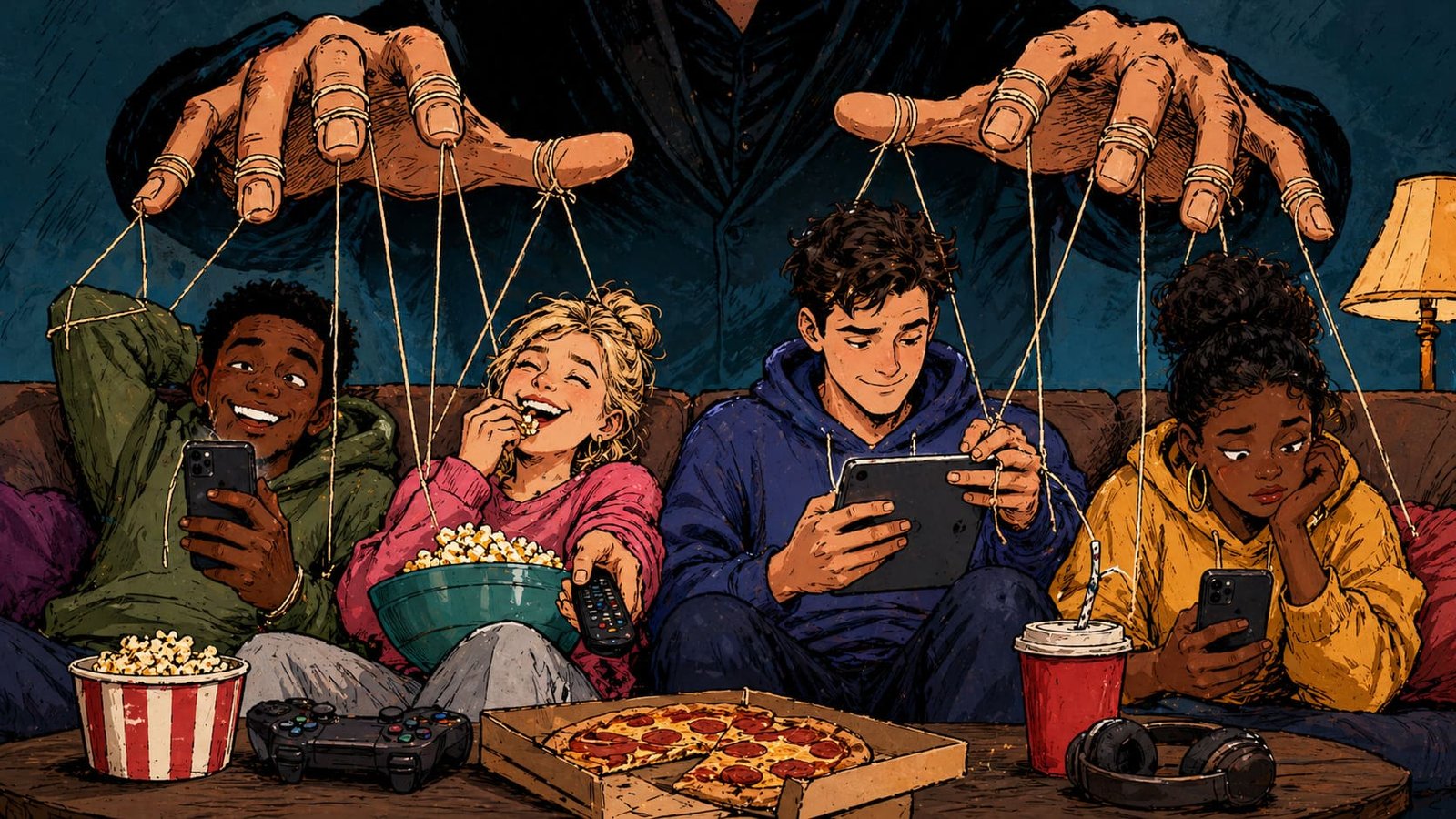
A living room glows in soft pulses, the kind that blur the edges of time. A show plays in the background, then becomes the foreground, then becomes something closer to atmosphere. Characters speak, pause, suffer, win. Laughter slips in, then silence, then a line that lands harder than expected. No one announces what just happened. No one calls it instruction. Yet something shifts. A preference forms. A belief softens. A decision, days later, feels oddly familiar, as if it had already been rehearsed.
Entertainment has mastered the art of appearing weightless while carrying extraordinary weight. It does not demand attention in the way traditional authority does. It invites it. It seduces rather than instructs. This makes it more effective. Messages wrapped in story bypass resistance. They settle into the mind quietly, blending with memory until they feel self-generated. Influence becomes invisible at the moment it matters most.
There was a junior lawyer named Salim who spent late nights watching a popular legal drama. The pacing, the confidence, the sharp exchanges between characters, it all felt aspirational. Weeks later, during a real negotiation, Salim found himself echoing a line he had heard on screen. It landed well. The room responded. He felt a surge of validation. Only later did he realize how seamlessly fiction had shaped his behavior. It did not feel like imitation. It felt like instinct.
This is the subtle power of narrative. Stories do not just entertain. They model behavior. They offer scripts for how to speak, how to react, how to interpret situations. Over time, repeated exposure builds familiarity. Familiarity becomes comfort. Comfort becomes preference. A viewer begins to gravitate toward choices that align with the patterns they have absorbed, often without conscious awareness.
A creative director named Inez once described her work in advertising with a kind of quiet honesty. “We are not selling products,” she said during a campaign review. “We are selling frames for seeing the world.” Her team crafted narratives that positioned certain lifestyles as desirable, certain decisions as obvious. The campaigns were entertaining, even delightful. They also nudged behavior in predictable directions. Inez understood that the most effective influence rarely feels like influence.
Entertainment also shapes perception of success. Films, series, and digital content present compressed versions of achievement, where struggle is stylized and resolution arrives with satisfying clarity. This creates expectations that rarely match reality. A startup founder named Karan once admitted that his early vision of entrepreneurship had been shaped more by cinematic portrayals than by actual experience. When real challenges emerged, slower, messier, less dramatic, he felt disoriented. The gap between narrative and reality created a quiet frustration that took time to reconcile.
Pop culture reinforces these patterns by amplifying certain archetypes. The relentless achiever, the misunderstood genius, the effortless influencer. These figures become reference points, shaping how individuals interpret their own journeys. The danger is not in the existence of these archetypes, but in their dominance. When a narrow set of narratives repeats, it limits the range of possibilities people can imagine for themselves.
A teacher named Marisol noticed this shift in her classroom. Students began referencing characters from shows as benchmarks for behavior. Confidence was modeled after a specific persona. Humor followed recognizable patterns. Even conflict resolution mirrored scripted interactions. Marisol did not discourage this. She used it as a starting point, guiding students to question what they were absorbing. The goal was not to remove influence, but to make it visible.
There is a tension between enjoyment and awareness. Entertainment offers relief, connection, a shared cultural language. It also carries embedded assumptions that shape perception. The challenge lies in engaging with content without surrendering entirely to its framing. This requires a level of attentiveness that is not always easy to maintain, especially when the experience is designed to be immersive.
A documentary filmmaker named Pavel approached this tension by deliberately breaking narrative patterns in his work. He left moments unresolved, avoided clear conclusions, introduced ambiguity where audiences expected clarity. Reactions were mixed. Some viewers felt frustrated. Others found the experience more reflective. Pavel believed that discomfort could create space for independent thought, a rare commodity in environments optimized for seamless consumption.
The broader culture continues to treat entertainment as a neutral space, a break from seriousness. This perception allows its influence to operate without scrutiny. It becomes part of the background, shaping attitudes and expectations in ways that are rarely examined. The lightness is part of the design. It lowers defenses, making the underlying messages easier to absorb.
There are still individuals and communities that approach entertainment differently. They engage critically, discuss openly, question assumptions. They treat content as material for reflection rather than passive consumption. This approach does not remove enjoyment. It adds depth to it. It transforms entertainment from a one-way experience into a dialogue.
The screen continues to glow, scenes unfolding with effortless rhythm. Characters move through arcs that feel complete, even when they are not. The viewer remains, watching, absorbing, adjusting in ways that are difficult to trace. Nothing feels imposed. Everything feels chosen.
Pause for a moment and consider: when the story ends and the screen fades, which parts of it are still quietly directing the choices you believe are your own?
