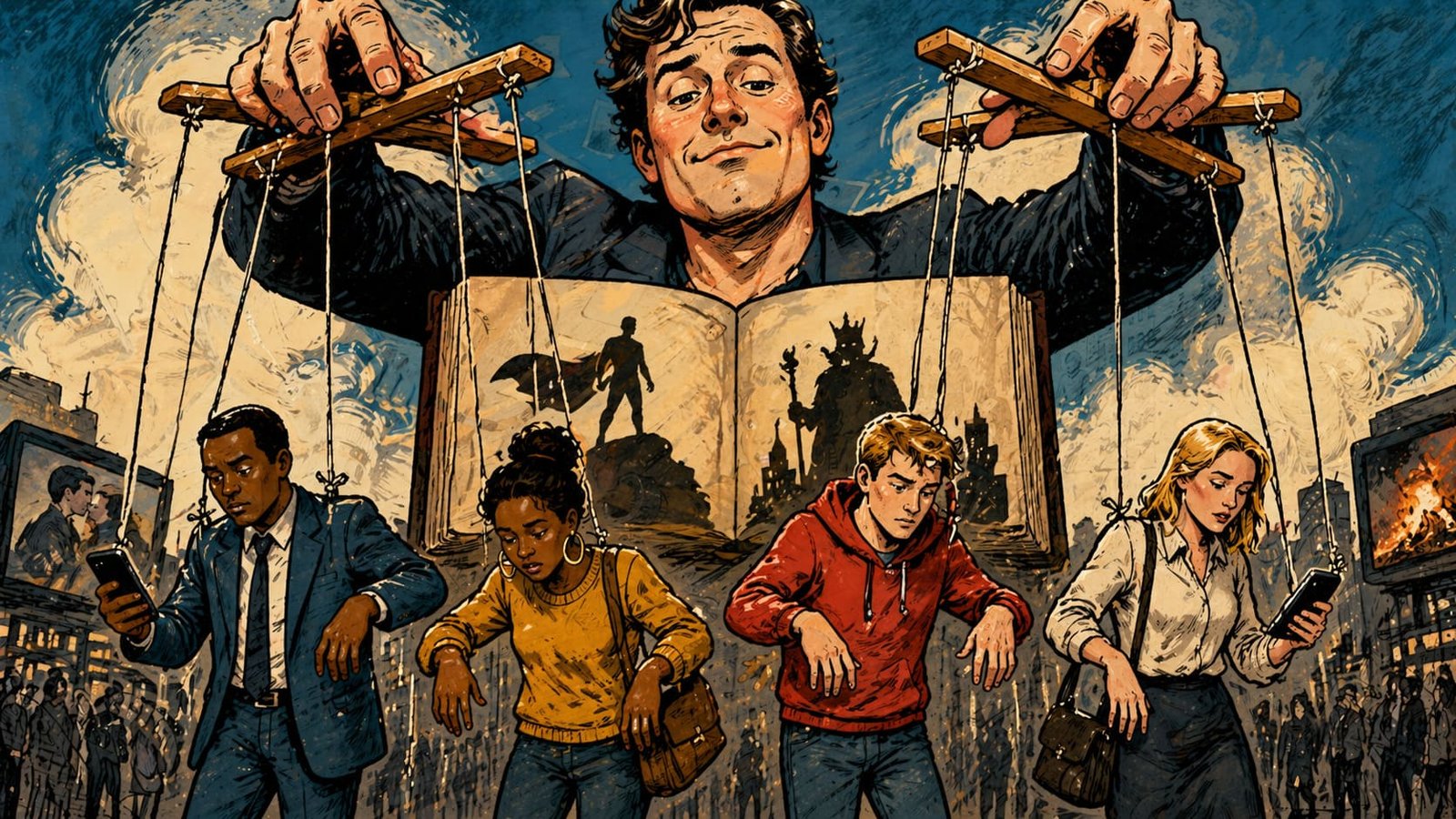
A long table sits under sterile light in a strategy room where nobody calls it storytelling, yet every decision reads like a script. Slides move, phrases tighten, arcs emerge. Somewhere between a bullet point and a tagline, a version of reality is drafted, polished, and sent out into the world. It does not announce itself as fiction. It arrives as coherence. People receive it not as a story, but as the way things are.
Story systems are older than media platforms, but modern distribution has made them feel almost mechanical. They are patterns that repeat until they feel natural, sequences that shape expectation before events even unfold. The literary critic Roland Barthes once wrote about myth as a system that turns history into nature. That idea feels abstract until a narrative repeats often enough to stop feeling like a narrative at all. It becomes common sense. It becomes instinct.
The influence shows up in decisions that seem personal but carry a familiar rhythm. A product lead named Arjun once realized this while pitching a new feature to his team. Without planning it, he framed the idea as a heroic breakthrough, positioned competitors as obstacles, and cast users as beneficiaries waiting for rescue. The structure felt intuitive. It also felt borrowed. Later that evening, scrolling through interviews and case studies, Arjun noticed the same arc everywhere. The hero, the conflict, the resolution. He had not created a narrative. He had stepped into one that already existed.
Inside organizations, these systems operate quietly but persistently. A communications director named Elena described it during a strategy retreat held in a coastal town where the air carried a faint scent of salt and sunscreen. She explained that internal narratives often shape external outcomes more than data alone. Teams align around stories that feel coherent, even when the evidence is mixed. A project framed as inevitable gathers support. One framed as uncertain struggles, regardless of its actual potential. The story becomes the scaffolding on which decisions are built.
This is where the tension sharpens. Reality resists neat arcs. It stumbles, contradicts itself, refuses to resolve on cue. Story systems, by contrast, demand structure. They compress complexity into sequences that can be followed and shared. Consider how political campaigns unfold. Candidates are cast as reformers or disruptors, opponents as obstacles or relics. The strategist Steve Bannon once spoke about the power of narrative framing in shaping public perception. The specifics change, but the underlying scripts remain familiar. They guide interpretation before policies are even examined.
A small fintech startup in Lagos once found itself trapped inside its own narrative. The founder, Sadiq, had positioned the company as a disruptor challenging outdated systems. The story attracted attention, investment, and early users. Yet as the company matured, its operations became more complex, more cautious. The disruptor narrative no longer fit, but it continued to shape expectations. Employees felt pressure to act in ways that aligned with the original script, even when those actions conflicted with practical needs. The story that had fueled growth began to constrain it.
Pop culture reinforces these systems with relentless consistency. Films, series, and viral content recycle archetypes that become mental shortcuts. The underdog triumphs. The villain reveals a hidden weakness. The system collapses just in time for redemption. These patterns are satisfying because they are predictable. They offer closure. When real events unfold, people search for these familiar arcs, sometimes forcing them onto situations that do not naturally fit. The comfort of the script outweighs the discomfort of ambiguity.
The deeper consequence is subtle but profound. People begin to interpret their own lives through borrowed narratives. A young analyst named Jonas once described feeling like he was “behind schedule” in his career, not because of any objective measure, but because his path did not match the success stories he had absorbed. Those stories followed clean arcs, rapid ascents, clear turning points. His experience felt messier, less defined. The comparison was not against reality. It was against a script.
There is a quiet moment when this becomes visible. It does not arrive with drama. It arrives as a small dissonance, a sense that the story being followed does not quite match the terrain being walked. That awareness can feel unsettling. It removes the comfort of a predefined path. It introduces uncertainty where certainty once lived. Yet it also creates space. Space to question, to reframe, to step outside the inherited structure.
In a dim rehearsal studio, empty except for scattered props and a faint echo of past performances, a director pauses mid-script. The lines are well written, the arc is familiar, the ending is clean. Yet something feels off. The story works, but it does not feel true. The director sets the script aside, not in rejection, but in search of something less polished and more honest. The room grows quieter, heavier with possibility.
As the next narrative begins to take shape, a question lingers, patient and quietly defiant: if the scripts shaping reality were written long before arrival, what would it take to step off the stage, and what kind of truth might emerge once the performance finally stops?
