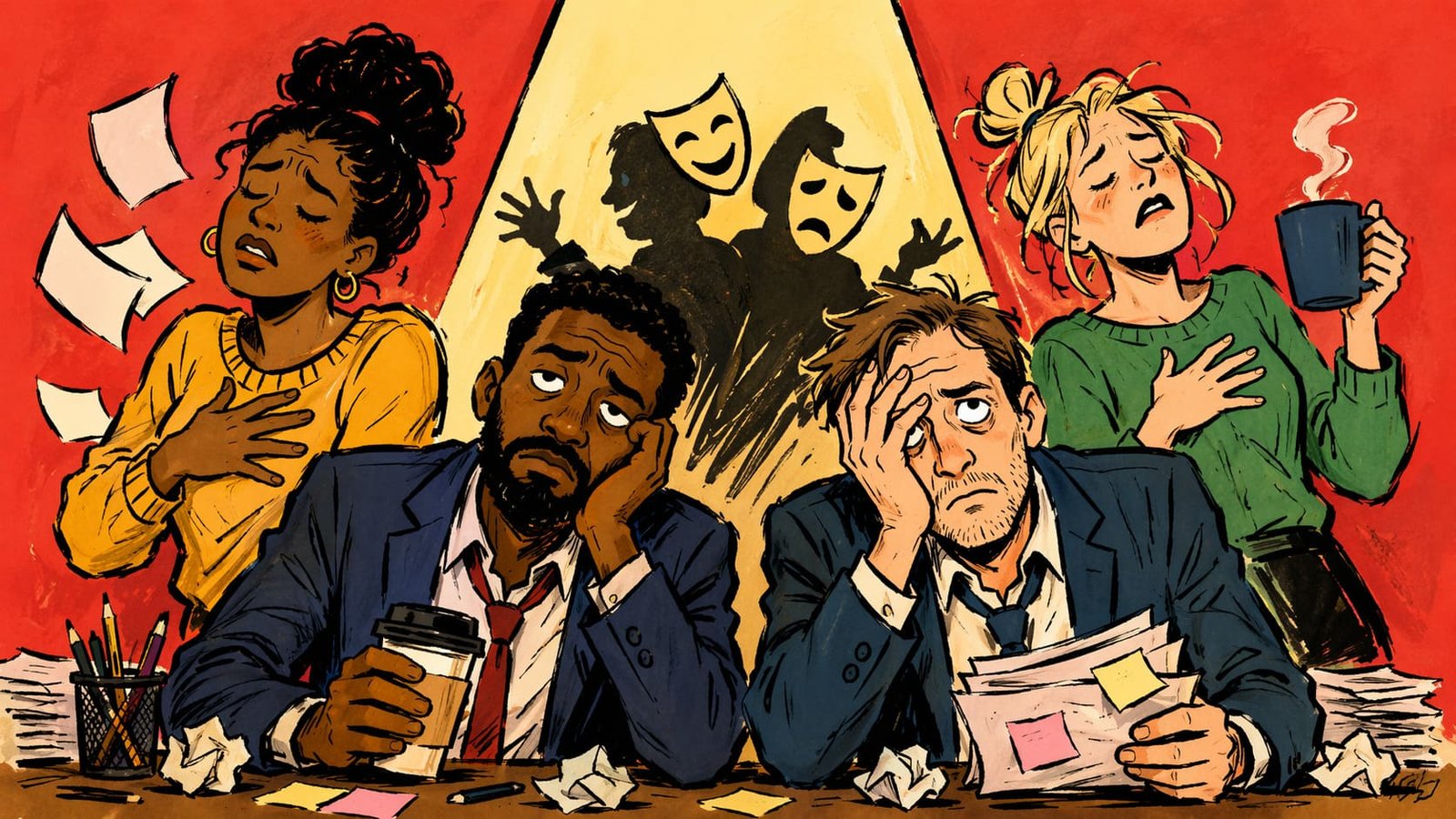
The lights never really turn off anymore. Offices dim, laptops close, yet something keeps running beneath it all, a quiet current of unfinished tasks and half-formed thoughts. A man sits in a rideshare at midnight, replying to messages that could wait but feel urgent anyway. Across the city, another screen glows in a dark bedroom, a presentation being adjusted for the third time. No one announces exhaustion. It leaks through behavior, subtle at first, then impossible to ignore.
Burnout used to signal a breaking point. It meant something had gone wrong, a system pushed too far, a person stretched beyond capacity. Now it moves differently. It blends into routine, almost expected, sometimes even admired. Being overwhelmed becomes evidence of importance. Fatigue becomes proof of effort. The language shifts quietly. People no longer ask how to avoid burnout. They ask how to manage it.
Clara, a brand strategist in Madrid, recognized the change during a team meeting that felt more like a confession circle. Colleagues shared how little they had slept, how many deadlines they were juggling, how close they felt to the edge. The tone was not despairing. It carried a strange pride, as if endurance itself had become an achievement. Clara listened, then noticed something unsettling. No one questioned the pace. They only compared how well they could survive it.
The performance of burnout thrives in environments where visibility matters. Long hours become signals. Late-night emails become proof of commitment. A manager in Chicago, David, once praised an employee for responding to messages at odd hours, calling it dedication. Weeks later, the same employee quietly resigned, citing exhaustion. David replayed the moment in his head, realizing that what he had rewarded was not productivity, but depletion.
Pop culture has reinforced this narrative in subtle ways. Films like The Devil Wears Prada captured the allure of high-pressure environments where sacrifice is framed as ambition. The characters who endure the most often receive the most recognition, at least temporarily. The lesson lingers. Success requires intensity. Rest becomes negotiable.
A software engineer in Berlin, Lukas, experienced this firsthand while working at a fast-growing startup. Deadlines moved constantly, expectations shifted, and the pace felt relentless. At first, he leaned into it, working late, skipping breaks, chasing the momentum. Recognition followed. Promotions seemed within reach. Then something changed. He began to feel detached from his own work, completing tasks without connection. One evening, staring at code that no longer felt like his, he said quietly, “I’m not tired because of the work. I’m tired because I can’t stop performing it.”
The system sustains itself because it rewards visibility more than sustainability. Output is easier to measure than well-being. A consultant in London, Priya, noticed this during client engagements where teams pushed themselves beyond reasonable limits to meet expectations. The results were impressive in the short term. Over time, the quality began to slip, not dramatically, but enough to matter. “They look productive,” she said during a review session, “but they’re running on something that doesn’t last.”
There is also a deeper emotional layer beneath burnout’s visibility. People do not only work to achieve. They work to feel valued, to feel necessary, to feel part of something moving forward. When those feelings become tied to exhaustion, the line between effort and identity blurs. A marketing director in New York, Elena, described it during a quiet conversation after a long day. “If I’m not busy,” she said, her voice steady but reflective, “I start to feel like I’m falling behind, even when nothing is wrong.”
A small business owner in Nairobi, Samuel, chose a different approach after watching his team struggle through cycles of overwork and recovery. He reduced meeting hours, encouraged slower pacing, and resisted the pressure to expand too quickly. Growth slowed. Investors questioned his decisions. Months later, his team’s output stabilized, and retention improved. “We stopped treating exhaustion like a badge,” he said, leaning back in his chair as the office settled into a calmer rhythm. “And people started thinking again.”
The normalization of burnout creates a paradox. The more common it becomes, the less seriously it is treated. People learn to function within it, adjusting expectations rather than addressing causes. A psychologist in Toronto, Dr. Rachel Kim, observed this pattern in her clients. “They don’t come in saying they’re burned out,” she explained during a session that carried a quiet heaviness. “They come in saying they’re tired, distracted, unmotivated. Burnout has become invisible because it’s everywhere.”
The scene shifts to an early morning where the city is just beginning to wake. A woman sits at her kitchen table, coffee untouched, staring at a list of tasks that feels both familiar and overwhelming. The room is quiet, yet her mind moves quickly, already anticipating the day ahead. Outside, the light changes slowly, indifferent to the pace inside.
And beneath that stillness, a realization begins to surface. Burnout is no longer only a signal that something has gone wrong. It has become part of how success is displayed, a quiet performance that people participate in without always recognizing it.
So the question lingers, steady and difficult to ignore: when exhaustion starts to feel like proof that you are doing something right, how do you recognize the moment it begins to take something essential away from you?
