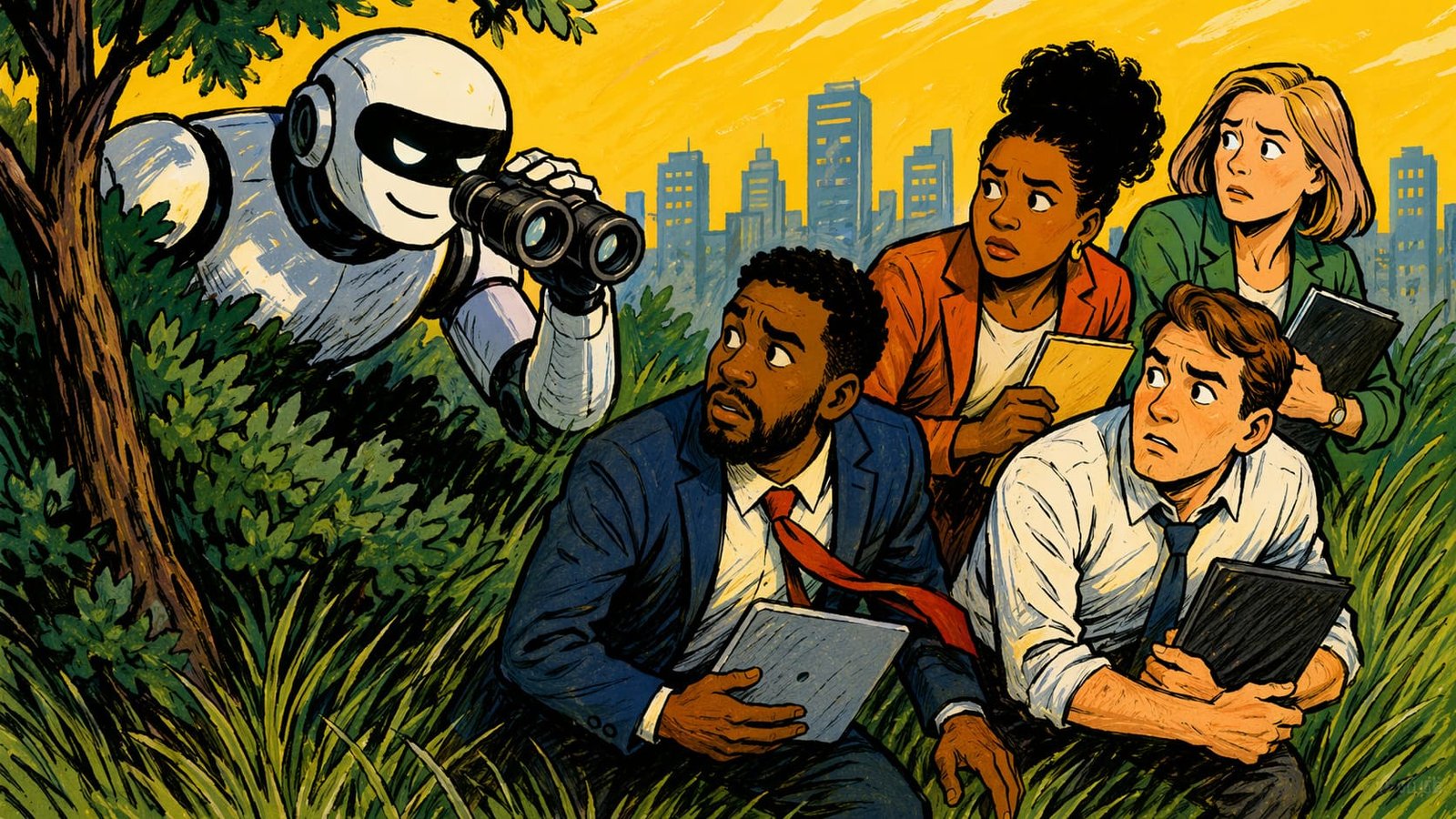
The office still looks the same, yet something invisible has shifted. Screens glow with outputs that arrive too quickly, too cleanly, as if thought itself has been compressed into a button. Conversations pause mid-sentence, replaced by silent prompts typed into quiet machines. A report appears in seconds, polished, structured, confident. No hesitation, no second-guessing, no fatigue. Around the room, people continue working, but with a new kind of awareness, the kind that makes every action feel slightly observed.
The arrival of artificial intelligence has not announced itself as a replacement. It presents itself as assistance, as augmentation, as progress. The language is reassuring. It suggests partnership rather than displacement. Yet beneath that language, something more fundamental is unfolding. Work is not simply being automated. It is being redefined, reshaped at a level that touches identity as much as function.
Adrian, a financial analyst in Boston, noticed the shift during a routine quarterly cycle. His team introduced an AI system to assist with forecasting, positioned as a tool to enhance productivity. Within weeks, the system began generating insights faster than the team could verify them. Meetings shortened. Discussions narrowed. Adrian found himself reviewing outputs instead of creating them. One evening, staring at a screen that had just completed in seconds what used to take him hours, he said quietly to no one in particular, “I used to think my job was thinking. Now it feels like checking.”
The psychological impact of this transition rarely makes headlines. Work has always carried more than economic value. It shapes identity, purpose, a sense of contribution. When machines begin to perform core aspects of that work, the shift feels personal, even when it is structural. A designer in Berlin, Klara, described it after integrating AI tools into her workflow. “It’s like watching your own process happen outside of you,” she said, closing her laptop with a softness that suggested hesitation. “And realizing it doesn’t need your permission anymore.”
Pop culture anticipated this moment long before it arrived quietly in offices. Films like Her explored relationships between humans and intelligent systems, hinting at a future where boundaries blur. The reality feels less dramatic, yet more pervasive. There is no single moment of takeover. There are small, continuous adjustments that gradually redefine what it means to contribute.
A startup founder in Bangalore, Kavita, chose a different approach. Instead of automating entire roles, she redesigned workflows to amplify human judgment. AI handled pattern recognition, data processing, initial drafts. Her team focused on interpretation, context, decision-making. Growth came steadily, not explosively. Investors questioned her pace. During one tense meeting, she leaned forward and said, “Speed without meaning is just noise.” The room fell quiet, not because the statement was radical, but because it was difficult to argue against.
The economic narrative around AI focuses on efficiency, cost reduction, competitive advantage. These metrics matter, yet they do not capture the full transformation. When roles shift, the ripple effects extend beyond productivity. A customer support specialist in Toronto, Luis, found his interactions increasingly guided by AI-generated responses. Conversations became smoother, faster, more consistent. They also became less his. “I’m talking more,” he said, adjusting his headset as calls continued to queue, “but it doesn’t feel like my voice anymore.”
There is also a cultural adaptation taking place. Workers are learning to collaborate with systems that do not experience fatigue, doubt, or hesitation. The comparison is constant, even when unspoken. A consultant in Nairobi, Amina, reframed her role during client engagements. Instead of competing with AI on speed, she leaned into nuance, asking better questions, interpreting context. Clients responded differently. “They don’t need faster answers,” she observed during a late evening discussion. “They need someone who understands what the answer means.”
The tension at the center of this shift is not purely technological. It is philosophical. What does it mean to work when thinking can be partially outsourced? When creativity can be assisted, accelerated, even imitated? The answers are still forming. Some adapt quickly, integrating new tools into their workflows. Others resist, holding onto methods that feel more authentic, even if they are less efficient.
A product manager in London, Daniel, experienced both sides within months. At first, he embraced AI fully, delegating tasks, optimizing processes, increasing output. Performance metrics improved. Recognition followed. Over time, something felt off. Decisions became easier, but also less satisfying. One night, long after the office had emptied, he sat alone with a report generated entirely by a system and asked himself a question he had not considered before. “If I didn’t think this through,” he said quietly, the words almost disappearing into the room, “did I actually do the work?”
The system continues to evolve, faster than the frameworks designed to understand it. Skills that once defined value shift quickly. New competencies emerge. Adaptation becomes less about learning specific tools and more about rethinking how one relates to work itself. The worker is not only performing tasks anymore. The worker is negotiating relevance.
The scene shifts to a late evening office where the lights remain on longer than necessary. A man sits in front of a screen, watching outputs appear with effortless precision. The room is quiet, yet it feels full of something unspoken. Outside, the city moves with its usual rhythm, unaware of the subtle transformation unfolding behind glass walls.
And beneath that quiet, a realization begins to take shape. The future of work is not only about what machines can do. It is about what humans choose to remain responsible for, even when they no longer have to be.
So the question settles, steady and difficult to ignore: when intelligence becomes something you can access instantly, what part of thinking will you still choose to own?
