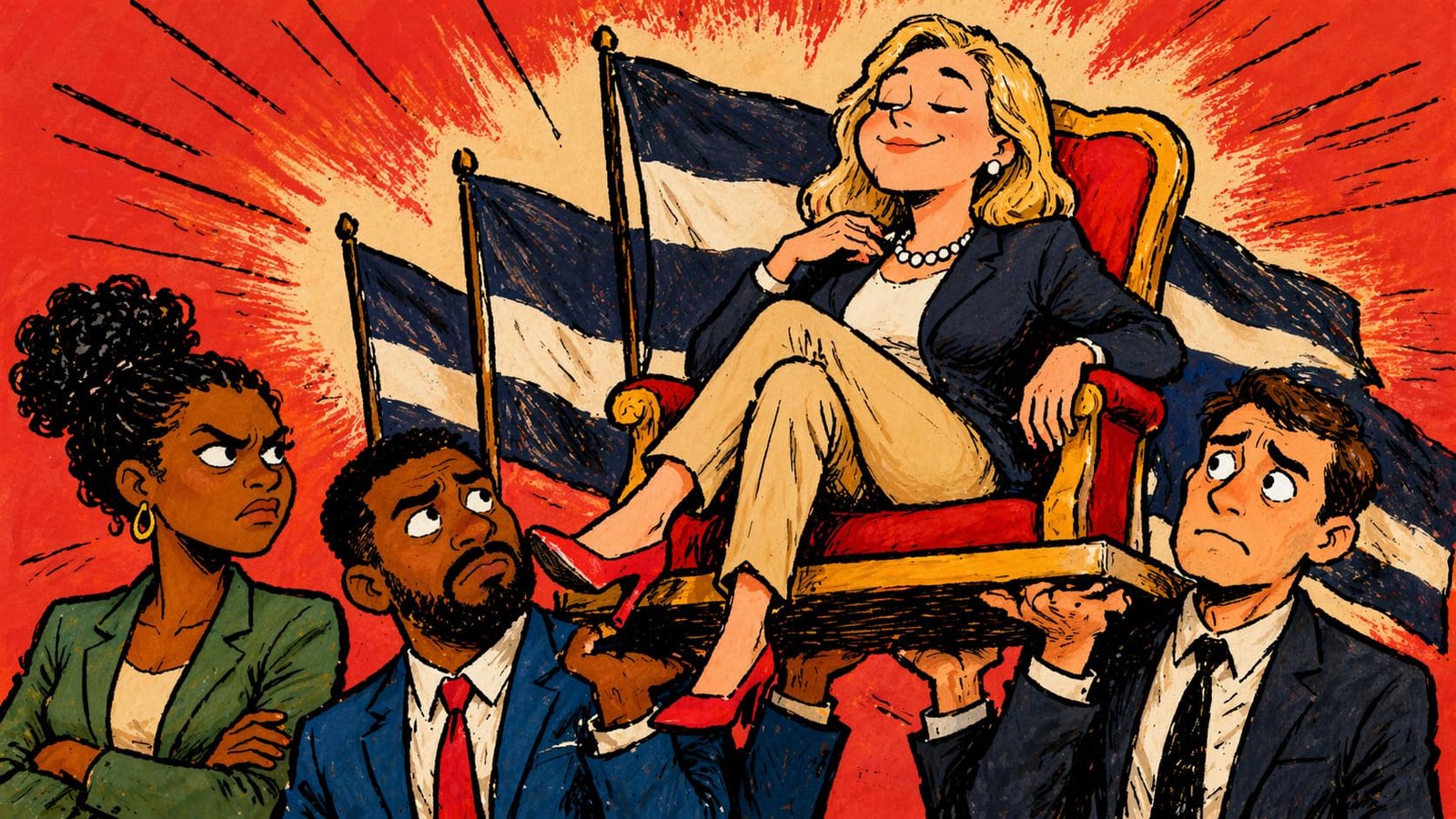
The footage always looks familiar. A crowd, a confrontation, a moment that feels larger than the people inside it. Faces are pulled from the chaos and turned into symbols within hours. One image travels faster than context ever could. The story begins to harden before it is fully understood.
What stands out is not just the conflict, but the selection. Certain individuals become the center of attention, not randomly, but predictably. Their presence carries narrative weight. Their identity makes the story easier to package, easier to distribute, easier to argue about. Complexity is reduced to something shareable.
The pattern reveals a deeper mechanism. Culture wars do not operate on facts alone. They operate on emotional shortcuts. A single face can stand in for an entire argument. A single moment can represent a broader tension. The result is a kind of symbolic warfare where individuals are elevated into roles they did not choose.
A media strategist named Colin once described this process as “narrative anchoring.” He explained how audiences latch onto recognizable figures to make sense of larger issues. It simplifies engagement. It also distorts reality. The person becomes less important than what they represent.
You can see the consequences in how quickly nuance disappears. Conversations shift from what happened to what it means. Interpretations multiply, each aligned with a different perspective. The original event becomes secondary. What matters is how effectively it can be used.
A teacher named Lila found herself at the center of one such moment after a brief classroom incident was recorded and shared. Within days, she was portrayed in conflicting ways across different platforms. Some saw her as a symbol of fairness. Others saw her as something entirely different. She later said that the strangest part was feeling both visible and invisible at the same time.
The tension lies between individuality and symbolism. People want to be understood as individuals, yet public discourse often reduces them to representations. That reduction makes arguments easier to construct, but it leaves very little room for truth to breathe.
There is also an economy of attention at play. Stories that fit familiar patterns travel further. They confirm existing beliefs, reinforce group identities, and generate engagement. The more a narrative aligns with expectation, the less it needs to explain itself.
In quieter moments, away from the noise, the individuals at the center of these stories often experience something more personal. Confusion, isolation, a sense of being pulled into something larger than their own actions. The spotlight does not illuminate. It flattens.
And the question that remains, almost uncomfortable in its simplicity, refuses to disappear: when people become symbols, who is left to tell the truth of what actually happened?
