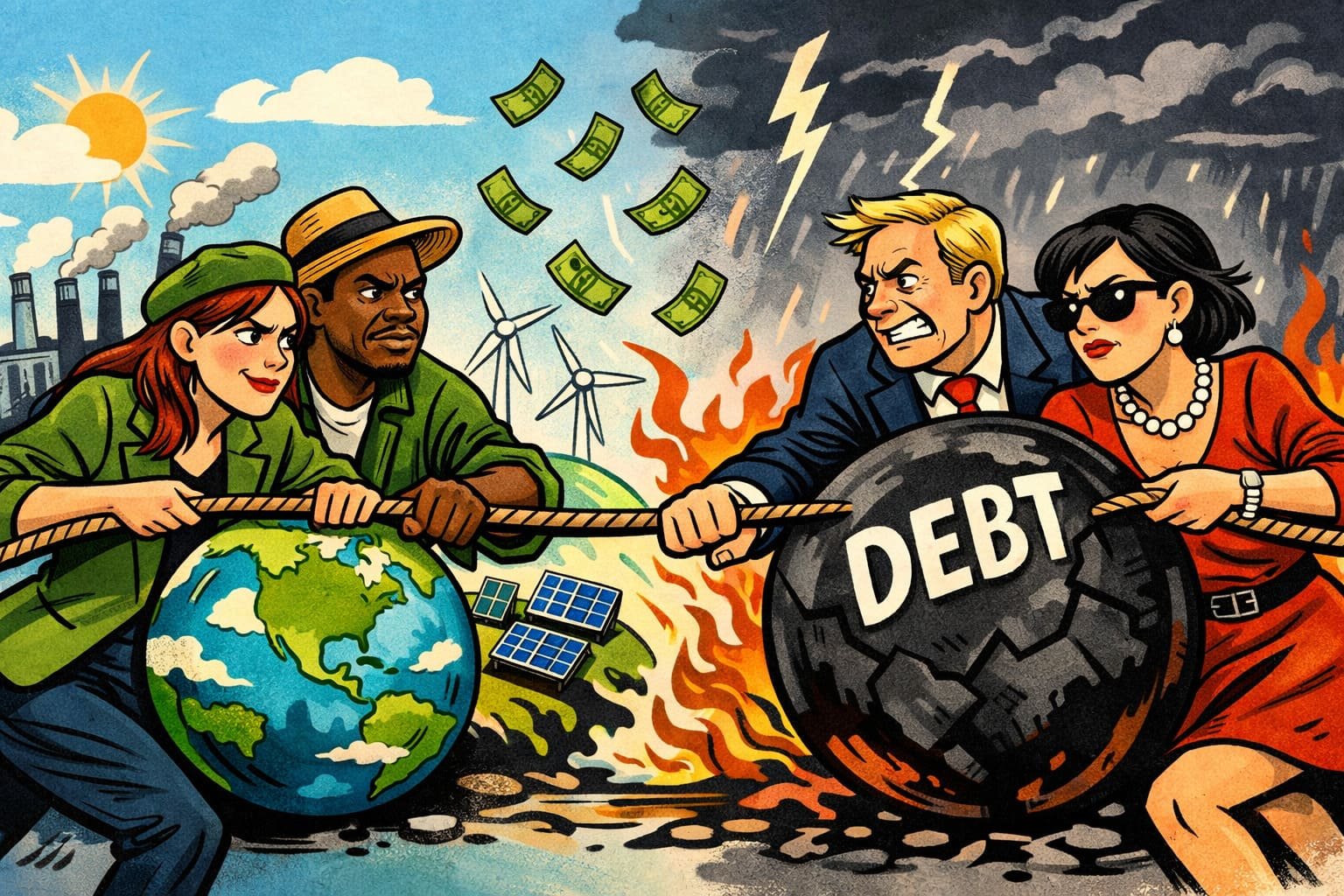
Climate policy used to sound like an argument about science, conscience, and distant time. It now sounds like procurement, subsidies, industrial strategy, grid upgrades, heat pumps, battery plants, flood defenses, and the extraordinary price of changing an economy without breaking it. That shift matters. Once climate moved from moral plea to fiscal program, a new war began. It is no longer simply about whether governments should act. It is about how they should pay, who benefits first, what gets built, which industries survive the transition, and how much debt a society will tolerate in pursuit of a cleaner future.
The easy story says green spending is noble and debt worries are small minded. The opposite easy story says climate budgets are vanity projects for elites who fly to conferences and tax everyone else. Both stories flatter their audiences. Neither is serious enough for the task ahead. Decarbonization requires enormous investment, but investment is not a magic word. A country can spend badly in the name of the planet just as easily as it can spend badly in the name of defense or development. Fiscal quality matters. Timing matters. Sequencing matters. Political trust matters more than campaign slogans admit.
The United States sharpened this debate when it turned climate policy into industrial policy with serious state backing. Supporters saw overdue ambition, a push to revive manufacturing, clean up energy, and compete with China. Critics saw a subsidy rush with loose boundaries and plenty of room for corporate rent seeking. Both camps saw something real. Green spending can create supply chains, jobs, and technological momentum. It can also become a buffet for firms skilled at lobbying, branding, and collecting public money without delivering lasting productivity. Climate spending fails when states confuse announcing factories with building economic ecosystems.
Europe offers a different caution. Many governments embraced ambitious climate targets while also carrying large welfare states, aging populations, and fragile growth. The result has been a recurring collision between long term ecological necessity and short term fiscal exhaustion. Citizens may support cleaner energy in the abstract and revolt when household bills surge or industries threaten to move. That tension appeared during energy shocks, when climate urgency met the brutal politics of affordability. A heat pump looks visionary in a policy document. It looks different to a homeowner already staring at a punishing financing decision and a cold winter.
Germany’s energy transition became a global reference point for both inspiration and frustration. It showed that large economies can commit seriously to clean power. It also showed how difficult it is to manage grids, storage, pricing, industrial competitiveness, and public consent at the same time. Climate policy is often sold as a smooth ascent into a modern future. In practice it is a messy fight with transmission lines, permitting delays, political coalitions, and human impatience. Debt can fund part of that journey, but debt does not dissolve complexity. Borrowed money can accelerate transition. It can also magnify expensive confusion.
A fishing town facing rising seas understands something budget hawks sometimes forget. Climate inaction also creates debt, just in another costume. Delayed adaptation shows up later as disaster repair, insurance collapse, stranded infrastructure, forced migration, agricultural loss, and public health costs. The bill arrives whether politicians vote for it or not. That is why the lazy choice between green spending and fiscal restraint is false. Some climate spending is defensive maintenance for civilization. The hard part is distinguishing resilient investment from theatrical spending, productive decarbonization from subsidy cosplay, and urgent adaptation from politically fashionable noise.
There is a class politics problem inside green budgets that too many leaders handle with moral scolding. Wealthier households often capture the early gains from subsidies for electric vehicles, retrofits, rooftop solar, and cleaner technologies because they have capital, credit, and property. Poorer households get the lecture, the levy, or the higher energy bill. That is not a communications error. It is a design failure. Climate policy that feels like a transfer from ordinary workers to affluent adopters will not hold. It breeds backlash not because voters reject the planet, but because they recognize an upside down reward system when they see one.
A stronger green fiscal strategy begins with priorities that are dull enough to be effective. Build grids. Fix permitting. Modernize public transport where density makes it viable. Invest in flood control, water resilience, building efficiency, and clean energy systems that reduce future vulnerability. Support innovation where markets underinvest and public gains could be large. Be suspicious of prestige spending that photographs well and delivers little. The green state should act like a disciplined builder, not a nervous influencer. Citizens can forgive gradualism if they see competence. They punish grandiosity when the invoice arrives before the benefit.
Private capital matters here, but it is often treated like a fairy godmother. Governments announce frameworks and assume investors will happily fund the rest. Sometimes they do. Often they wait for guarantees, subsidies, or stable rules that politicians are slow to provide. Climate finance works best when public money lowers risk in a targeted way and draws in durable private investment. It works worst when the state socializes downside, privatizes upside, and then calls the arrangement visionary. Debt funded climate policy should not become a machine for public risk and selective corporate glory.
There is also a geopolitical layer. Green spending is now tangled with trade strategy, mineral access, industrial rivalry, and national security. A nation that depends on imported components, unstable supply chains, or hostile powers for core clean technologies is not merely going green. It is making strategic bets. Debt can be justified if it builds resilience and future productive capacity. It becomes harder to defend if it mainly purchases dependency at a premium price. Climate budgets are no longer separate from questions of sovereignty. A serious state has to think like an engineer, an accountant, and a chess player at once.
The odd thing about the green spending war is that both zealots and skeptics often underestimate discipline. The zealot assumes urgency excuses inefficiency. The skeptic assumes restraint means delay. The smarter path is harsher and less glamorous. Spend boldly where public return is clear. Move slowly where hype outruns evidence. Protect low income households from transition pain. Tie subsidies to performance. Sunset weak programs. Admit tradeoffs instead of dressing them in spiritual language. The climate challenge is real enough that it deserves better than theater. Debt may be part of the answer, but only if seriousness governs the borrowing.
In the uneasy glow of a future already pressing against the present, governments stand between two clocks, one counting carbon, the other counting interest. Ignore the first and the landscape will collect its payment in fire, flood, scarcity, and disorder. Ignore the second and the treasury will begin to ration ambition with cold hands. The countries that get this right will not be the loudest. They will be the ones that learn how to build cleanly without spending foolishly, how to borrow without daydreaming, and how to make sacrifice feel shared. The planet may not care about slogans, but voters do, and that is where the battle will be decided.
