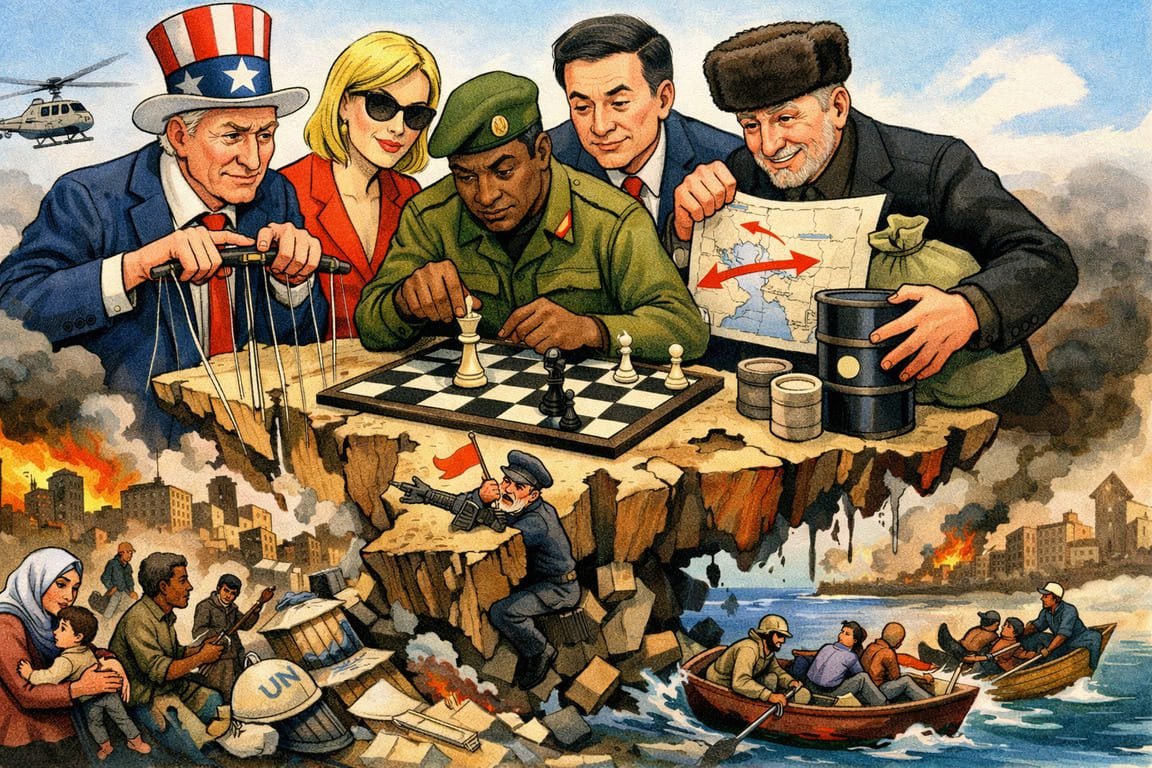
The situation room feels sealed off from consequence. Screens glow with maps, arrows, and confident annotations that imply control. Coffee cools untouched as voices debate timelines and leverage. From this altitude, nations look manageable, almost modular, as if order can be installed with enough funding and resolve. Yet far from the polished table, streets fracture, institutions hollow, and ordinary life absorbs decisions made by people who will never wait in those lines. This is where the fantasy of running failed nations begins, and where it reliably unravels.
The idea that powerful states can fix broken ones rests on a seductive belief: that failure is primarily technical. Replace leaders, rewrite laws, train security forces, inject capital, and stability will follow. It sounds clean. It photographs well. It also misunderstands what failure means. States do not collapse because of missing manuals. They collapse because legitimacy erodes, trust evaporates, and social contracts snap under pressure that outsiders rarely feel in their bones.
Superpowers often arrive armed with templates. Constitutions drafted elsewhere. Economic models proven under different conditions. Timelines shaped by election cycles rather than generational repair. These moves assume that institutions can be transplanted like organs. In reality, institutions grow from shared history, norms, and enforcement that feels locally owned. Without that soil, imported systems survive on life support until attention shifts.
There is a deeper contradiction at play. External control weakens the very sovereignty it claims to restore. When security depends on foreign backing, local leaders answer upward rather than outward. Accountability skews. Corruption adapts. The state exists, but its spine remains borrowed. Citizens sense this quickly. Cynicism spreads faster than compliance.
Economics complicates matters further. Aid and contracts flood in, often distorting incentives. Talented people pivot toward donor-facing roles rather than productive sectors. Rents replace returns. Short-term stabilization masks long-term fragility. The economy grows busy without growing strong. When external money slows, the hollowing becomes visible.
Culturally, interventions misread dignity. Populations may accept help, but resent management. Being governed by outsiders, even benevolent ones, bruises identity. Resistance does not always wear the face of rebellion. It hides in noncompliance, quiet sabotage, and the slow withdrawal of belief. Order enforced without belonging remains brittle.
Security-first approaches reveal another flaw. Stability imposed through force rarely translates into legitimacy. Violence may drop temporarily, but fear is a poor foundation for governance. Once pressure lifts, unresolved grievances resurface sharper than before. The calm was rented, not earned.
Supporters argue that doing nothing is worse. Sometimes they are right. Collapse spills beyond borders. Human suffering demands response. The critique is not against engagement, but against illusion. Running a nation is not a project with deliverables. It is a relationship built through consent, habit, and credibility. Outsiders can support that process. They cannot substitute for it.
History offers sobering patterns. External administrators promise transition. Transitions stall. Timelines extend. Costs climb. Public support erodes at home while legitimacy erodes abroad. Eventually, fatigue replaces resolve. Exit arrives without success or closure. The nation remains fragile, now layered with new grievances.
The most effective external roles look almost unimpressive. They focus on enabling local problem solving rather than directing it. They accept slow progress. They tolerate imperfection. They invest in boring capacities like courts, tax systems, and local governance that never trend. They plan to leave from day one and treat departure as a measure of success.
Philosophically, the urge to run failed nations reveals something about power itself. Control is comforting. Complexity is not. Superpowers mistake reach for understanding. They assume scale equals wisdom. Reality resists that arrogance. Societies are not systems to be optimized. They are living arrangements negotiated daily by people with memory and pride.
Late evenings in capital cities tell the real story. Officials draft reports for donors while neighborhoods improvise survival. Parallel realities emerge. The state performs competence upward and loses relevance downward. Eventually, the gap becomes unbridgeable.
None of this denies responsibility. Powerful nations influence global stability whether they admit it or not. The choice is not between intervention and neglect. It is between humility and hubris. Between partnership and management. Between supporting sovereignty and quietly replacing it.
And as the next crisis tempts another grand strategy, the uncomfortable question waits beneath the briefings and banners: if running a nation keeps failing, why does power still believe it can manage what legitimacy alone can hold?
