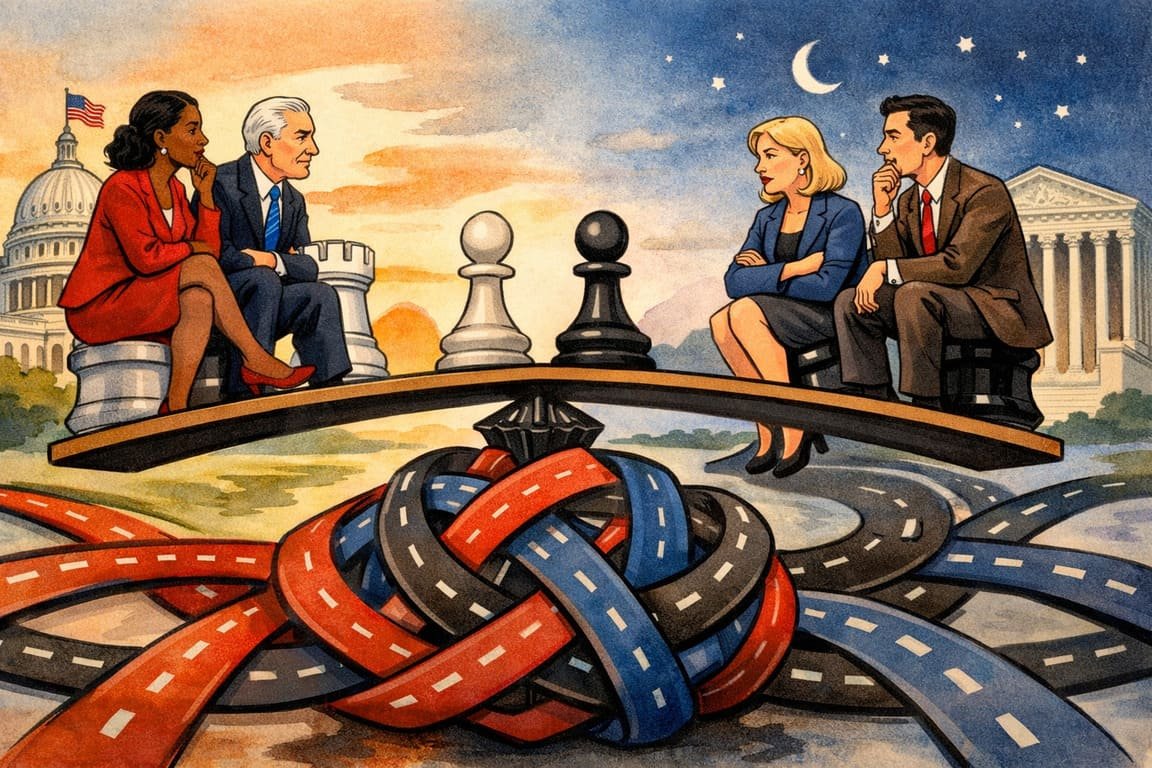
The chamber is loud but motionless. Screens flash amendments that will never pass. Faces harden into certainty while calendars fill with delays. Commentators call it failure. Citizens call it broken. The word “gridlock” lands like an accusation, as if stillness itself were a moral flaw. Yet beyond the stalled votes and furious panels, society continues to function, adapt, and in some cases, quietly improve. What looks like paralysis from the outside often behaves like restraint from within.
Modern politics worships movement. Action signals strength. Speed implies competence. A leader who signs quickly is praised. One who hesitates is mocked. This bias toward motion ignores a basic truth about power. The most dangerous moments in history were rarely caused by governments that could not act, but by those that could act too easily. When authority flows without resistance, error scales fast.
Gridlock introduces friction into systems that desperately need it. When ideas collide instead of gliding through, weak assumptions are exposed. Bad policies do not always die in stalemate, but they are forced to survive contact with skepticism, time, and unintended consequences. That delay, frustrating as it feels, often prevents irreversible damage.
Pluralistic societies are not designed for elegance. They are designed for endurance. Conflicting values do not dissolve because a vote is held. They persist, grind, and demand negotiation. Gridlock acknowledges this reality. It treats disagreement as permanent rather than pathological. In doing so, it prevents any single faction from mistaking temporary dominance for moral certainty.
The cost of stalemate is real. Urgent reforms stall. Public trust erodes. Anger grows louder. Yet there is an overlooked benefit hiding inside that frustration. When governments slow down, societies relearn self-reliance. Local solutions emerge. Markets adjust. Civil institutions step forward. Power disperses instead of concentrating.
Economic history offers a quiet pattern. Periods of legislative calm often produce bursts of private creativity. When rules stop shifting daily, planning becomes possible. Risk can be priced. Investment regains patience. Stability, even when unglamorous, creates room for long-term thinking that hyperactive governance rarely allows.
Critics argue that gridlock protects entrenched interests, and they are not wrong. Stillness can preserve injustice. Yet speed can lock injustice in just as effectively. The difference is visibility. Slow systems allow mistakes to surface before they harden. Fast systems often realize failure only after damage is complete.
There is also a moral humility embedded in stalemate. It signals that no group understands society well enough to redesign it alone. That humility is unfashionable in an era addicted to certainty. But it is essential in complex systems where interventions ripple unpredictably.
Culturally, gridlock lowers the emotional temperature. Constant legislative churn exhausts attention. Every issue becomes existential. When motion slows, expectations recalibrate. People invest energy closer to home. Families, communities, and work reclaim oxygen from national drama.
This does not romanticize dysfunction. Broken institutions still require repair. Emergencies still demand decisive action. The insight is narrower and more uncomfortable. Not all inaction is neglect. Sometimes it is a guardrail against collective overconfidence.
The fantasy of total efficiency treats society like a machine awaiting the right operator. Reality behaves more like an ecosystem. Interference has costs. Patience has value. Gridlock becomes a form of respect for complexity rather than surrender to it.
Late nights after failed votes leave no monuments. Laws not passed are forgotten. Yet many of history’s greatest catastrophes exist precisely because no one slowed them down. The wars not launched. The freedoms not traded away. The economies not overcorrected. These absences leave no evidence, only continuity.
The next time impatience surges and the demand for decisive action overwhelms caution, the harder question deserves attention: is the frustration with gridlock driven by wisdom, or by discomfort with limits that were designed to protect society from itself?
