The airport terminal does not feel chaotic. It feels controlled, efficient, almost sterile, yet something unsettled lingers beneath the polished floors and orderly queues. Conversations overlap in dozens of languages. Screens announce departures with mechanical calm. People move forward, yet many eyes carry the same quiet question. Where is all this movement taking us. This ordinary place reveals an extraordinary truth. The global argument over immigration is not really about borders. It is about stability, identity, and a growing sense that the world is changing faster than people were ever prepared to handle.
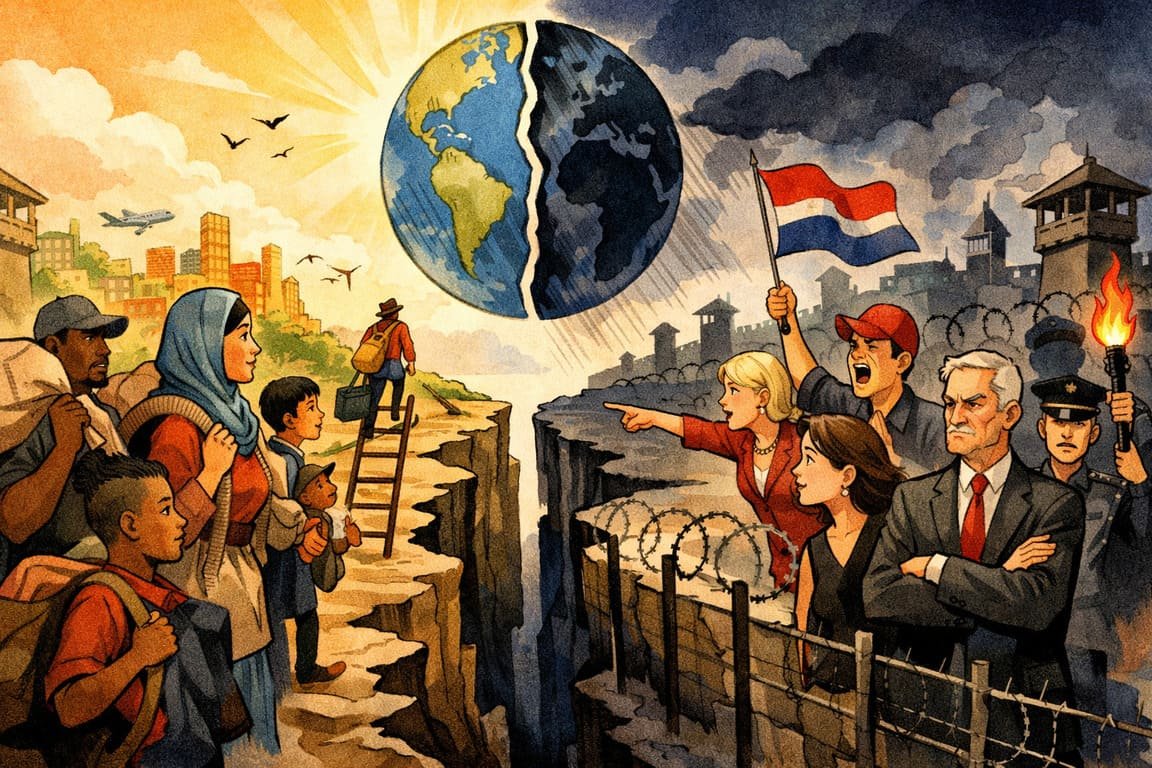
Nationalism did not roar back into politics overnight. It crept in softly, wrapped in familiar symbols and reassuring language. Flags became louder not because pride returned, but because certainty vanished. Immigration emerged as the most visible marker of that uncertainty. It was tangible. It could be pointed at. For many citizens, especially those in communities already struggling, migration felt like the final proof that control had slipped away. The emotional reaction came long before the political one.
Economic reality deepened the tension. Decades of wage stagnation, disappearing industries, and fragile employment hollowed out trust in institutions. Automation erased jobs silently. Trade shifted production invisibly. Political leadership offered optimism instead of protection. When immigrants arrived, they became the only visible change in a long chain of invisible losses. A laid off machinist in northern England once said the machines took his job, but the migrants took the blame. That single sentence explains more than a shelf of policy reports.
Nationalist leaders understand this emotional math perfectly. They do not begin with anger. They begin with belonging. They speak of home, heritage, and dignity. Their speeches feel warm, almost intimate. Immigration is introduced not as a policy issue, but as a threat to that warmth. Stories replace statistics. A classroom that feels unfamiliar. A neighborhood that no longer looks the same. A language overheard that signals change. These details bypass logic and land directly in the gut.
Governments share responsibility for the backlash they now struggle to contain. Many invited labor without building integration systems strong enough to absorb it. Housing lagged behind population growth. Schools stretched thin. Transportation strained. When public services faltered, leaders deflected accountability. Immigration became the scapegoat for failures rooted in planning and investment. A former city official in southern Europe once admitted that integration budgets were slashed years before tensions exploded. The fuse was cut long before the spark.
Culture magnified every fracture. Communities once bound by shared routines lost their anchors as work became unstable and social life fragmented. Immigration did not cause that erosion, but it became its symbol. Sociologists often describe identity loss as a form of grief. Grief seeks meaning. Nationalism offers a narrative that makes pain feel justified and directed. It simplifies complexity into a clear divide. Us feels protected. Them feels responsible.
Media ecosystems poured fuel on the fire. Algorithms rewarded outrage and punished nuance. One crime could define an entire population. Corrections traveled slower than fear. Political actors learned quickly which images triggered clicks and which phrases provoked panic. A former broadcast editor once called it emotional efficiency. Fear kept audiences longer than explanation ever could. Immigration became content, not context.
The contradiction sits in plain sight. Many nationalist economies depend deeply on migrant labor. Hospitals, farms, construction sites, and care facilities would collapse without it. Business leaders quietly lobby for openness while politicians campaign on closure. Citizens sense the hypocrisy instinctively. Trust erodes when rhetoric and reality drift apart. Cynicism grows where clarity should live.
Immigrants themselves carry the weight of this confusion daily. They contribute, pay taxes, raise families, and remain subjects of abstract debate. A software engineer in Canada once described receiving praise for innovation on Monday and suspicion about belonging by Friday. That emotional whiplash rarely appears in political discourse. Distance allows dehumanization. Proximity complicates the story too much for slogans.
The deeper truth is uncomfortable. Immigration exposes fractures that already exist. It does not create them. Societies with strong social cohesion, fair economic transitions, and honest governance absorb diversity with less turmoil. Those that neglect these foundations find nationalism waiting patiently to fill the void. Borders become the battleground because shared purpose has already collapsed.
Picture a town hall late at night. Campaign posters peel slightly at the edges. Chairs are stacked. The speeches are over. What remains is consequence. Nationalism promises certainty, but it rarely delivers peace. Immigration will continue because human movement always has. The question is whether societies respond with confidence or retreat into fear, mistaking volume for strength.
The divide was never really about who crossed the border, it was about who felt left behind, and the question now quietly rests with you: will the future be shaped by fear seeking comfort, or by courage willing to confront what truly broke first.
