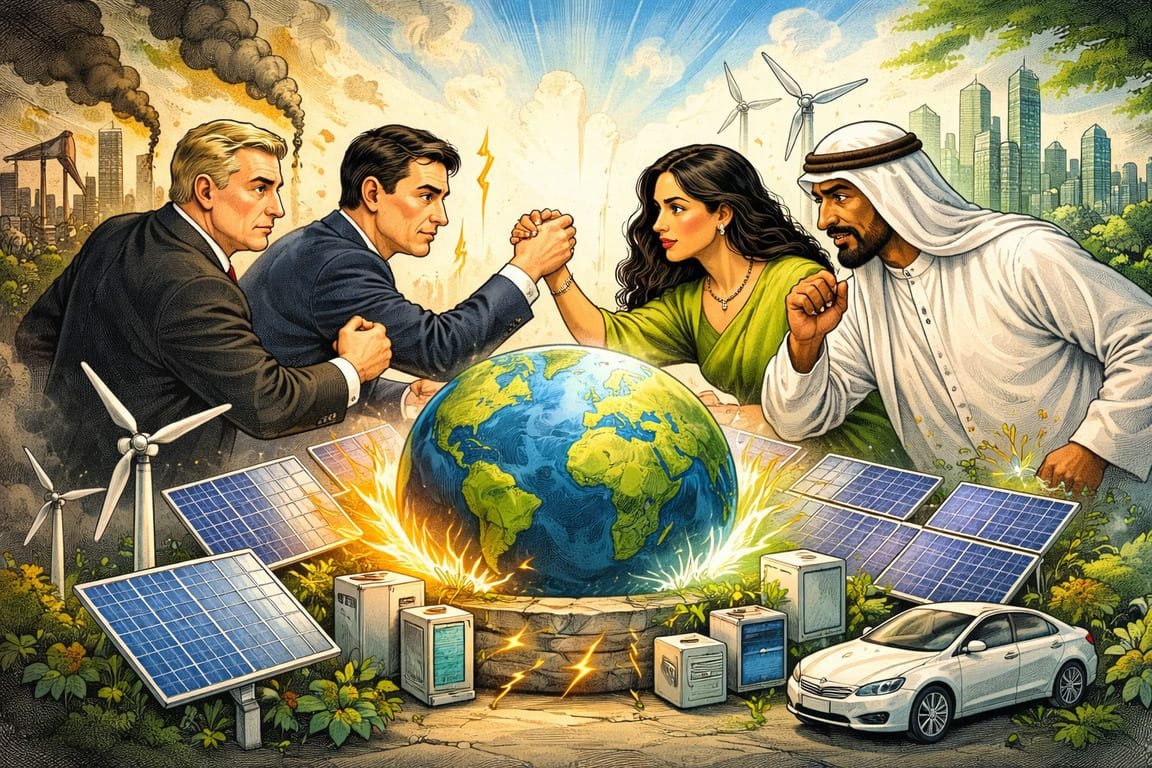
On a wind scoured plateau, turbines turn with disciplined calm. In a desert thousands of miles away, solar panels drink sunlight in flawless rows. Deep beneath the surface, miners extract minerals with surgical care. None of it looks like conflict. There are no headlines screaming confrontation. Yet this is a war unfolding quietly, one that will decide who shapes growth, security, and influence for generations. Clean energy is no longer just about climate. It is about who controls the architecture of the future.
Energy has always been power. For over a century, that power flowed through oil fields, pipelines, and shipping lanes. Nations rose and fell on access to fuel. Alliances hardened around supply. Clean energy disrupts that logic. Sunlight cannot be embargoed. Wind does not respect borders. The leverage now hides elsewhere, in manufacturing capacity, technology standards, and the materials that make transition possible. Control no longer comes from owning the resource. It comes from owning the system.
China grasped this shift early. While others argued over narratives, Beijing built factories, refined rare earth processing, and scaled battery ecosystems with relentless focus. Solar panels, electric vehicle components, and storage systems flowed outward from a deeply integrated industrial base. This was not coincidence. It was design. By dominating the middle of the value chain, China made itself unavoidable, even to competitors. Dependency formed quietly, wrapped in efficiency and affordability.
The United States responded later, but with urgency once the implications became clear. Clean energy transformed from an environmental aspiration into an industrial strategy. Domestic manufacturing returned to political vocabulary. Incentives replaced indifference. The transition gained a new justification, not just saving the planet, but securing economic relevance. Climate policy began to sound like national defense, because in many ways it now is.
Europe occupies a more fragile position. Ambition runs high. Execution struggles. Regulatory leadership shapes global norms, yet manufacturing depth remains uneven. Energy security concerns collide with decarbonization goals. Europe sets rules the world must follow, but too often relies on others to build what those rules demand. Influence through standards is powerful. It is not sufficient on its own.
Traditional energy powers sense the shift and hedge accordingly. Oil rich states invest aggressively in solar, hydrogen, and infrastructure. Some diversify cautiously. Others pivot with surprising speed. Clean energy threatens their core revenue, yet offers survival if embraced early. The paradox defines the era. Those who once slowed transition now race to control it.
Technology firms changed the emotional equation. Electric vehicles, smart grids, and energy storage became aspirational rather than sacrificial. Innovation reframed sustainability as performance. Software merged with hardware. Energy transformed into an ecosystem, not a commodity. Whoever controls platforms, data, and standards captures loyalty along with profit. This is not an environmental revolution alone. It is a cultural one.
Critical minerals add a sharper edge. Lithium, cobalt, nickel, and rare earths now carry strategic weight once reserved for oil. Mining regions become geopolitical assets. Environmental concerns collide with urgency. Communities resist extraction even as demand surges. The contradiction is uncomfortable. A cleaner future still requires deeper excavation. Managing that tension will define credibility in the years ahead.
Developing nations face the highest stakes. Clean energy offers resilience, decentralization, and opportunity to leap ahead. It also risks reproducing dependency if financing, technology, and ownership remain concentrated elsewhere. Without access on fair terms, the transition becomes extractive under a greener banner. The outcome depends not on ambition, but on inclusion.
Infrastructure determines who actually wins. Grids, storage, and transmission lines decide whether abundance becomes usable power. These investments lack glamour. They attract fewer headlines than breakthrough technologies. Yet without them, ambition stalls. Power in the clean era belongs to those who master systems rather than slogans.
Global coordination struggles to keep pace. Climate summits announce targets. Markets move regardless. Capital flows toward stability and return, not rhetoric. Governments chase investment while promising sustainability. The transition advances anyway, driven more by competition than consensus. Clean energy spreads because it increasingly makes economic sense, not because everyone agreed it should.
Inside a factory lit by artificial daylight, workers assemble components destined for distant grids. No flags hang on the walls. No speeches echo. Yet national futures are being shaped quietly, one shipment at a time. Clean energy is not a side story to geopolitics. It is the arena where power learned to disguise itself as progress.
And as turbines keep turning and panels absorb light with indifferent efficiency, one unsettling question lingers for those paying attention: when energy no longer runs through guarded pipelines but through contracts, patents, and supply chains, will the world recognize who truly won, or will dependence settle in so smoothly that resistance only begins after choice has already vanished?
