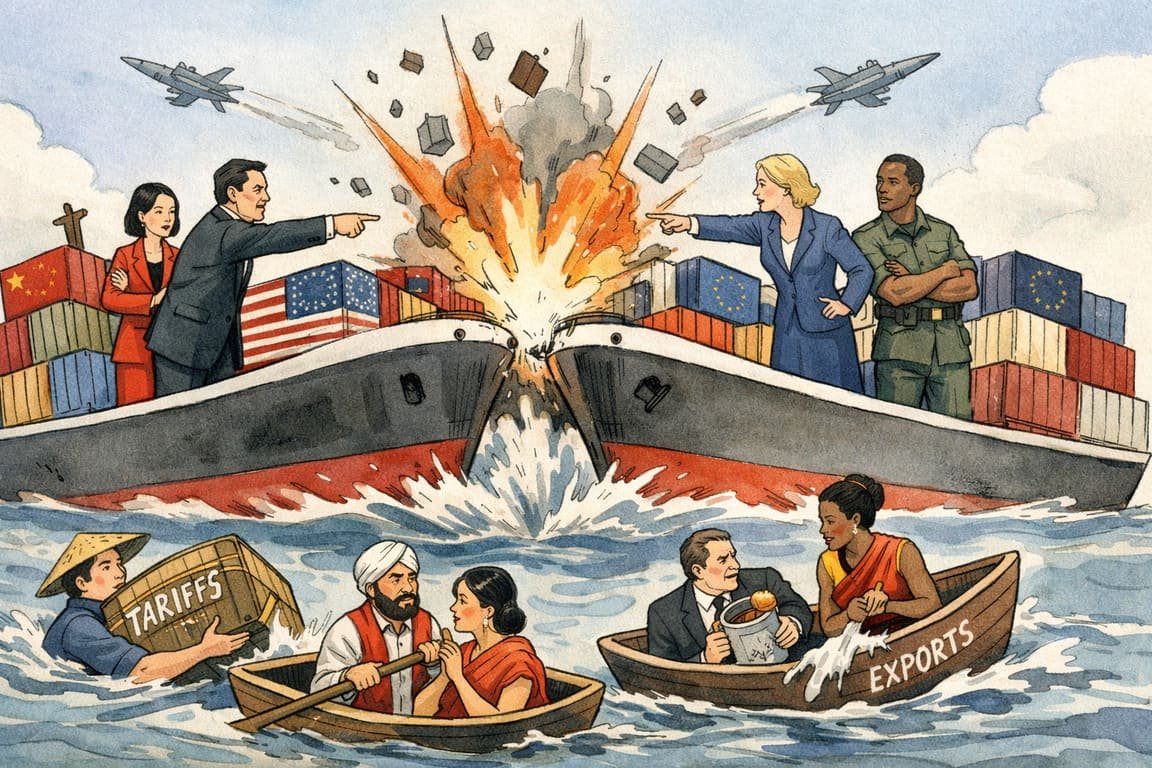
The port appears calm from a distance, cranes moving with mechanical patience, containers stacked in obedient rows. Yet beneath the routine hum, tension simmers. Ships wait longer. Paperwork thickens. Prices shift quietly before anyone announces why. Trade wars rarely begin with spectacle. They arrive through policy briefings and tariff schedules, carrying the emotional weight of national pride and economic fear. Exchange turns into suspicion long before conflict feels official.
For years, free trade enjoyed near-sacred status. It promised efficiency, lower prices, and mutual growth through interdependence. Supply chains stretched across continents, optimized for speed and cost. That system delivered abundance for many, but it also scattered pain unevenly. Entire industries vanished from some regions. Workers felt replaceable. Communities hollowed out while balance sheets thrived elsewhere. Protectionism returned as a response to that imbalance, framed as defense rather than retreat.
Political leaders speak of shielding domestic jobs and restoring fairness. The language resonates because it mirrors lived experience. When factories close and wages stagnate, abstract benefits of global efficiency feel distant. Tariffs offer a visible lever. They signal action. Yet trade barriers rarely stop at intention. They raise input costs, invite retaliation, and ripple through economies in unpredictable ways. What begins as protection often escalates into standoff.
A mid-sized manufacturer once built its business on components sourced globally to remain competitive. Overnight, new tariffs shattered that model. Contracts were renegotiated. Prices climbed. Workers faced reduced hours. The policy meant to defend employment destabilized it instead. Trade wars tend to wound the systems they claim to safeguard, even when motivations feel sincere.
National pride amplifies escalation. Concessions sound like weakness. Compromise risks political backlash. Leaders frame disputes as tests of resolve rather than shared problems to solve. Negotiation becomes performance for domestic audiences. Trust erodes behind the theater. Each side insists necessity while options narrow quietly.
History offers warnings that feel inconvenient. Past trade wars deepened downturns and magnified instability. Interdependence did not disappear. It fractured. Smuggling rose. Informal markets expanded. Extremism found fertile ground in economic anxiety. Modern economies differ in complexity, but human reactions to scarcity and humiliation remain consistent.
Global institutions strain under this pressure. Rules designed for cooperation falter when major players ignore them. Enforcement feels selective. Smaller nations maneuver cautiously, caught between giants. They diversify partners, absorb shocks, and adapt without meaningful influence over decisions that reshape their future. The system tilts toward power rather than principle.
Economically, protectionism reshapes strategy. Companies localize production to reduce exposure. Redundancy replaces efficiency. Costs rise slowly, then noticeably. Consumers feel the impact first, often without connecting higher prices to distant policy battles. Accountability weakens when cause and effect stretch across borders.
The philosophical tension runs deeper than tariffs. Sovereignty promises control. Interdependence promises resilience. Absolute autonomy proves illusory in a connected world. Unchecked openness breeds vulnerability. Framing the choice as binary fuels conflict rather than clarity. Balance demands humility, a trait scarce during nationalist surges.
Media coverage often reduces trade disputes to scorecards of winners and losers. Reality resists such clarity. Effects vary across sectors, regions, and time. Short-term gains mask long-term costs. Early victories get celebrated. Structural damage accumulates quietly, revealed only when rebuilding becomes unavoidable.
Technology complicates the battlefield further. Digital services cross borders invisibly. Data flows ignore customs checkpoints. Tariffs chase an economy that has already outgrown their reach. Protectionism aimed at physical goods struggles to regulate value increasingly created in code. The mismatch widens frustration.
Some diplomats push de-escalation through targeted agreements and confidence-building measures. Progress remains fragile. Domestic pressure punishes moderation. Yet without these efforts, escalation becomes default. Trade wars rarely conclude decisively. They fade into uneasy truces or morph into broader rivalries.
Late in the day, cranes resume motion as paperwork clears. Containers move again, slower and costlier than before. The system adapts, as it always does, but adaptation leaves scars. Trade wars do more than rearrange supply chains. They reshape trust, expectations, and cooperation itself. The question that lingers feels heavier than any tariff list: when protection becomes reflex, how long before collaboration starts to feel like an act of betrayal rather than survival?
