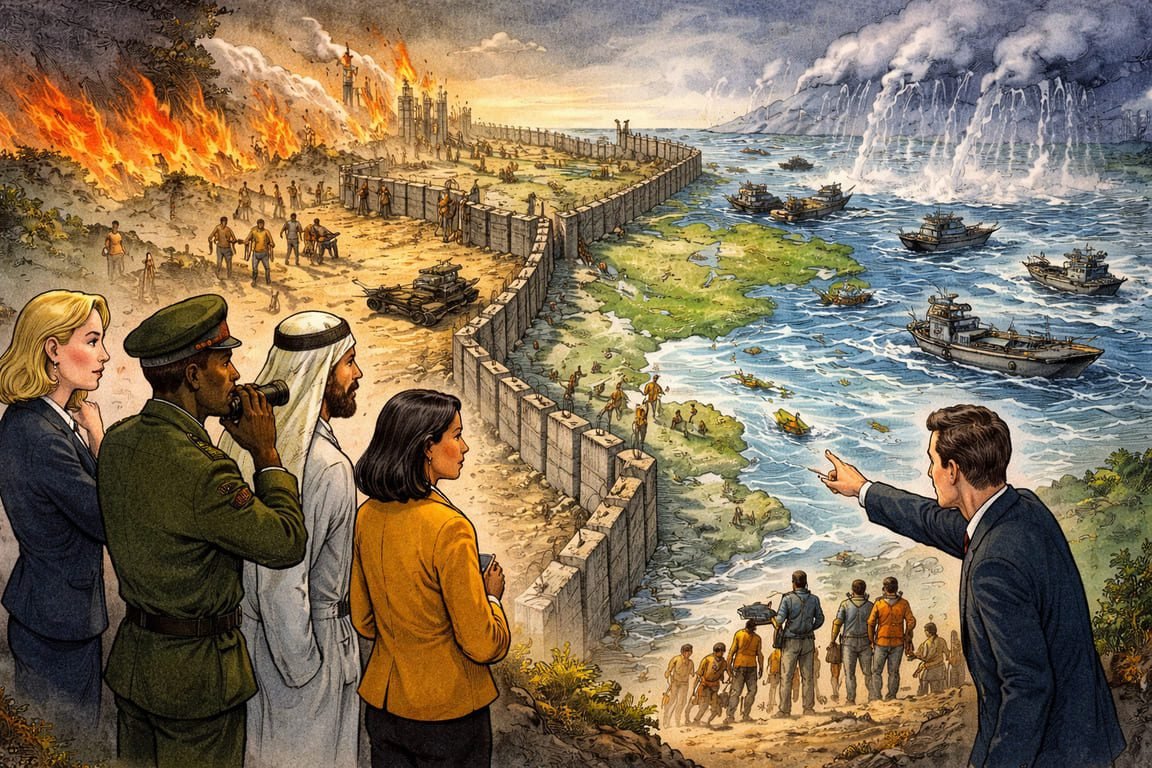
The checkpoint still exists on paper, a neat line etched into maps and guarded by protocol, but the land no longer agrees. The river that once justified the boundary has shifted, carving a new path through dust and debris. Fields nearby lie scorched or drowned, depending on the season. Officials stand where the border used to make sense, issuing statements while nature edits the terms. Climate disasters do not challenge authority with speeches. They simply move the ground beneath it.
For years, climate change was framed as an environmental issue, distant and technical. That framing softened its political edge. Now the edge is sharp. Floods erase neighborhoods. Fires redraw towns. Drought empties reservoirs and futures at the same time. These events force movement, and movement forces conflict. Borders, once treated as permanent, reveal themselves as temporary agreements with a planet that never signed them.
Scarcity sits at the center of this transformation. When water dries up and arable land shrinks, coexistence becomes fragile. Farmers compete with cities. Regions bargain against neighbors. Pastoral routes overlap. What begins as environmental stress turns social quickly. Political leaders often respond by fortifying boundaries rather than addressing causes. Walls feel decisive. Adaptation feels abstract. The result is security theater layered over ecological reality.
History has rehearsed this pattern before. Civilizations weakened when climate shifted faster than governance adapted. Drought hollowed economies. Floods undermined legitimacy. Today’s difference lies in speed and scale. Global supply chains amplify disruption. A failed harvest in one region ripples through markets elsewhere. Food prices spike. Unrest follows. Climate becomes a multiplier, not a backdrop.
A coastal town once rebuilt after a storm that locals called the worst in memory. Aid arrived. Homes rose again. Then another storm came, then another. Insurance withdrew. Families relocated inland, framed as temporary guests. Years passed. Children grew up away from the sea that shaped their parents. Property disputes emerged. Electoral districts shifted. Disaster made decisions politics avoided.
Internal displacement reshapes nations quietly. When millions move within borders, power balances change. Cities strain under sudden growth. Rural regions hollow out. Services lag. Political representation warps. Leaders frame newcomers as burdens rather than citizens displaced by shared fate. That language hardens divisions precisely when cooperation matters most.
Cross-border migration intensifies the tension further. People fleeing heat, floods, or failed harvests rarely qualify under refugee definitions built for war. Without status, they exist in limbo, vulnerable and politicized. Host countries debate morality against capacity. Sending countries lose human capital. Climate does not respect asylum law, yet its victims depend on it.
Military planners adapt faster than diplomats. Defense strategies now include climate risk, not from environmental concern but operational necessity. Bases flood. Training grounds burn. Arctic passages open, inviting competition. These preparations acknowledge what public discourse often avoids. Climate change reshapes strategic geography. Ignoring that reality does not prevent conflict. It invites surprise.
Philosophically, the moment exposes a contradiction. Borders are human constructs layered onto ecosystems that move constantly. Insisting on permanence in an impermanent world breeds friction. Yet abandoning borders entirely feels unrealistic. The challenge lies in flexibility without chaos. Shared resource management, regional cooperation, and adaptive governance offer paths forward, but require trust in short supply.
Media narratives often isolate disasters as singular tragedies. A fire here. A flood there. The connective tissue gets lost. Each event nudges the global order, stress-testing alliances and norms. When attention fades, urgency fades with it. Meanwhile, cumulative impact accelerates. The slow grind destabilizes more effectively than spectacle ever could.
Economics sharpen the pressure. Property values collapse in high-risk zones. Investment flees uncertainty. Insurance retreats. Governments face hard choices about what to protect and what to surrender. Declaring a place unviable feels like abandonment. Rebuilding repeatedly drains public trust. Every budget becomes a moral statement about whose land matters.
Technology offers prediction and early warning, but tools cannot negotiate peace. Satellites track drought. Models forecast displacement. They do not decide who moves first or who pays. Those decisions remain stubbornly human, entangled with history, pride, and fear. Climate wars ignite when those emotions collide under stress.
Some leaders attempt cooperation through shared water treaties, joint disaster response, and climate migration frameworks. These efforts rarely dominate headlines, yet they matter. They suggest borders need not harden in response to pressure. They can evolve. The problem is tempo. Progress inches forward while climate sprints ahead.
At dusk, smoke from distant fires stains the sky an unfamiliar color. The horizon blurs, not from fog but from ash. Somewhere beyond that haze, lines on a map insist on relevance. Climate will keep testing those lines, pushing with wind, water, and heat. The question is no longer whether borders will change. They already are. What remains unsettled is whether those changes will be shaped by foresight and cooperation, or left to disaster to decide who belongs where.
