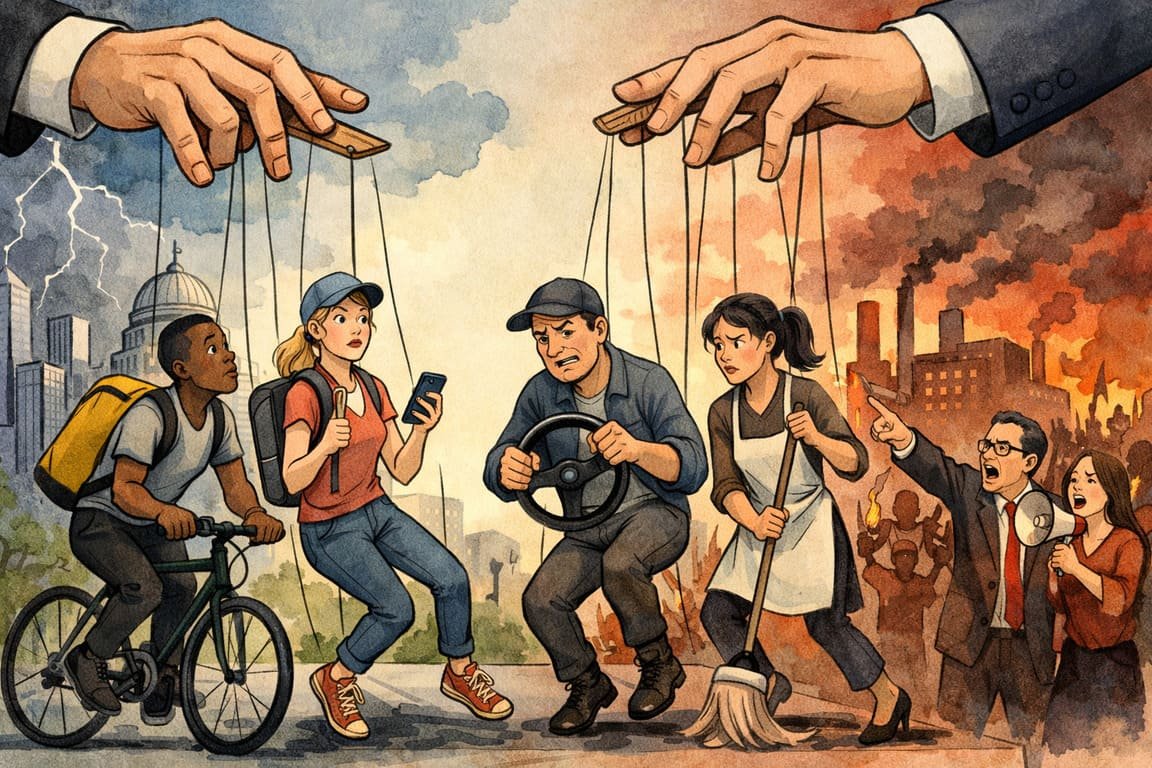
The phone vibrates softly on a kitchen counter, a polite sound that carries far more weight than it should. A job offer appears, framed as opportunity, urgency baked into the countdown clock. Someone taps accept without hesitation, not out of greed, but out of necessity. Across cities and suburbs, bedrooms and back seats, this moment repeats endlessly. The gig economy does not announce itself as a system of power. It slips into daily life disguised as convenience, then quietly rewrites the rules of work.
The original promise felt almost radical in its simplicity. Work when it suits you. Choose your hours. Escape bosses, cubicles, and rigid schedules. For parents juggling school pickups, students balancing tuition, and migrants navigating closed doors, this flexibility felt like dignity. Platforms spoke the language of empowerment fluently. Yet beneath that language sat contracts few understood and algorithms no one could see. Freedom existed, but it arrived bundled with volatility that was never clearly priced in.
What followed was not exploitation in the traditional sense. It was something more subtle. Pay structures changed without warning. Bonuses appeared, then vanished. Ratings became lifelines. Workers learned to chase incentives rather than plan lives. A driver could earn well one week and struggle the next, with no explanation beyond a cheerful update notification. Instability became normalized, reframed as hustle rather than hazard.
Political institutions watched this unfold from a distance, unsure how to react. Innovation moved faster than regulation. Lawmakers praised disruption while avoiding classification battles that felt messy and divisive. Were gig workers independent contractors or employees stripped of protections. The question lingered, unresolved, because answering it carried consequences. Delay served platforms well. Ambiguity shifted risk downward while profits scaled upward.
A courier once described checking an app after a long shift only to discover a deactivation notice. No appeal process. No human conversation. Just a sentence thanking them for participation. The shock felt disproportionate, not because the work was glamorous, but because it had become essential. Digital systems had gained the power to exile people from income with the tap of a button. That asymmetry changed how work felt at a fundamental level.
Platforms defend themselves with familiar arguments. Participation is voluntary. Workers can log off anytime. Competition ensures fairness. Each claim holds a sliver of truth, yet misses context. When rent depends on access and access depends on opaque metrics, choice becomes constrained. Independence exists on paper while dependence grows in practice. The language of entrepreneurship masks a reality closer to piecework.
Public anger began to surface as stories aligned. Drivers shared screenshots. Freelancers compared rates. Patterns emerged that individual experience had obscured. This collective awareness transformed private frustration into political pressure. Lawsuits followed. Ballot initiatives appeared. Protests formed outside offices built to feel invisible. The storm did not erupt suddenly. It gathered momentum through recognition.
Governments responded unevenly. Some regions pushed for minimum standards, transparency, and benefit portability. Others competed for tech investment by loosening rules further. This patchwork deepened confusion. A worker crossing a city line could gain protections or lose them instantly. The inconsistency revealed a deeper struggle over the future of labor itself.
The philosophical tension cuts deeper than classification debates. Work has long been tied to identity and social belonging. Stable employment promised predictability and protection in exchange for loyalty. The gig economy broke that contract unilaterally, offering flexibility instead of security. Many accepted the trade unknowingly. Reversing course now feels harder because lives have reorganized around uncertainty.
Consumers complicate the picture. Convenience feels irresistible. Fast delivery, cheap rides, instant services all rely on invisible labor absorbing risk. Ethical discomfort fades quickly when friction disappears. Platforms thrive on this disconnect. Responsibility diffuses until no single choice feels consequential. Politics struggles when accountability dissolves this way.
Technology itself remains neutral only in theory. Design shapes behavior. Incentives steer effort. When algorithms reward speed over safety or availability over rest, outcomes follow predictably. These are not accidents. They are decisions embedded in code, shielded from scrutiny by complexity and scale.
The economic impact stretches outward. Traditional employers feel pressure to casualize work. Wages stagnate. Benefits erode. What began as an alternative model threatens to become the default. When precarity scales, it stops feeling temporary. It reshapes expectations across entire industries.
Some reformers propose portable benefits detached from employers. Others argue for platform cooperatives owned by workers themselves. These ideas gain traction because they acknowledge reality rather than denying it. They accept flexibility while demanding fairness. Progress remains slow, resisted by interests comfortable with the status quo.
Late at night, another notification buzzes, another decision made in seconds with consequences measured in weeks. The gig economy did not invent exploitation, but it perfected its camouflage. The political storm surrounding it is not about nostalgia for old jobs. It is about dignity in new ones. And as more people realize how quietly the rules shifted, the question grows harder to ignore: when work becomes an app, who truly carries the risk, and who has been pretending not to notice?
