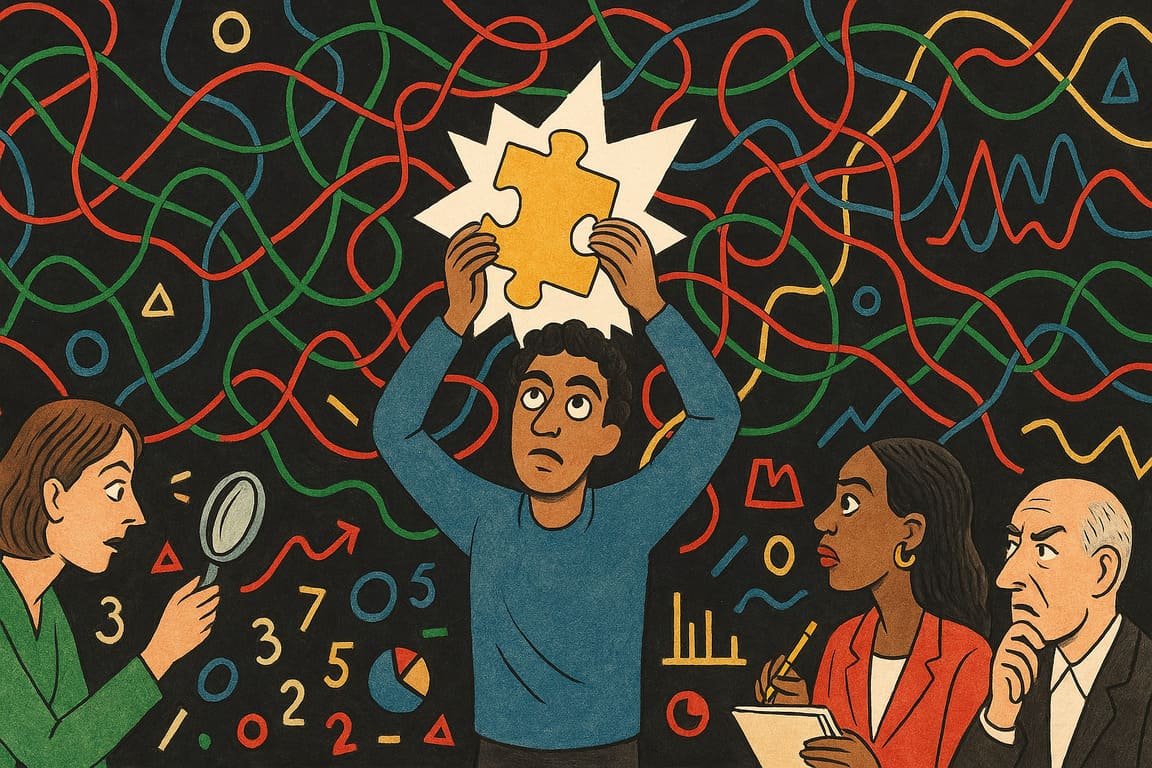
A midnight rain patters against the steel frame of a half-lit analytics lab, where a cluster of screens flickers with tangled graphs and cryptic strings. The hum of machines mixes with the soft thud of sneakers pacing back and forth. Chaos isn’t just present—it’s the oxygen. Among the clutter, a pattern hunter waits, eyes wide, pulse quick. Somewhere inside the noise, meaning hides. Every curve and anomaly on those screens is a breadcrumb, a dare to see what no one else does.
The world spins on invisible patterns. From the rise and fall of stock prices to the wild surges of social media trends, data is the heartbeat of modern ambition. But only a few possess the patience and vision to connect the dots. Consider Ada, a junior analyst at a shipping startup, who noticed a tiny spike in delayed orders each time the local soccer team lost. Her wild theory became a breakthrough: bad moods after losses led to canceled late-night shipments. A pattern, buried in noise, changed a company’s strategy overnight.
Pattern recognition isn’t about guesswork. It’s a skill, sharpened by skepticism, honed by failure. The human brain is wired for story, always searching for rhythm, repetition, a narrative arc. Yet in business, the difference between superstition and strategy comes down to proof. Anyone can imagine a connection; true pattern recognition demands evidence.
The stories of great discoverers are stories of pattern hunters. In Silicon Valley’s golden age, a programmer named Raj observed bursts of customer complaints just before software updates. He convinced his team to track user sentiment in real time. Soon, product launches smoothed out, and Raj became a legend—a reminder that even chaos leaves fingerprints.
You stand in a world where information bombards you, urgent and relentless. Marketing, medicine, politics, and sports all depend on finding the story within the static. In epidemiology, tracing the spread of a disease is pure pattern recognition—a game of cat and mouse played in spreadsheets and cell cultures. John Snow, the father of modern epidemiology, mapped cholera outbreaks with hand-drawn dots, proving water, not air, was the culprit. His pattern, though simple, saved thousands.
Every great company has a secret: the best innovations are born from overlooked details. Netflix’s early engineers mapped user watch habits, discovering odd peaks on Mondays. Turns out, users binged over the weekend, then recommended shows to coworkers. A single weekly spike revealed the viral magic behind word-of-mouth.
You don’t need a PhD to be a pattern detective. Curiosity is your superpower. The coffee shop manager who realizes rainy days mean more pastry sales, or the gym owner who tracks early morning attendance to optimize class schedules—these are everyday visionaries, seeing order in disorder.
Sometimes, the quest for patterns becomes obsession. There’s danger in chasing ghosts, in seeing what isn’t there. Remember the financial crisis of 2008? Banks believed they’d mastered risk by tracking patterns in housing prices. When the pattern broke, the world reeled. True mastery means questioning even your own insights.
Tech giants pour billions into algorithms that automate pattern recognition, but human intuition still leads the way. A fictional story: in a chaotic warehouse, an employee named Bea noticed misplaced barcodes always happened after lunch. Her observation led to an ergonomic shift and a sharp drop in errors. The lesson? Machines process, but people perceive.
Pattern recognition is as much art as science. The jazz musician riffing on a melody, the chess grandmaster sensing a mate ten moves ahead, the marketing team pivoting after a viral meme—each sees beyond the moment, drawing on experience, imagination, and guts.
Sometimes, what looks like chaos is really a new pattern waiting to be born. Creative leaps happen when you step back, zoom out, and ask the simplest questions: What repeats? What breaks the rule? What if the obvious is just camouflage for something deeper?
The most valuable insight you’ll ever find is often the least expected. A bakery that noticed scone sales doubled on days with live music, a hospital that cracked infection clusters by mapping shift changes, a sales team that linked conversion dips to changes in playlist tempo—these small victories are the real magic of pattern recognition.
Rain rattles on the lab’s skylight, each droplet a fragment of possibility. Amid the mess, a single pattern crystallizes—a line of symmetry inside the storm. Somewhere, a lone observer smiles, knowing the next big shift has already begun, hidden in plain sight.
You hold the keys to chaos and clarity. Will you search for meaning, or let the noise win?
