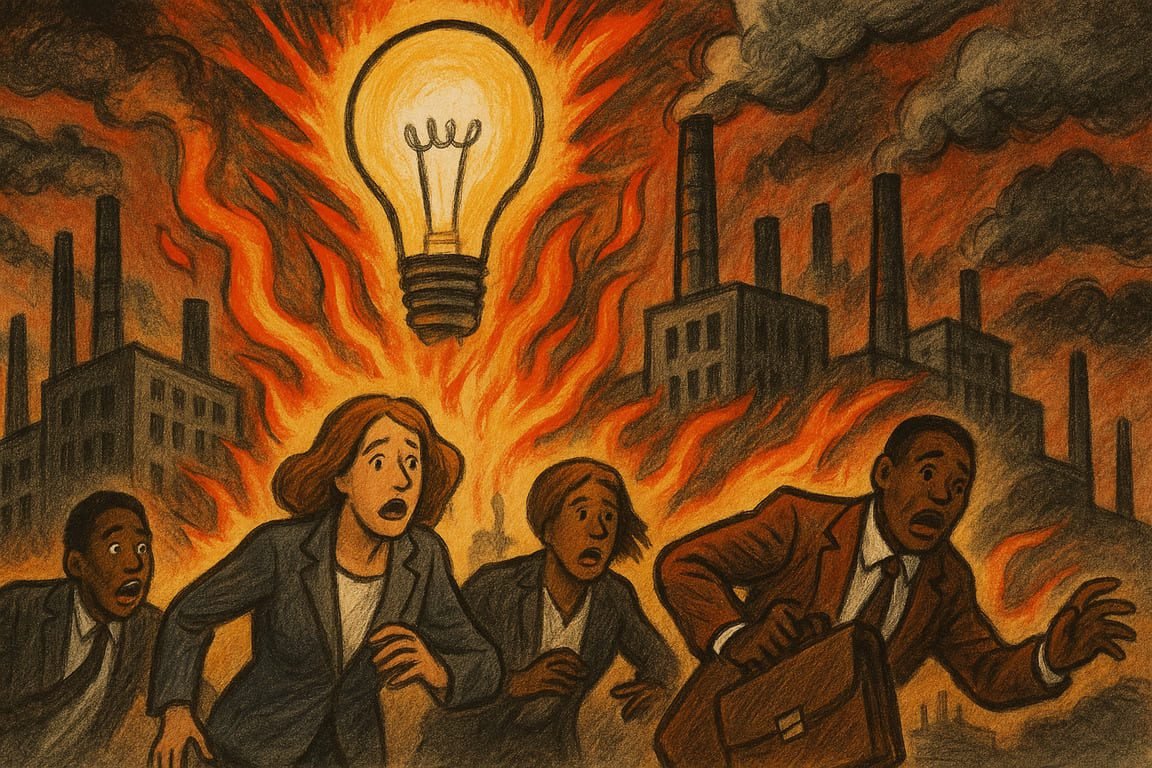
Night falls over a city shaped by smokestacks and glass. Skyscrapers shimmer, but the hum on the streets feels nervous, not celebratory. In the neon glow, a factory manager stands at a window, watching silent robots slide down the assembly line where old friends once swapped stories over coffee breaks. On the edge of town, a tech founder in a hoodie finishes a pitch deck that will dismantle what the skyline represents. Across the world, the pillars of whole industries begin to tremble. There is no fire, no siren—just a quiet, irreversible shift. Disruption never announces itself. It’s the sound of an old world dissolving.
Every industry thinks it’s immune to apocalypse—until it isn’t. Disruptive innovation doesn’t send advance warnings or stick to predictable patterns. It starts with a product dismissed as a toy, a business model laughed off as naive, a startup whose founders get shown the door by every major investor. Then, suddenly, the ground moves. The taxi business slept through Uber’s arrival. Hotels scoffed at the idea of Airbnb. Retail giants shrugged off e-commerce. Blockbuster laughed off Netflix until laughter turned into bankruptcy papers and “for lease” signs. The apocalypse isn’t noisy. It creeps in, then dominates.
You might feel safe today. Your sector feels stable, your customer loyal, your competitors predictable. That’s what makes disruption so brutal. It feeds on complacency. It loves the phrase, “That would never work here.” When new ideas emerge, your first instinct is to ignore them, to bet on the status quo. History proves this instinct is lethal. Companies that survived were the ones who noticed the tremors early and had the courage to cannibalize their own profits before someone else did. Fear of change is the enemy. Curiosity is the shield.
Research is your only reliable compass in this apocalypse. Look past quarterly reports and into the fringe. The future rarely arrives at the front door—it sneaks through the cracks. Insiders at Kodak saw the digital camera years before it ruined film, but research wasn’t taken seriously. In contrast, Apple’s team didn’t invent the smartphone, but their relentless curiosity and market testing showed how people wanted to live. That’s the difference: research that asks real questions, and leadership willing to hear uncomfortable answers.
Mini-case stories fill this new era. In Detroit, an auto engineer named Lisa Chen saw the writing on the wall when ride-sharing apps started devouring car sales. Instead of clinging to the old model, she convinced her company to invest in electric fleet vehicles and mobility-as-a-service. Colleagues called her idea risky, even desperate. Years later, her division leads the company’s growth, proving that betting on apocalypse can be the safest move of all.
Disruption isn’t just a Silicon Valley sport. In Bangalore, a tiny logistics firm built an AI-powered route system, cutting delivery times and upending giants in the field. They didn’t have the most capital, but they had relentless research—obsessively mapping customer pain points and field-testing new solutions. When the pandemic arrived, their nimble system became a lifeline for essential goods. Legacy players struggled to adapt. The “apocalypse” wasn’t destruction—it was an invitation for the prepared.
Whole professions vanish overnight, replaced by jobs that didn’t exist five years ago. This isn’t a tragedy—it’s a reset. The printing press killed scribes and birthed publishers. Streaming decimated video stores and made room for a million YouTube creators. Your industry’s end is always someone else’s beginning. If you’re the one watching jobs disappear, it feels like an ending. But look closer and you’ll find seeds of new opportunity in the ashes.
Disruption exposes every assumption. Do you know what your customers really want, or just what they wanted last year? Is your business built for resilience or routine? True research means living at the edge—interviewing dissatisfied customers, shadowing startups, listening to unlikely voices. Airbnb was born from two designers renting out air mattresses to make rent. Tesla survived years of mockery before old automakers raced to catch up. The apocalypse rewards those who dare to imagine the opposite of what everyone else expects.
Disruption is also deeply human. Workers lose jobs, families face uncertainty, communities must adapt. The companies that last do more than pivot—they support the people in their orbit. In Denmark, a legacy shipping firm faced extinction as digital logistics upended global trade. Instead of mass layoffs, leaders invested in retraining, offering coders’ bootcamps and innovation labs. Employees once destined for redundancy now lead new ventures within the firm, proof that apocalypse can be a rebirth, not just a collapse.
At its core, disruption is not a story of destruction. It’s the ongoing evolution of need, powered by people who see what’s next. Every industry apocalypse is a test. Will you cling to comfort, or become the spark for something new? The companies that win are not those with the deepest pockets, but those with the deepest curiosity—and the will to listen to what their own research reveals.
The final lesson: there is no such thing as a safe industry, only safe mindsets. Today’s giant is tomorrow’s footnote. Tomorrow’s disruptor is already out there, quietly rewriting the rules you rely on. Whether you see this as threat or invitation is the difference between extinction and evolution.
A city’s skyline glows in the blue light before sunrise, cranes silhouetted against new construction where factories once fell silent. A lone architect stands on a rooftop, blueprint rolled beneath her arm, watching as delivery drones buzz overhead and electric taxis idle at the curb. In the shifting air, yesterday’s rules crumble, replaced by a wild sense of possibility. The old world is gone, but in its place, new dreams flicker—raw, uncertain, alive.
There’s only one question left for you: Will you let the future disrupt you, or will you be the disruption everyone else fears?
